
Home › Squirrel Control
Lofts · Rooflines · Proofing
Squirrel Control
Getting them out solves this month. Closing the roofline solves it properly — and there is a legal position worth knowing before you book anyone.
Is it squirrels
The Question That Answers Itself
Before anything else: when do you hear it?
Squirrels work through the daylight hours, heaviest early morning and again late afternoon, and they are asleep overnight. Rodents run on the opposite clock. So a disturbance that starts at first light and dies away after dark points at a squirrel, and one that begins when you turn the lights off does not.
The second check is weight. A squirrel sounds heavy and energetic — bounding, rolling, sometimes a distinct thump, and people routinely describe it as sounding far too big for the space. A rat sounds like something walking. A mouse sounds like something light being dragged.
Getting this right before anyone attends matters, because a squirrel job and a rodent job are not the same work: one is about the roofline and ladders, the other is about floor level and bait. There is a fuller walk-through of the evidence, and of how to separate squirrel sign from rat and mouse sign, in how to identify the signs of squirrel damage.
The law
A Trapped Grey Squirrel Cannot Be Released
This needs saying plainly and early, because most people assume the job is catch-and-relocate, and it cannot be.
The grey squirrel is a non-native species listed on Schedule 9 of the Wildlife and Countryside Act 1981. Under section 14 of that Act it is an offence to release one into the wild, or to allow one to escape, other than under a licence — and licences are not handed out for moving a nuisance squirrel to a wood down the road. A grey squirrel that has been caught must therefore be dispatched.
It must also be done humanely. The Wild Mammals (Protection) Act 1996 makes it an offence to cause a wild mammal unnecessary suffering, and that governs how the work is carried out from the moment an animal is caught.
Two practical consequences. If a firm offers to catch your squirrels and let them go somewhere else, they are describing something that is not lawful. And traps have to be checked frequently — at least daily — for the same welfare reason, which is part of why this is not a single-visit job.
We would rather you knew that before booking than found out when a trap has something in it. It is a reasonable thing to feel strongly about, and there is a fuller account in grey squirrels and the law.
Why it matters
Wiring, Insulation and Water
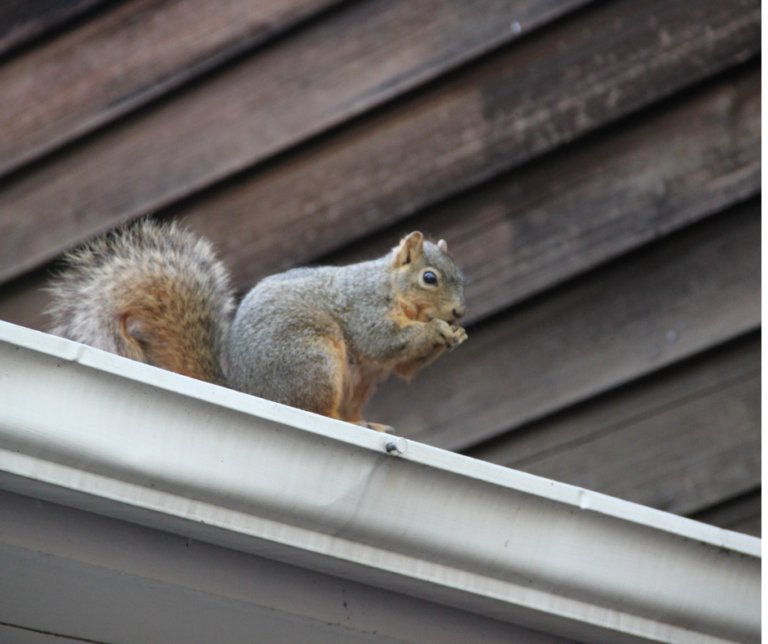
The noise is what you notice. The reason to act is the wiring.
Squirrels have continuously growing incisors and gnaw to manage them, which is why cable sheathing, plastic pipe and structural timber all get chewed whether or not the animal wants to eat them. Bare conductors in a loft full of insulation and drey material is a genuine fire risk, and it is the single best reason not to leave this until the spring.
Beyond that: insulation gets flattened, fouled and dragged into a drey, which costs you heating and has to be replaced; plastic water pipe gets chewed, which is how a squirrel problem becomes a ceiling collapse; and a cold water tank in the loft is a real problem if something drowns in it.
The live page puts it the same way — damage to insulation, woodwork and wiring, and a potential fire hazard. That is not salesmanship. It is the part of this that costs real money.
Photographs on this page are for illustration purposes only.
What we do
Inspect, Deal With It, Then Close the Roof
The work runs in that order and the last part is the one that matters.
Inspection. The roofline from outside, usually from a ladder or from above, and the loft from inside. What we are looking for is how they are getting in, what is up there now, and whether there are dependent young. On a two-storey house this is the longest part of the visit and it determines everything else.
Removal. Trapping over a period, with frequent checks, carried out in line with the legal position set out above.
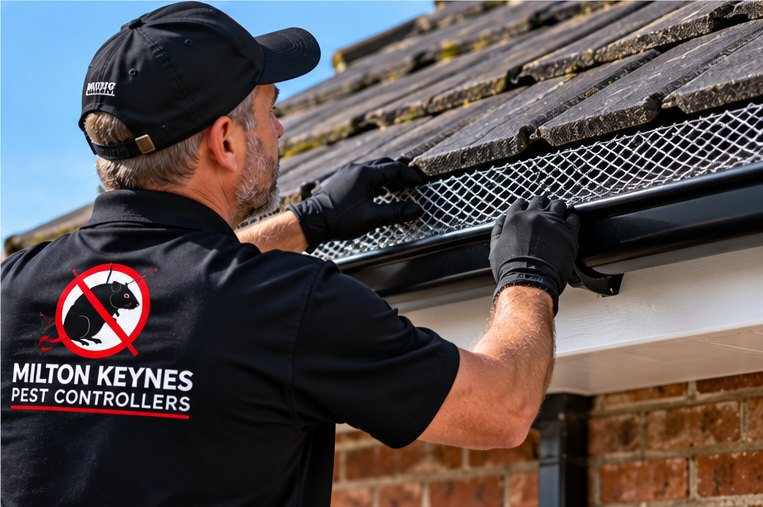
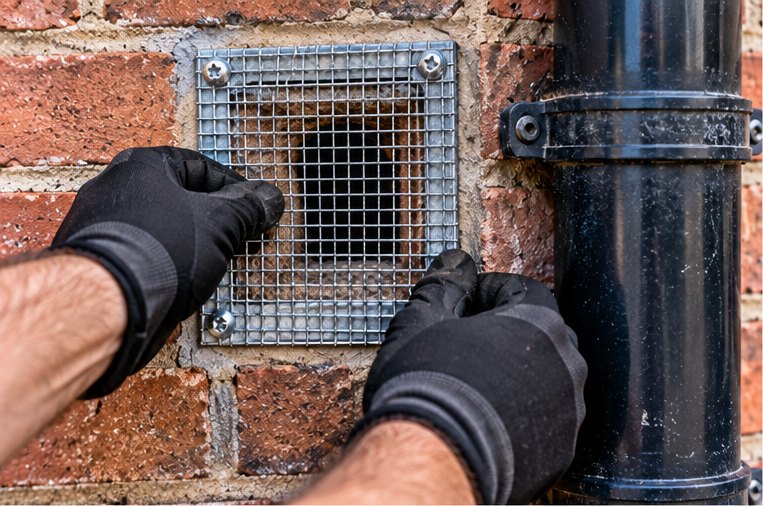
Proofing. Closing the way in, which is almost always the largest part of the job and easily the most valuable. Roofline openings are specific, findable and much the same from house to house — these eight account for nearly all of them.
- The soffit-to-wall junction. Where the soffit board meets the brickwork. Often a gap by design, and the commonest single way in on a modern house.
- Where a lower roof meets the wall. Garage, porch, extension or conservatory. A generous gap, out of sight from the ground, and easy to reach from the lower roof.
- A plastic roof or tile vent. Gnawed straight through. Replaced with a metal-guarded vent rather than patched.
- A loose dry-verge cap. Once a cap lifts, the end of the tile batten is open along the whole gable.
- A rotten bargeboard or fascia end. Usually below a gutter that has been overflowing for years. Mesh will not hold on soft timber, so the board is replaced first.
- A lifted or slipped verge tile. The verge is the most exposed edge of a roof and the first place tiles move.
- Lifted lead flashing at the chimney. Flashing that has come away leaves a gap straight into the roof void beside the stack.
- A loose ridge tile. Where the mortar has gone. Visible from the ground with binoculars, and often the oldest fault on the roof.
Almost every one of those is at or above eaves level and most are invisible from the ground, which is why the survey involves a ladder rather than a look from the drive.
Clearing up. Drey material out, fouled insulation lifted and replaced, and an electrician involved where cable has been chewed — that last one is not a pest control job and we will say so.
You will have a fixed-price quote for the whole of it before anything starts, and there is no call-out charge for the visit that produces it.
Squirrel work here carries a guarantee with follow-up support if it is needed. Ask what the wording covers when you book.
Photographs on this page are for illustration purposes only.
The timing
There Are Two Periods to Be Careful About
There are two litters a year here, the first arriving towards the end of winter and the second in the middle of summer. Take the mother out while a litter is still dependent on her and the litter dies where nobody can reach it — which is a welfare failure first, and then several weeks of smell coming through a bedroom ceiling.
So a survey checks for it before anything starts, and it may mean the approach changes or the timing shifts slightly. If nobody raises that with you at all, that is worth noticing about whoever you are talking to.
The other timing point is simpler: the longer it runs, the more the clearing up costs. A fortnight is noise. Three months is insulation, cable and a drey.
On what drives the figure — the number of animals, the number of openings, the height and complexity of the roof, and how much clearing up there is — there is a longer piece on what squirrel control costs and why.
What you can do
Two Things Worth Doing Yourself
Cut back overhanging branches. Squirrels reach a roof by jumping, and a limb within a couple of metres of the roofline is the usual route. Cutting it back is frequently the cheapest single intervention available and it removes the access rather than the animal.
Move bird feeding away from the house, and use feeders they cannot empty. Feeding birds is worth doing; feeding squirrels next to your soffit is not.
And one thing not to do: do not seal the hole yet. Closing the entrance with something still inside leaves an animal shut in your roof, and in the breeding season it can shut dependent young in with no adult. Find out what is in there, deal with it, then close up behind it — in that order.
Photographs on this page are for illustration purposes only.
Going further
Squirrel Guides
Short answers
Squirrel Questions
Will you take them away and let them go?
That is not something anyone can lawfully offer. The grey squirrel sits on Schedule 9 of the Wildlife and Countryside Act 1981, which makes putting one back into the wild an offence except under a licence that is not granted for nuisance work. So a caught animal is dispatched, and humanely, under the Wild Mammals (Protection) Act 1996.
Could this be rats instead?
Listen to the clock rather than the noise. Overnight activity is rodent. Daylight activity, heaviest at either end of the day, is squirrel. Weight is the second clue - a squirrel sounds far heavier than the space ought to allow.
Is it one visit?
No. Trapping runs over a period with frequent checks on welfare grounds, and the proofing is separate work again.
Do I have to have the proofing done?
You do not have to, but without it you are buying a pause rather than a solution. They come back to places they have used, and they are strong enough to widen a gap that was almost big enough.
Does the time of year change anything?
It can change the method. Between late winter and early spring, and again in midsummer, there may be a dependent litter in the roof, and that has to be established before anything is set.
What does it cost?
You get a fixed-price quote for your situation, upfront and with no hidden fees, and it is agreed before any work starts. The figure depends on the building rather than the animal, and there is no call-out fee for coming to look.
Is it worth cutting the branches back?
Usually it is the best value thing available to you. They arrive by jumping, so clear air between the tree and the roofline removes the route rather than arguing with it.
Can I seal the hole up myself?
Not before you know the roof is empty. Closing the way out traps an animal that will then chew its way through something more expensive, and in spring or summer it can shut a litter in with no mother.
Should I worry about the cable up there?
Yes, and it is the main reason not to let this run on. Gnawed sheathing leaves a live conductor sitting in loose insulation and dry drey material. Get an electrician to look at it - that part is outside what a pest controller can do.
Do you treat commercial buildings?
Yes. Roof voids in commercial and institutional buildings are the same problem at a larger scale, and the roofline work is the same.
Where we cover
Squirrel Control Across the Area
Across Buckinghamshire, Bedfordshire and into Hertfordshire. Houses, bungalows, flats, commercial roof voids and listed buildings.
Hearing Something Overhead?
Tell us what time of day you hear it — that one answer names the animal. No call-out fee for coming to look.
One Last Thing
If you are hearing something and you are not sure what it is, the time of day answers it before anyone comes out. If it is daytime, ring and describe where on the roof you have seen anything — there is no call-out fee for coming to look, and the roofline usually tells us more than the loft does.
Get in touch
Book an Ant Treatment
Tell us when you hear them, whether it is daytime or night, and whether you have seen anything on the roof. Those two answers name the animal.
- Phone
- 01908 465226
- Message us on WhatsApp
- sales@miltonkeynespestcontroller.co.uk
- Milton Keynes Pest Controller Service
- Address
- South Row
Milton Keynes
MK9 3DQ - Covering
- Milton Keynes, Buckinghamshire, Bedfordshire and parts of Hertfordshire