
Rats: the Short Version
Rats are the pest people most want gone the same day, and the one where getting rid of them properly takes more than a same-day visit. Both of those things are true at once, and the rest of this page is really about the gap between them.
We treat rats in houses, flats, lofts, gardens, drains, commercial kitchens and business premises across Milton Keynes and the surrounding towns. Same-day appointments are available, including evenings and weekends, at no extra cost, and there is no call-out fee.
What matters more is the second half of the job. A rat problem is a building problem as much as a pest problem: something has a hole in it, or a drain has failed, and until that is found and closed the rats keep coming back to the same address with a different set of individuals.
Ring 01908 465226.
Lofts, cavities, under floors, kitchens, gardens and sheds.
Kitchens, food premises, warehousing, retail and offices.
Finding the way in and closing it, which is the part that actually ends it.
Including evenings and weekends, at no extra cost, with no call-out fee.
Signs
How You Know It Is Rats and Not Mice
The two get mixed up constantly, and it matters because the treatment is different.
Rat droppings are 12–18mm long — about the size of a raisin or a small olive stone — dark and tapered, and you tend to find them in runs — a line of them along a joist, a beam or the back of a cupboard. Mouse droppings are 3–6mm, much more scattered, and about the size of a grain of uncooked rice.
Rats are also heavier. What people describe as heavy movement overhead, thumping rather than scurrying, or a sound like something rolling across the ceiling, is usually a rat. So is gnawing you can hear from another room.
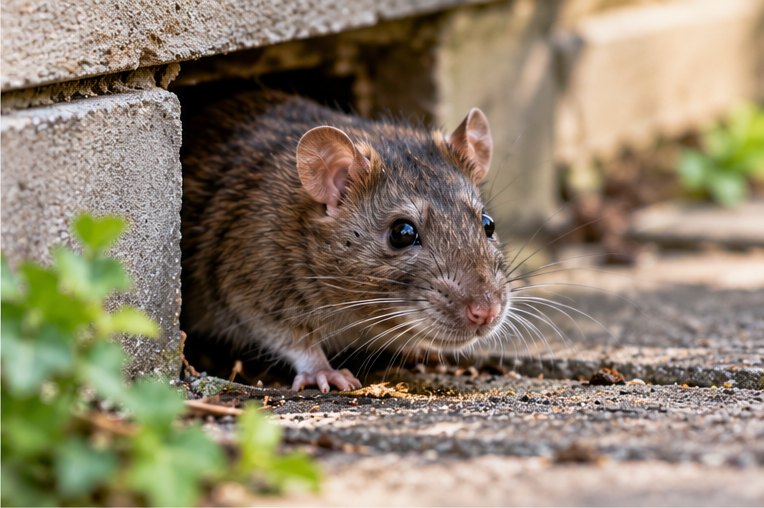
Outside, rats leave smears along regular routes where the oil in their coat rubs onto brick and pipework, burrow entrances about the width of a tennis ball near cover, and runs pressed flat through long grass.

Getting in
How Rats Get Into a Building
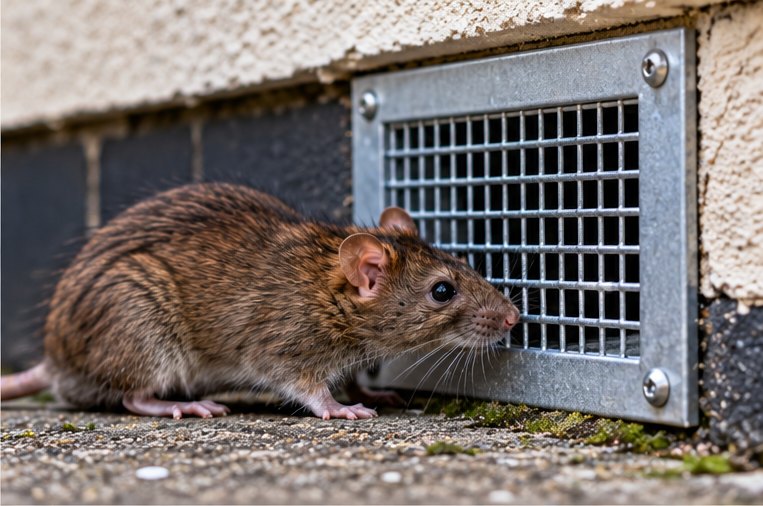
A rat needs a surprisingly small opening. If it can get its head through, the rest follows — a gap about the width of your thumb is enough for a young one.
The usual ways in, in roughly the order we find them:
- Defective or disused drains, which is the single most common cause we find in older housing
- Gaps where service pipes and cables pass through external walls
- Airbricks with broken or missing grilles
- Open soil and vent pipe ends
- Gaps at the roofline, under the eaves and at the gutter
- Damaged or rotten timber at ground level, and gnawed door bottoms
- Cavity walls with an open route from the ground into the roof space
- Garage and shed doors that no longer meet the floor
The drain one is worth dwelling on, because it explains the cases that make no sense otherwise: a modern, well-kept house with no visible gaps and rats in the kitchen. If a drain run has cracked or an old connection was capped badly, the rats are already inside the building envelope before they ever reach a wall.
The treatment
What We Actually Do
The first visit is an inspection as much as a treatment. We look for the droppings and the runs, follow them back, check the likely entry points, and look at the drainage where there is reason to.
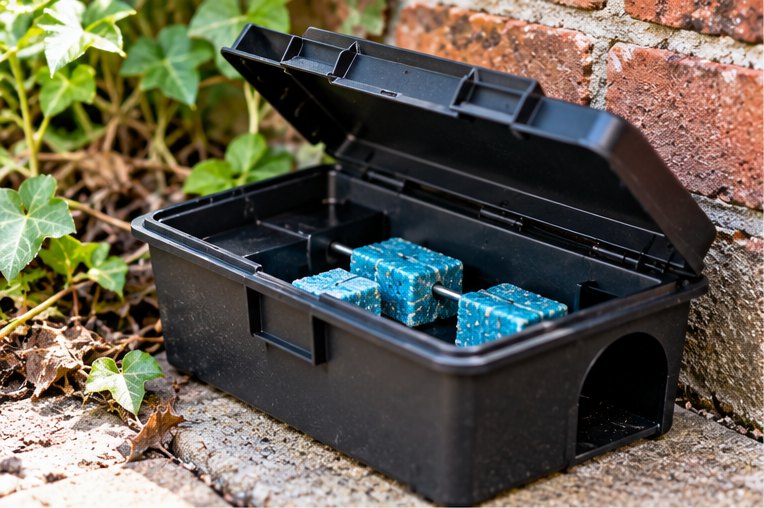
Where baiting is appropriate it goes into lockable stations, secured in place, positioned on the runs rather than scattered where it might be found by something else. Where it is not appropriate — and in some settings it is not — there are trapping and proofing routes instead.
Then we come back. Rat work is not a one-visit job, and anybody telling you otherwise is selling you a visit rather than a result.

Why it takes time
Why One Visit Rarely Finishes It
There is a specific reason, and it is worth knowing because it explains the timescale.
Rats are neophobic — wary of anything new in an environment they know. Put a bait station on a run and the rats will often avoid it for several days simply because it was not there yesterday. They will edge around it, then investigate it, then eventually use it. Mice barely do this. Rats do it strongly.
So the pattern of a rat job is a visit to inspect and set up, a gap, and then return visits to check take-up and replenish. Activity often looks unchanged for the first week. That is normal and it is not the treatment failing.
It is also why the proofing work matters so much. If the way in stays open, you are not solving a rat problem, you are running a feeding station.
Proofing
Closing the Way In
This is the half of the job that decides whether you see us again next year.
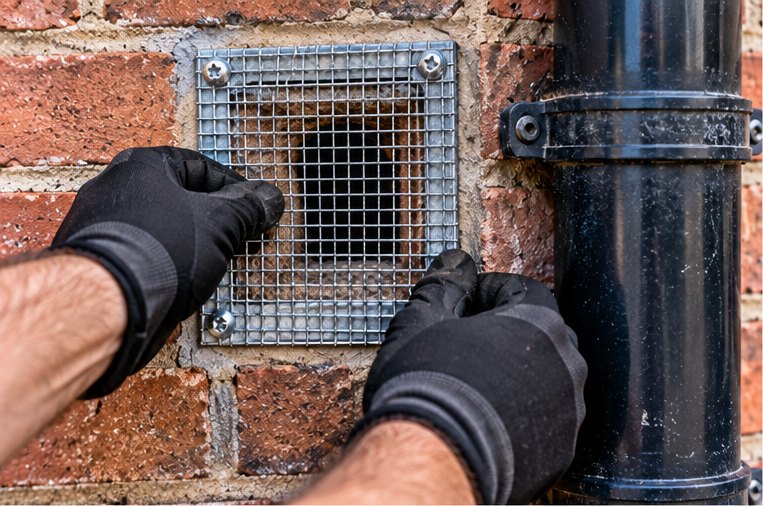
Proofing means physically closing the routes: meshing airbricks, capping open pipe ends, sealing service entries, closing gaps at the roofline, fitting bristle strip or plates to door bottoms, and where drains are implicated, identifying that and getting it put right.
Some of it we do as part of the job. Some of it — a collapsed drain, a roof that needs a builder — is somebody else's trade, and we will tell you plainly which is which rather than patch something that needs replacing.
Lofts
Rats in the Loft
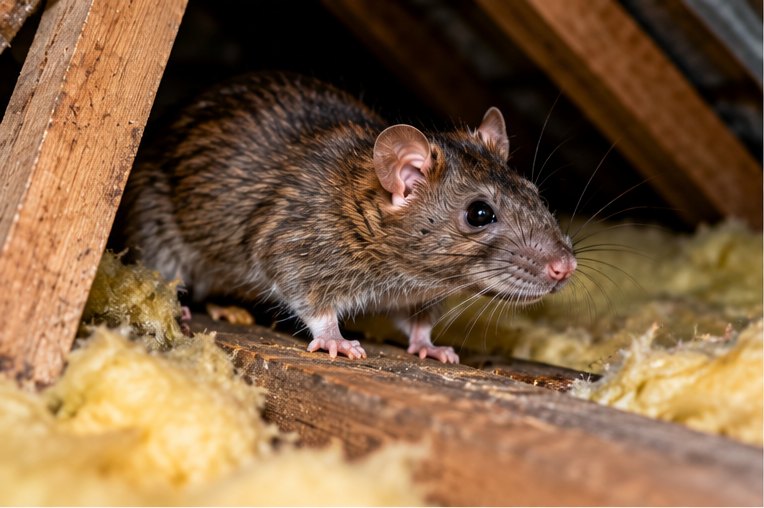
Loft rats are the most common call we get from houses, usually in autumn as the weather turns.
They get up there by climbing — brickwork, downpipes, trees and trellis, or internally through a cavity — and once in they run along the joists and the pipe runs, nest in the insulation and gnaw whatever is in the way. Cables are the reason this matters more than the noise does: the sheathing is exactly the sort of thing a rat will work on.
The job in a loft is the same shape as anywhere else: establish the runs, treat, then find where they are coming up and close it. Contaminated insulation sometimes needs lifting and replacing afterwards, which is a separate piece of work we can talk you through.
Businesses
Commercial Rat Control
For a business the problem is rarely only the rats. It is the inspection, the paperwork and whoever is going to see it.
We work with kitchens, food premises, retail, warehousing and offices, and we provide written reports of what was found, what was done and what still needs doing — which is what an EHO or an auditor will ask for.
Where a site needs ongoing cover rather than a one-off visit, that can be arranged on a schedule that suits the premises.
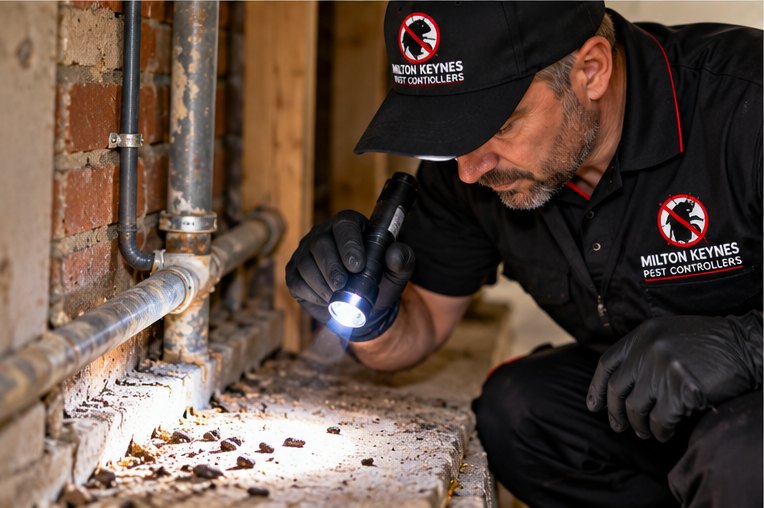
Safety
Bait, Pets and Wildlife
A fair question, and one we would rather answer before you ask it.
Rodenticides are used under a stewardship regime in the UK, and the professional rules around them exist because of secondary poisoning — the risk to the fox, the owl, the neighbour's cat or your own dog that finds a poisoned rat rather than the bait itself.
In practice that means bait goes in lockable stations, secured so they cannot be moved or opened, placed where rats travel and pets and children do not. It means we look for and remove carcasses. And it means there are situations — open sites, sensitive premises, properties with particular pets — where we will recommend trapping and proofing instead.
If you have a dog that gets everywhere, tell us at the point of booking. It changes what we do.
Gardens
Rats Outside
Not every rat problem is indoors, and dealing with the outside is often what stops it becoming an inside problem.
What draws them is food and cover: bird feeders and the spillage under them, compost heaps with cooked waste in, open bin stores, decking with a void underneath, sheds standing on a frame, and dense ground-level planting against a wall.
None of that means you have done anything wrong. It means there is a reason they are there, and the reason is usually fixable.
Why us
Why Milton Keynes Pest Controllers
- Local, covering fifteen towns
- Same-day appointments available
- Evenings and weekends at no extra cost
- No call-out fee
- Homes, businesses and managed property
- Proofing as well as treatment
- Written reports for business premises
- Work guaranteed
Ring 01908 465226 and tell us what you have seen.
Reading
Rats: the Questions We Get Asked
Ten pieces on the things people ring us about, written to answer the question rather than to sell the visit.
Rat or Mouse? How to Tell Which You Have
The two get confused constantly, and it matters, because what works for one is the wrong approach for the other.
Read it →Why Rats Chew Cables, and Why It Matters
Gnawing is not vandalism and it is not hunger. It is maintenance, and it is the reason rats in a roof space are worth dealing with promptly.
Read it →Rats in the Garden: Decking, Compost and Bird Feeders
Most rat problems indoors started outdoors. The garden stage is the easy one to deal with, and it is the one most people wait through.
Read it →Why the Rats Came Back
A rat problem that returns is rarely a treatment that failed. It is usually a route that was never closed.
Read it →How Long Does Rat Treatment Take?
The honest answer is more than one visit, and there is a specific biological reason for it that is worth understanding.
Read it →Scratching Under the Floor at Night: What Is It?
Almost everyone rings us because of a noise rather than because they have seen anything. The noise usually tells you more than you think.
Read it →Rat Bait, Pets and Wildlife: How It Is Done Responsibly
A fair question and one worth asking before anybody puts anything down in your house.
Read it →Reading the Signs: Runs, Smears and Burrows
Rats are creatures of habit, and habit leaves marks. Most of what a technician does on a first visit is read them.
Read it →Seeing a Rat in Daylight: What It Means
It is the thing that makes people ring the same day, and the instinct is right — though not quite for the reason most people assume.
Read it →Building Work and Rats: Why Digging Stirs Them Up
If a rat problem started when the builders did, that is not a coincidence — and the moment to deal with it is while the ground is still open.
Read it →Before you book
Rat Control — Questions
How quickly can you come out?
Same-day appointments are available across the area, including evenings and weekends, at no additional cost. Ring 01908 465226 and we will tell you the soonest we can get to you.
Is there a call-out charge?
No. There is no call-out fee.
Is the work guaranteed?
Yes. If rats return within the guaranteed period we will re-attend and treat as necessary. The period is set out with your quotation, because it depends on the property and on whether the proofing work was carried out.
How many visits will it take?
More than one, in almost every case. Rats are wary of anything new in their environment, so bait placed on a run is often avoided for several days before it is taken. The usual pattern is an inspection and set-up visit followed by return visits to check take-up and top up.
Is it rats or mice?
Droppings are the quickest tell. Rat droppings are about the size of a large grain of rice, dark and tapered, and tend to appear in lines along a run. Mouse droppings are much smaller and more scattered. Heavy, thumping movement overhead is usually rats; light scurrying is usually mice.
How are they getting in?
Most often a defective or disused drain, a gap where a pipe or cable passes through a wall, a broken airbrick, an open pipe end, or a gap at the roofline. A rat can pass through an opening about the width of your thumb. Finding the route is part of the job, not an extra.
Is the bait safe around pets and children?
Bait is placed in lockable stations, secured so they cannot be moved or opened, and positioned on rat runs rather than anywhere a pet or a child goes. Tell us at the point of booking if you have a dog that gets everywhere or any unusual circumstances, because it changes what we recommend — in some situations trapping and proofing is the better route.
Do you deal with rats in the loft?
Yes, and it is one of the most common jobs we attend, particularly in autumn. As well as treatment it usually means finding how they are climbing or getting up internally, and closing it.
Do you work with businesses?
Yes. Kitchens, food premises, retail, warehousing and offices, with written reports of what was found and what was done, which is what an inspector will want to see. Ongoing cover can be arranged where a site needs it.
Will you tell me what needs fixing?
Yes, including the parts that are not our trade. If a drain has collapsed or a roof needs a builder, we will say so rather than patch something that needs replacing.
Where we cover
Rat Control Across the Area
Across Buckinghamshire, Bedfordshire and into Hertfordshire, and the villages between them. Tenants, homes, businesses, landlords and managed property.
Book a Rat Control Visit
Rats in the loft, in the kitchen, under the decking or on the premises — tell us what you have seen and where, and we will tell you what it is likely to be and what it takes to deal with it.
Get in touch
Book a Rat Control Visit
Tell us what you have seen or heard and roughly where. If it is urgent, ring instead — the phone is faster.
- Phone
- 01908 465226
- Message us on WhatsApp
- sales@miltonkeynespestcontroller.co.uk
- Milton Keynes Pest Controller Service
- Address
- South Row
Milton Keynes
MK9 3DQ - Covering
- Milton Keynes, Buckinghamshire, Bedfordshire and parts of Hertfordshire