
Home › Squirrel Control › Roofline Proofing: What Actually Works
Proofing
Roofline Proofing: What Actually Works
This is the part of the job that decides whether you are reading this again next year.
The principle
Teeth, Not Weather
Roofline repair and roofline proofing are different jobs with different standards. A repair has to keep water out. Proofing has to resist a determined animal with chisel teeth and time.
That single distinction explains most proofing failures. Expanding foam keeps water out beautifully and is gnawed through in an evening. Mastic and sealant the same. Plastic trim, plastic vents and plastic soffit board are all perfectly adequate against rain and entirely inadequate against teeth.
What holds is metal, mechanically fixed to something sound: stainless steel mesh, galvanised or stainless sheet closures, metal vent guards, screwed or fixed rather than glued. Where the timber behind it has rotted, the timber gets replaced first, because nothing holds when fixed to soft wood.
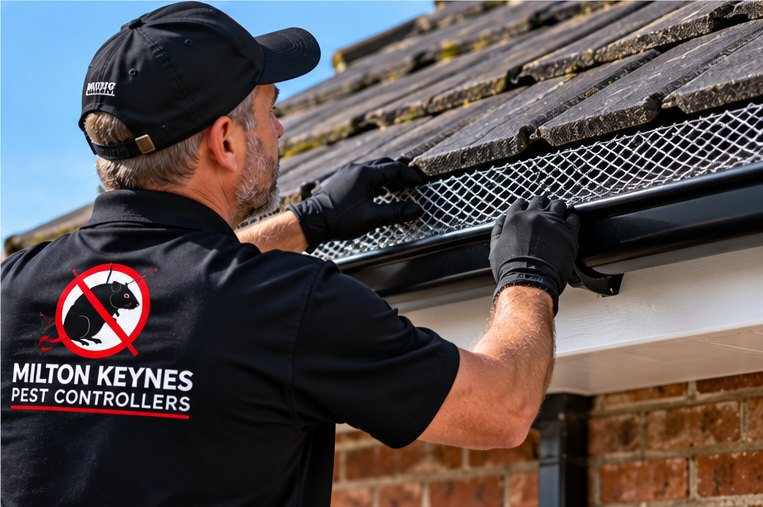
Photographs on this page are for illustration purposes only.
The openings
Where They Actually Get In
Entry points are specific, findable and repeat from house to house. In rough order of how often they turn out to be the answer:
- The soffit-to-wall junction. Where the soffit board meets the brickwork. Often a gap by design, and the commonest single way in on a modern house.
- Where a lower roof meets the wall. Garage, porch, extension or conservatory. A generous gap, out of sight from the ground, and easy to reach from the lower roof.
- A plastic roof or tile vent. Gnawed straight through. Replaced with a metal-guarded vent rather than patched.
- A loose dry-verge cap. Once a cap lifts, the end of the tile batten is open along the whole gable.
- A rotten bargeboard or fascia end. Usually below a gutter that has been overflowing for years. Mesh will not hold on soft timber, so the board is replaced first.
- A lifted or slipped verge tile. The verge is the most exposed edge of a roof and the first place tiles move.
- Lifted lead flashing at the chimney. Flashing that has come away leaves a gap straight into the roof void beside the stack.
- A loose ridge tile. Where the mortar has gone. Visible from the ground with binoculars, and often the oldest fault on the roof.
Note that almost all of these are at or above eaves level and most are invisible from the ground. That is why the survey involves a ladder or a roof inspection rather than a look from the drive.
All of them
Partial Proofing Is Not Proofing
There is no credit for closing most of the openings. A roof with one way in is a roof with a way in, and a squirrel looking full time will find it in days.
Which is why the inspection is the expensive part of the thinking even though the proofing is the expensive part of the invoice. An old or complicated roof — multiple pitches, dormers, valleys, additions joined to originals — can have twenty or thirty candidate points, and they are not all reachable from one ladder position.
It is also why the rear elevation matters so much. People instinctively check the front, because that is what they look at. Squirrels use whichever side the tree is on.
One-way exits
When They Are Used and When They Are Not
A one-way exit lets an animal out and not back in, and it has a place in this work. It is not a universal answer.
It is useful where you are confident about the number of animals and confident there are no dependent young. It is actively wrong during the breeding season, because letting the adult out and not back in is exactly how young starve in a loft. And it does nothing at all about the next squirrel that comes along, because it is a device rather than a closure.
So it is a step, used on the right job, followed by proper mesh. Anyone offering a one-way exit as the whole solution has skipped the part that lasts.
The order
Why Sealing First Is the Classic Mistake
The sequence is: find out what is in there, deal with it, close behind it. Reversed, it produces the two worst outcomes in this line of work.
Seal an adult in and it will make a new hole, from the inside, usually through something more expensive than what it came in through — and a squirrel that cannot get out will chew ceiling, cable and pipework trying.
Seal dependent young in and they die where you cannot reach them. That is weeks of smell, then flies, then somebody cutting a hole in your ceiling.
So if you have found the hole and you are holding a tin of foam: put it down and find out what is inside first. It is the single most useful piece of advice on this page.
Short answers
Squirrel Questions
Is expanding foam any good for squirrels?
No. It keeps water out and they gnaw straight through it. Proofing needs metal mechanically fixed to sound timber.
Where do they usually get in?
Most often the soffit-to-wall junction, the point where a garage or extension roof meets the wall, and plastic roof vents.
Do you have to close every opening?
Yes. A roof with one way in is an open roof, and they will find it within days.
Are one-way exits a good solution?
They have a place, on the right job and outside the breeding season, but they are a step rather than the answer. Proper mesh follows.
Can I just block the hole myself?
Not until you know nothing is inside. Sealing an animal in is worse than the gap, and sealing young in is far worse.
Does the woodwork need repairing first?
If it has rotted, yes. Nothing holds when fixed to soft timber.
Going further
Squirrel Guides
Where we cover
Squirrel Control Across the Area
Across Buckinghamshire, Bedfordshire and into Hertfordshire. Houses, bungalows, flats, commercial roof voids and listed buildings.
Still Not Sure What You Have?
The time of day answers it before anyone attends. There is no call-out fee for coming to look.
Get in touch
Book an Ant Treatment
Tell us what you have heard or seen, where, and at what time of day.
- Phone
- 01908 465226
- Message us on WhatsApp
- sales@miltonkeynespestcontroller.co.uk
- Milton Keynes Pest Controller Service
- Address
- South Row
Milton Keynes
MK9 3DQ - Covering
- Milton Keynes, Buckinghamshire, Bedfordshire and parts of Hertfordshire