
Home › Wasp Control
Nests · Lofts · Gardens
Wasp Control
Fixed price £90, no call-out fee. The nest will die on its own by November — the question is whether you can live with it until then.
First question
Is It Actually a Wasp Nest?
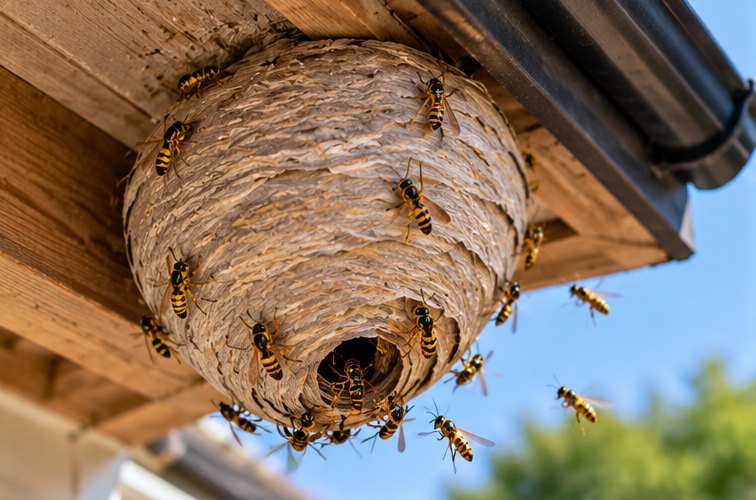
A British wasp nest is a closed grey-brown ball made of chewed wood pulp, with fine horizontal banding across the surface and one entrance hole, usually underneath. You cannot see the cells. They are inside, under that shell.
That matters because a lot of pictures online show something else — an open honeycomb on a stalk, with the cells visible. That is a paper wasp, a southern European and American insect, and it is not what you have.
The other reliable tell is traffic. A established nest has a steady two-way stream at one point: wasps arriving and leaving from the same spot, all day, in a fairly straight line. One wasp at a window is a lost wasp. Twenty going in and out of the same gap under the eaves is a nest.
- The envelope. Layers of chewed wood pulp, built up like papier mâché and banded in grey and brown. This is all you see from outside, and it is why a British nest looks like a smooth ball rather than a honeycomb.
- The combs. Horizontal tiers of cells hanging inside, one above the other, with the grubs in them. You cannot see these unless the nest is broken open — which is the single commonest reason people think they have something other than a wasp nest.
- One entrance. Usually a single hole near the bottom. Everything goes in and out of it, which is what makes a steady two-way stream the giveaway, and it is why treatment at the entrance reaches the whole colony.
- The attachment. A short stalk fixing the nest to a rafter, a branch, a joist or the underside of a soffit. In a cavity or underground there is no stalk visible and no nest visible either.
If you cannot see a nest at all but there is a steady stream going into a gap in the brickwork, an airbrick or a roof vent, that is still a nest. It is just inside the wall or the roof where you cannot see it, which changes some things about the job but not the price.
Images on this page are illustrations only.
The clock
It Will Die By November. That Is Not Always Enough.
A wasp colony lasts one year and one year only. A single queen starts it in April or May, the colony grows all summer, and at the first hard frosts the whole thing dies. Next year's queens have already left to hibernate somewhere else. The nest is never used again.
So "will it go away on its own?" has an honest answer, which is yes, in November. Whether that helps depends entirely on where it is.
What the clock does change is the size of the job. Roughly:
- May and June — a golf ball to a tennis ball, a queen and a handful of workers. Barely defended. The easiest and safest moment there will ever be.
- July — a melon, several hundred workers, and now it is defended properly.
- August and September — a football or bigger, several thousand workers, and the colony is at its most aggressive. This is when most people ring.
The treatment is the same job at any of those stages and the price does not change. What changes is the risk while it is still there, and how much of your garden or loft you have lost in the meantime. If you have spotted a small nest in June, that is the cheap moment to deal with it in every sense except the invoice.
What we do
The Treatment, and Why the Nest Usually Stays Put
Worth knowing before anyone arrives, because it surprises people. Treating a nest and removing a nest are not the same thing.
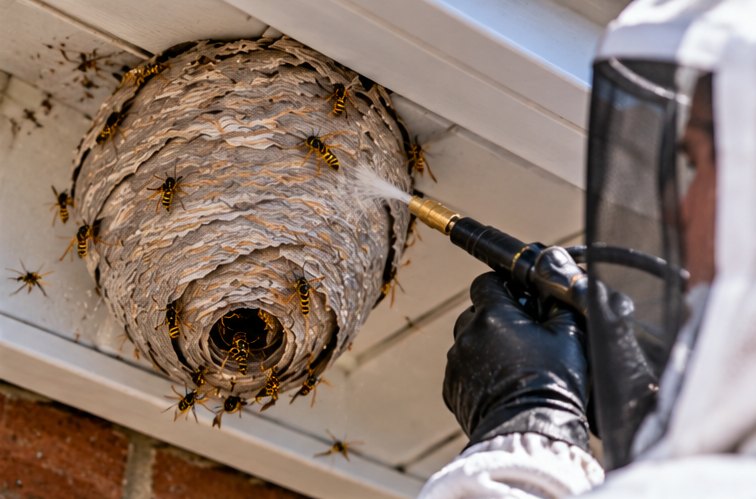
The treatment is an insecticidal dust applied at and into the nest entrance. Wasps walk through it on the way in and carry it through the colony on their bodies, which reaches the parts nobody can get to, including the queen. Activity usually drops within hours and the colony is normally dead inside a day or two, though you will see returning foragers for a while after that — they have nowhere to go and they die off.
The nest itself is generally left where it is, and that is deliberate rather than lazy. It is annual, so nothing will move back into it, and an empty nest is harmless. Cutting a dead nest out of a wall cavity or a roof can mean opening up the structure for no benefit. Where it is somewhere it genuinely cannot stay — a nest in a loft you are about to convert, or one hanging in a porch — it can be taken away once it is dead. Ask on the day.
The guarantee is specific, which is the useful kind. In the firm's own words: if the wasps return to the same nest location, they come back and re-treat at no extra cost.
Images on this page are illustrations only.
The price
Ninety Pounds, and What That Covers
Wasp nest treatment is £90, fixed, with no call-out fee. It is the only service on this site with a published price, and that is because it is the only one that is genuinely the same job every time: one nest, one visit, done.
That price includes the visit, the treatment and the guarantee. It does not change because the nest is in a loft rather than a shed, or because it is August rather than June.
Where it can change is access. A nest at normal ladder height is the standard job. A nest four floors up, or one that needs a tower or a cherry picker, is a different piece of work and anything extra is agreed with you before it happens, not afterwards. Same for more than one nest on a property.
Same-day appointments are available, and evenings and weekends at no additional cost.
Not everything that buzzes
If It Is a Honeybee, We Will Say So
This costs us bookings and it is still the right answer.
Honeybees are not a pest control job. If a swarm has landed in your garden — a seething cluster the size of a rugby ball, hanging off a branch or a fence post — that wants a local beekeeper, not us, and most will collect a swarm for nothing because they want the bees. A swarm is usually gone within a day or two anyway.
Bumblebees nest in small numbers in compost heaps, bird boxes and under decking, they are not aggressive, and the colony dies out by late summer like a wasp colony does. Leave them.
Solitary bees — the ones coming out of holes in mortar or in a lawn — have no colony to defend and almost never sting. Leave them too.
Telling them apart is easier than it sounds: wasps are smooth and shiny with a hard bright-yellow and black pattern and an obvious thin waist. Bees look furry and matt, and are browner. There is a fuller guide in honeybees are not a wasp job.
Where they turn out to be
Seven Places, and One of Them Is Not the Building
Over a season the same short list accounts for nearly all of it.
- The loft or roof space, hung from a rafter or the felt. The commonest of all.
- Under the eaves or behind the soffit, entering at a gap or a vent.
- Inside a wall cavity, entering at an airbrick, a weep hole or a crack in the mortar. You never see the nest.
- A shed, garage or outbuilding, often in the roof apex.
- Underground, in an old rodent burrow or a bank — a hole in the lawn with steady traffic and no nest in sight.
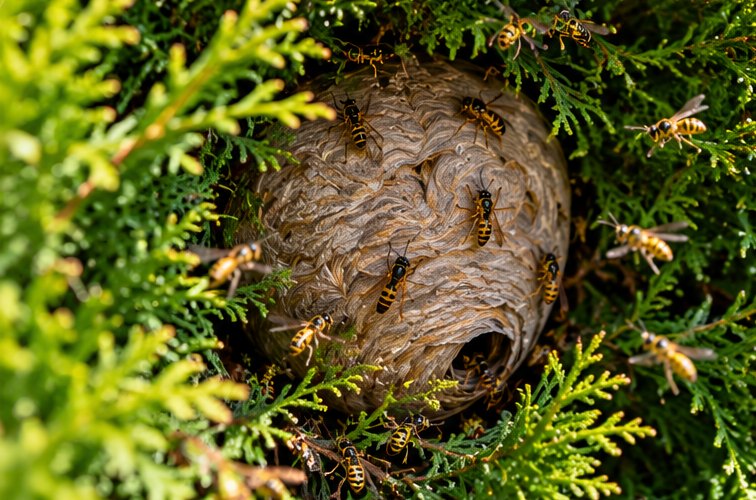
- In a hedge or dense shrub, particularly conifer. Frequently found by whoever is cutting it, which is a bad way to find it.
- A bird box, a bin store, a rolled-up parasol, a barbecue cover — anything sheltered and undisturbed since spring.
You do not need to find it before ringing. Where the traffic goes is enough to start with, and finding the nest is part of the visit.
Images on this page are illustrations only.
Three things not to do
Especially the First One
Do not block the entrance. This is the one that causes real damage. Wasps that cannot get out of a wall cavity will chew a new way out, and the new way out is often into the room on the other side. Filling an airbrick or a gap in the mortar with foam or cement while a colony is alive behind it is how a garden problem becomes an indoor one. Treat first, block afterwards.
Do not do it off a ladder. Most serious wasp injuries are not from the stings, they are from the fall. A defending colony arrives faster than you can climb down, and you will be holding a rung when it does.
Do not spray it and walk away. A shop aerosol reaches the entrance and perhaps the outer layer. It is enough to convince the colony it is under attack and not enough to end it, and the defended radius round that nest gets considerably wider for the rest of the day. If you have already tried it, say so when you book — it is not a telling-off, it genuinely changes how the technician approaches the nest.
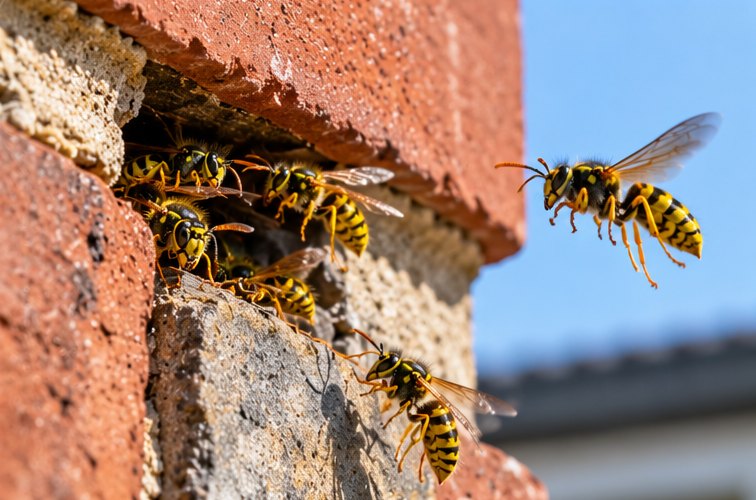
Images on this page are illustrations only.
Going further
Wasp Guides
Short answers
Wasp Questions
How much is it?
Ninety pounds, fixed, with no call-out fee. That covers the visit, the treatment and the guarantee. Difficult access - a nest well beyond ladder height, or needing a tower - is agreed with you beforehand.
Can you come today?
Same-day appointments are available, and evenings and weekends at no extra cost.
What does the guarantee actually cover?
If the wasps come back to the same nest location, the firm returns and re-treats at no extra cost.
Will you take the nest away?
Usually it is left where it is, and that is deliberate. A nest is only used for one season, so nothing moves back into it, and cutting a dead nest out of a wall or a roof means opening up the structure for no benefit. If it is somewhere it cannot stay, it can be removed once it is dead.
How long until they are gone?
Activity usually drops within hours and the colony is normally dead inside a day or two. You will see returning foragers for a while after that, which is expected.
Will it just die off on its own?
Yes, at the first hard frosts, and the nest is never reused. Whether waiting is sensible depends entirely on where it is and who has to walk past it.
Is it cheaper to deal with a small one?
The price is the same. What is smaller in June is the risk and the disruption, not the invoice.
I think it might be bees.
Then say so when you ring. Honeybees are a job for a local beekeeper rather than a pest controller, bumblebees and solitary bees are best left alone, and we would rather tell you that than turn up.
I cannot see a nest, just wasps going into the wall.
That is a cavity nest and it is common. It does not change the price. Do not block the hole - they will chew a new way out, sometimes into the room.
Someone here is allergic to stings.
Tell us when you book. It changes how and when we attend, and it is the single most useful thing you can tell us.
Where we cover
Wasp Nest Treatment Across the Area
Across Buckinghamshire, Bedfordshire and into Hertfordshire. Houses, gardens, sheds, flats, pubs and food premises — fixed price £90, no call-out fee.
Found a Nest?
Tell us roughly where it is and how high up. Fixed price £90, no call-out fee, same-day appointments.
One Last Thing
If you are not sure whether it is wasps or bees, or you can see traffic but no nest, ring and describe what you are seeing and where it is going. There is no call-out fee, and the answer to the bee question is free either way.
Get in touch
Book an Ant Treatment
Tell us roughly where the nest is and how high up, and whether anyone in the house reacts badly to stings. Those two answers decide how we come equipped.
- Phone
- 01908 465226
- Message us on WhatsApp
- sales@miltonkeynespestcontroller.co.uk
- Milton Keynes Pest Controller Service
- Address
- South Row
Milton Keynes
MK9 3DQ - Covering
- Milton Keynes, Buckinghamshire, Bedfordshire and parts of Hertfordshire