
Home › Ant Control
Homes · Kitchens · Businesses
Ant Control
Ant treatment for homes and business premises across Milton Keynes, Buckinghamshire, Bedfordshire and into Hertfordshire — finding the nest and dealing with that, not just the ants on the worktop.
Ants: the Short Version
Almost everything people do about ants is aimed at the wrong place.
The ants crossing your worktop are workers out foraging. The colony they came from is almost always outside: under a paving slab, at the base of an external wall, in the soil beside a patio, under a doorstep. What is coming through the kitchen is a supply line, and killing what is on it changes nothing about the thing at the other end.
That is why a can of spray clears the trail by teatime and the ants are back on Thursday. It is also why the treatment that actually works looks like doing very little: bait the foragers are happy to carry home, so the colony feeds it to the queen and the brood.
We treat ants in houses, flats, kitchens, patios and drives, and in business premises across Milton Keynes and the towns around it. Same-day and emergency appointments are available, evening and weekend visits to suit your timetable, and there is no call-out fee.
Ring 01908 465226.
Trails, entry points and the nest they are running back to.
Soil pushed up between slabs, and what it is doing underneath.
Kitchens, shops and storage, worked around your trading hours.
Evenings and weekends to suit you, with no call-out fee.
The species
Which Ant You Have Almost Certainly Got
In a British house the answer is nearly always the same one.
The black garden ant does the overwhelming majority of what people ring about. Workers are small, a few millimetres, dark brown to black, and they nest outdoors in soil: under paving, along a wall base, beneath a doorstep, in a lawn, under decking. They come inside to forage and go home again.
Flying ants are not a different insect. They are the same colony's winged queens and males, produced once the nest is mature enough, and they leave on a warm, still, humid day in July or August to mate. Several colonies in an area go on the same day, which is why it feels like an event. There is an article about it below.
Pavement ants are worth knowing about because they are the other one that nests under hard standing, and unlike the garden ant they can sting — weakly, and only if handled, but it is a real difference. They are small, dark and stocky, and they turn up under paving, kerbs and path edges in the south of England. Treatment is much the same; the reason to identify them is so nobody is told an ant cannot sting and then finds out otherwise.
Pharaoh ants are the genuinely different case, and the one where getting it wrong makes things much worse. They are tiny and yellowish, not black; they are tropical, and unlike the garden ant they nest inside the building in warm voids: behind pipework, in heating ducts, in wall cavities. They have many queens instead of one, and spraying them makes the colony split and spread through the building instead of dying. If what you have is small, pale and indoors all year instead of black and seasonal, say so when you ring.
The trail
What a Trail Actually Is
Ants navigate by scent. A worker that finds food lays a chemical trail on the way home, and every ant that follows it and finds the food still there reinforces it. That is the whole mechanism, and it explains most of what you see.
It explains why they march in a line instead of wandering. It explains why the line appears overnight and along the same route each time. It explains why they favour an edge (the join between worktop and wall, the line of a skirting, the frame of a door), because an edge holds scent and gives them something to follow.
And it explains the one genuinely useful thing you can do yourself: wipe the route with hot soapy water or a detergent spray. That removes the trail, not the ants, and the line breaks up until they find the food again. It is not a treatment. It buys you a clear worktop and tells you something, because where they re-form is where the route really runs.
Do not, though, spray insecticide along it. That kills foragers, which the colony replaces easily, and some products repel, so the trail simply moves to a route you have not found.
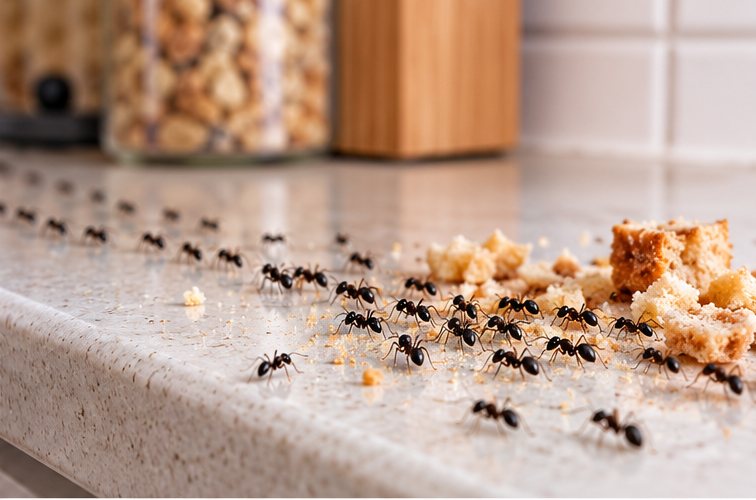
Photographs on this page are for illustration purposes only.
The nest
Why the Nest Is the Only Thing That Matters
A garden ant colony has one queen, she can live for many years, and she is the entire problem. Workers are disposable and are produced continuously. You could kill every ant in the kitchen every evening for a month and the colony would not notice.
So the job is to find where the trail goes when it leaves the building and deal with what is at the end of it. Outside, the signs are specific and once you know them you see them everywhere:
- Fine excavated soil pushed up between paving slabs, along the edge of a drive, or in the joints of a patio. That is spoil from tunnelling and it is the clearest sign there is.
- A small hole at the centre of it, with traffic going in and out.
- A line of ants running to a wall and disappearing at a joint, an airbrick, or where a pipe enters.
- Activity under a doorstep, a decking board or a large stone — lift one on a warm day and you may find brood being moved.
The treatment is a bait the workers accept and carry home, where it is shared through the colony and reaches the queen. That takes a few days, not an afternoon, and the live page says the same: some ants go immediately, the colony takes longer. Seeing ants on the bait is the treatment working, not failing.
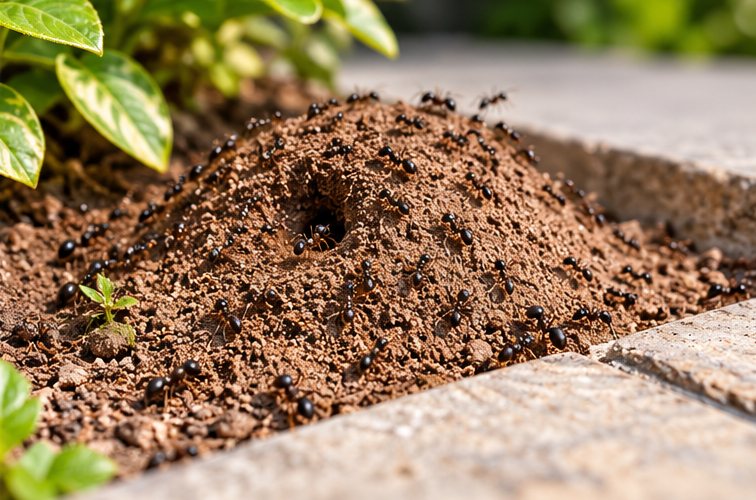
Photographs on this page are for illustration purposes only.
Getting in
How They Get In, and What Actually Closes It
Ants need almost nothing. A gap you would not notice at a door threshold, the joint where a kitchen unit meets the floor, the hole where a waste pipe passes through a wall, a crack in mortar, the gap under a patio door track, an airbrick, or simply the seam between a conservatory base and the house.
Sealing is worth doing and it is second, not first. A colony sitting a metre from the kitchen wall with its entry point closed will find another one, so the sealing is what stops the next colony, not this one.
What helps most, in order: deal with the nest; then close the obvious routes with sealant or mortar; then remove the reason they came in. Sugar is what they are usually on: the pedal bin lid that does not shut, the spilled squash behind the kettle, the honeydew dripping off an aphid-covered plant by the back door. Though they take protein and fat too, particularly in spring while the colony is rearing brood, so pet food and a greasy hob count as well.
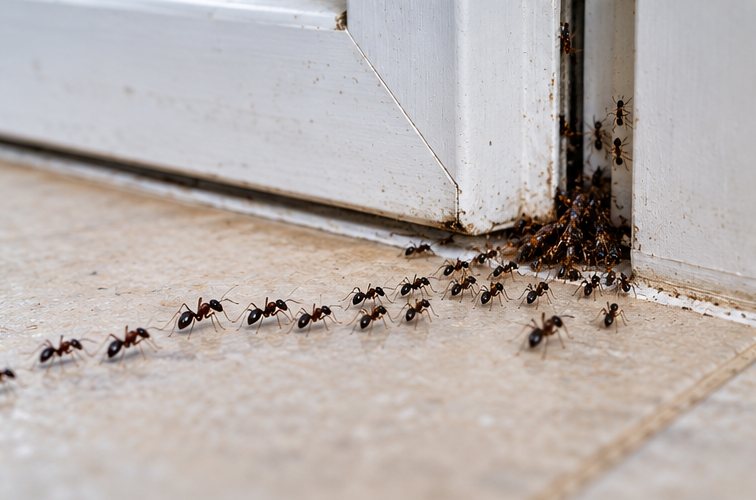
Photographs on this page are for illustration purposes only.
The visit
What the Visit Involves
The survey comes first and most of it happens outside. We follow the trail out of the building to establish where it goes, look at the paving, the wall base, the doorstep and the borders for excavated soil and activity, and work out how many nests are involved, because a long-running patio problem is often more than one.
Then treatment goes in on the routes and at the nest, using bait where bait is the right answer, which for a garden ant colony it usually is. The method is chosen around the property: a kitchen with a toddler and a dog, a food premises, and an open drive are three different problems.
The live page puts the safety point plainly and so do we: the treatments are safe when they are applied correctly, and the technician will tell you what precautions are needed for your property. That is the part that matters, and it is why the survey happens before anything goes down.
If what you have turns out to be pharaoh ants rather than garden ants, we will say so and the approach changes entirely: bait only, no repellent products, and usually more than one visit.
Paving
Ants Under a Patio, Drive or Path
This is the version of the job people leave longest, because it does not happen in the kitchen.
A colony under paving excavates soil from beneath the slabs and pushes it up through the joints. Do that for a few seasons and the bedding sand goes with it: slabs rock, joints open, edges drop, and a block-paved drive develops the sunken patches people blame on the original laying.
It is not sudden and it is not dramatic, which is exactly why it is worth dealing with early. The fix is the same as anywhere else, treating the colony and not the surface, and afterwards the joints can be re-sanded without it simply happening again.
Business
Restaurants, Shops, Offices and Food Premises
For a business ants are a contamination finding before they are a nuisance. A trail across a preparation surface or into a store room is something an environmental health officer will act on, and it is not a conversation to have during an inspection.
We work around trading hours, including evenings and weekends, and can set out what was found, where the nest is and what was done in writing for your records. Ask when you book and say who it is for.
In commercial kitchens the findings are usually structural and the source usually external: the gap under a delivery door, a service duct, the joint where the building meets a yard or a bin area. Pharaoh ants are the exception and a serious one in food premises and any building with continuous warmth, because they nest inside and spray products make them spread. If there is any doubt about the species we will establish it before treating.
Afterwards
What Happens After the Treatment
Expect activity to continue for a few days, and expect to see ants actively feeding at the bait. That is the mechanism doing its job: what they carry home is the point of the whole exercise, so ants on the bait are good news, not bad.
What you should see is the trail thinning over the following days and then stopping. The live page puts full effect at a few days for the whole colony; a large or well-established nest can take longer.
In the meantime: do not spray anything near the bait, because repellent products drive ants off it and stop the treatment reaching the nest. Keep sugar and food sources away from the route. Wipe trails away from areas that have to stay clean, but leave the ones near the bait alone.
If the trail is still running after a couple of weeks, ring us. It usually means a second nest, or a route from a neighbouring property, and finding it is the job rather than repeating the same treatment.
Every summer
Why They Come Back at the Same Time Each Year
Ants are seasonal above ground, not seasonal as a colony. The nest is there all year; it is simply quiet and deep when it is cold. As the soil warms in spring the workers start foraging again, and the calls begin in April and run through the summer.
So a house that had ants in the kitchen last June and again this June does not have bad luck. It has a nest that was never dealt with, sitting in the same spot, doing the same thing on the same schedule.
That is the case for treating the nest properly once rather than managing the trail every summer, and it is the single most useful thing on this page.
Why us
Why Milton Keynes Pest Controllers
- Local, covering fifteen towns across three counties
- Same-day and emergency appointments, evenings and weekends
- No call-out fee, with clear costs before the work
- The nest located and treated, not just the trail you can see
- Fully trained and insured technicians
- The species established first, because pharaoh ants change everything
- Patios, drives and paths as well as kitchens
- The species established before anything is applied
Ring 01908 465226 and tell us what you have seen.
Reading
Ants: the Questions We Get Asked
Ten things people ring and ask us about ants, answered properly.
Why Spraying the Trail Never Works
It is the most natural thing in the world to do, and it is aimed at the part of the problem that does not matter.
Read it →Where the Nest Actually Is
Twenty minutes and a bit of patience will usually find it, and finding it is most of the job.
Read it →Flying Ant Day, Explained
They are not a different insect, it is not one national day, and what it tells you depends entirely on where they emerge.
Read it →Why Ants March in a Line
Understanding the line tells you why the sprays fail and why hot soapy water does something useful.
Read it →Ants in the Kitchen: What They Are After
Sugar, mostly. Knowing that narrows what you have to do about it.
Read it →Pharaoh Ants: the One That Is Different
Everything else on these pages assumes the nest is outside. This is the case where it is not, and it changes the whole approach.
Read it →Ants Under Paving, Patios and Drives
The version of this job people leave longest, because it does not happen in the kitchen. It is also the one that costs money.
Read it →What To Do, and Not Do, Before We Arrive
Most of it is about leaving things alone, which is not what anyone’s instincts say.
Read it →Ants in a Food Business
For a food business a trail across a preparation surface is a finding, and the clock is different.
Read it →Why They Come Back Every Summer
A house that gets ants every June does not have bad luck. It has a nest that was never dealt with.
Read it →Before you book
Ant Control — Questions
Why do the ants come back after I spray them?
Because spraying kills foragers and the colony replaces them without difficulty. The nest is almost always outside the building and is entirely untouched by anything you do to the trail. Some sprays also repel, so the trail moves to a route you have not found. The treatment that works is bait the workers carry home to the queen.
Where is the nest likely to be?
Outdoors, close to the building. Look for fine excavated soil pushed up between paving slabs, along a drive edge or in patio joints, usually with a small hole at the centre. Also under doorsteps, decking boards, large stones and along the base of an external wall. Follow the trail out of the house and it will generally take you there.
Are flying ants a different species?
No. They are the same colony’s winged queens and males, produced once the nest is mature, leaving to mate on a warm, humid, still day in July or August. Several colonies go at once, which is why it feels like a single event. Winged ants emerging inside the house mean a nest in or right against the building, which is worth a look.
Is the treatment safe with children and pets?
The methods are safe when they are applied correctly, and the technician will tell you what precautions are needed for your property. That is why the survey happens before anything is put down, and why a kitchen with a toddler and a dog gets a different answer from an open drive.
How long before they are gone?
Some ants go immediately and the colony takes a few days, because the bait has to be carried home and shared. A large or long-established nest can take longer. Seeing ants feeding at the bait during that period is the treatment working.
Should I clean the trail away before you come?
Clean food preparation surfaces by all means, but leave a trail that is running if you can. It is the single most useful thing on the property, because following it out of the building is how we find the nest. Photograph it if you have to clear it.
Can ants damage the building?
Not in the way people fear — UK garden ants do not eat timber. What they do is excavate soil, and a colony under a patio, path or drive removes the bedding from beneath the slabs over a few seasons, so joints open and slabs start to rock. That is a real cost and it builds slowly.
What if they are small and pale, not black?
Then it may be pharaoh ants, and that changes everything. They nest inside the building in warm voids, they have many queens instead of one, and spraying makes the colony split and spread instead of dying. Tell us what you are seeing and where, and we will establish the species before treating anything.
There are ants in the garden but not the house. Do I need treatment?
Not necessarily. Ants in a lawn or a border are doing no harm and they eat a good deal of what you would rather not have in a garden. It is worth dealing with when a nest is under paving and lifting it, or when the trail has found its way indoors.
Do you treat business premises?
Yes — restaurants, kitchens, shops, offices and storage. We work around trading hours, including evenings and weekends, and can put what was found and done in writing for your records.
Where we cover
Ant Control Across the Area
Across Buckinghamshire, Bedfordshire and into Hertfordshire, and the villages between them. Houses, flats, kitchens, patios and drives, shops, offices, restaurants and food premises.
Tell Us Where the Trail Goes
Which room it is coming into, where the line runs, and whether you have found soil between the paving outside. Same-day and emergency appointments are available.
Get in touch
Book an Ant Treatment
Tell us which room the trail is in, where it goes when it leaves the building, and whether you have found excavated soil outside. A photograph of the trail is worth more than any description.
- Phone
- 01908 465226
- Message us on WhatsApp
- sales@miltonkeynespestcontroller.co.uk
- Milton Keynes Pest Controller Service
- Address
- South Row
Milton Keynes
MK9 3DQ - Covering
- Milton Keynes, Buckinghamshire, Bedfordshire and parts of Hertfordshire