
The main event
Mice, and Then More Mice
Winter is not a quiet season. It is the busiest one, because the single most common pest call of the year peaks in it.
What happens is simple. Field margins, gardens and outbuildings get cold and wet, food outdoors runs out, and a heated house with accessible food becomes the best address on the street. Mice do not hibernate and they do not stop breeding indoors, so a few that came in during October are a resident population by January.
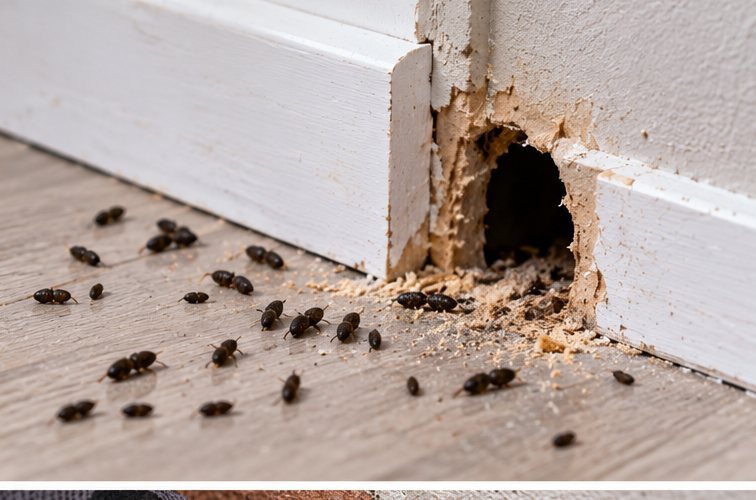
The gap a mouse needs is about the width of a pencil, and a building has more of those than anyone expects: where the waste pipe goes through the kitchen wall, under a poorly fitting external door, at the edge of an airbrick, where a cable enters, behind the boiler flue. None of them look like a way in until you kneel down and look.
Rats follow the same logic on a bigger scale, moving from gardens and drains towards buildings as the weather turns.
Photographs on this page are for illustration purposes only.
The ones that ignore winter
Heating Is Their Season Too
Bed bugs do not care what month it is. They live in a heated bedroom and feed on a person who is in it. Winter is if anything slightly worse, because people travel at Christmas and bring them home.
Fleas are the classic winter surprise. Eggs and pupae sitting dormant in a carpet through the autumn are triggered by warmth and vibration, so switching the heating on in a room that has been shut up — or coming back to a property after a few weeks — can produce a sudden hatch of hungry adults out of a carpet that looked fine.
Carpet moths positively prefer a centrally heated house. Warmth keeps the larvae developing right through the winter, in exactly the undisturbed places you stop vacuuming: under the sofa, behind the wardrobe, along the edges of a room.
Cockroaches, where they occur, are almost always in heated commercial premises and are unaffected by the season.
The quiet ones
What You Genuinely Get a Break From
Wasps are the good news. A colony does not survive the winter: the workers die off through the autumn and only new queens overwinter, tucked away individually in lofts, sheds and log piles. A nest found in December is an empty one from the summer and can simply be removed.
Ants go quiet above ground but the colony is still there, under the paving, alive and waiting for spring. A patio problem that seems to have solved itself in November has not.
Cluster flies are the seasonal oddity — they gather in lofts and around south-facing windows in autumn to overwinter, and produce a burst of calls on the first warm day of the new year when they wake up.
Prevention
The Work Is Done in October
Everything that helps with winter rodents is done before they are in. Once there is a population indoors you have a treatment job rather than a prevention job.
- Walk the outside of the house at ground level and look for gaps. Airbricks, door thresholds, service entries, gaps under render.
- Close them with wire wool, mesh, mortar or metal. Not foam or filler — neither stops teeth.
- Move bird feeding away from the walls, and keep spillage cleared. Feeding birds through the winter also feeds rodents, which is not a reason to stop, only to move it.
- Get bin stores and compost tidy before the ground gets sodden and they become the driest thing in the garden.
- Clear the loft hatch area so that if you do hear something, you can get up and look.
Short answers
Questions, Briefly
Is winter a quiet time for pest control?
No - it is the busiest, because mice and rats move indoors as it gets cold. Only the wasps and the outdoor insects stop.
We suddenly have fleas in January with no pet. How?
Pupae can lie dormant in a carpet for months and are triggered by warmth and vibration. Heating a room that has been shut up, or returning to an empty property, sets them off.
Do wasps come back to the same nest in spring?
No. The colony dies off over winter and new queens start fresh nests elsewhere. An old nest is an empty shell.
Do ants die off in winter?
The workers go quiet but the colony survives underground. A paving problem that stops in November returns in May.
When should I do the proofing?
Autumn, before anything is in. Once there is a population indoors it becomes a treatment job first and a proofing job second.
Ring and Describe It
No call-out fee, same-day appointments where we can, and evenings and weekends.
Get in touch
Ask Us About It
Tell us what you have seen and where in the property. If you have a photograph, it is worth more than a description.
- Phone
- 01908 465226
- Message us on WhatsApp
- sales@miltonkeynespestcontroller.co.uk
- Milton Keynes Pest Controller Service
- Address
- South Row
Milton Keynes
MK9 3DQ - Covering
- Milton Keynes, Buckinghamshire, Bedfordshire and parts of Hertfordshire