
Home › Squirrel Control › Why the Squirrels Came Back
Recurrence
Why the Squirrels Came Back
If they are back, it is almost never bad luck. There are five reasons and four of them are fixable.
First
They May Never Have Left
The commonest explanation is the least satisfying: the job was not finished. Two animals were using the loft, one was caught, and the quiet fortnight afterwards was the second one being cautious rather than absent.
Squirrels are not gregarious in the way rats are, but a loft in a good position can hold more than one, particularly in autumn, and particularly where the roof void runs over several houses. The way to tell the difference is fresh sign: new gnawing on clean timber, new droppings on top of old, insulation moved since the last visit. Old sign proves the history. Only fresh sign proves the present.
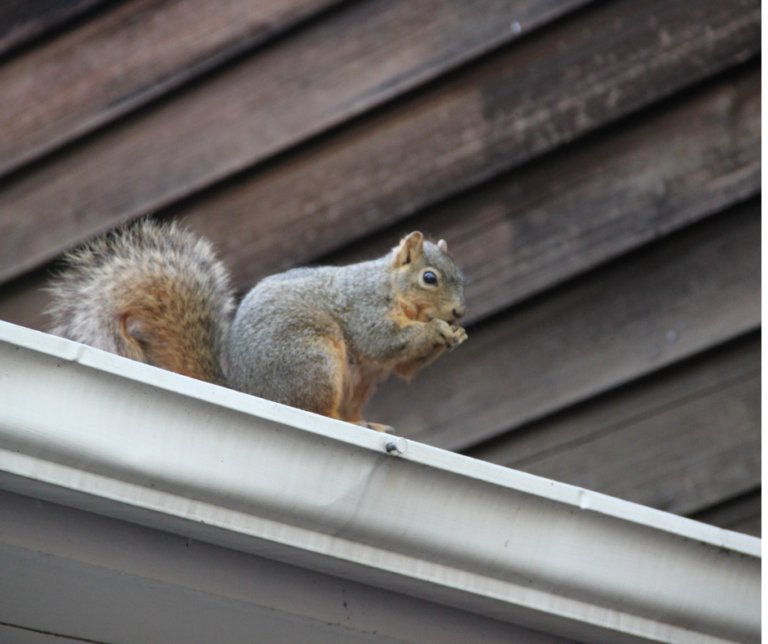
Photographs on this page are for illustration purposes only.
Second
The Roof Was Not Actually Closed
Proofing either works or it does not; there is no partial credit. Close five openings on a roof that has six and the roof is open.
This is much easier to get wrong than it sounds, because the sixth one is usually the one you cannot see from a ladder at the front of the house — a rear dormer cheek, a gap behind a parapet, the junction where a garage roof meets the wall, the far side of a chimney stack. Squirrels will find it in days. They are looking full time and the surveyor was looking for an hour.
Materials matter as much as coverage. Expanding foam and mastic are not proofing: they are gnawed out. What holds is stainless mesh and metal closures, mechanically fixed to sound timber. If you were shown foam, you were shown a repair rather than a proofing job.
Third
Site Fidelity Is Real
A place that has been used gets used again, and a closed opening is still a remembered opening. Squirrels return to known sites, they work at them, and they are strong enough to enlarge a gap that was nearly big enough — which is why "they could not possibly fit through that" is a sentence technicians hear constantly.
Scent from previous occupation persists in insulation and timber and makes a loft more attractive rather than less, which is one of the less obvious arguments for clearing out drey material rather than leaving it.
Fourth
The Route Is Permanent
If your roof is reached from a mature tree, the route does not go away. Removing one animal from a house that sits under continuous canopy leaves a vacancy in a good spot, and there is a population next door to fill it. That is not a failure of the treatment. It is the geography.
Which means the proofing is not the optional extra on a job like this. It is the only durable part. Where the branches can be cut back, cut them back — two metres of clear air around the roofline is worth more than any deterrent sold for the purpose. Where they cannot, because the tree belongs to the council or is protected, the roofline has to do all the work.
Fifth
It Is Next Door
In terraces and semis, party walls frequently stop at ceiling level rather than continuing to the underside of the roof. Where that is the case, a run of houses shares one void and an opening four doors along serves yours.
This produces the most frustrating version of the problem: your roofline is sound, your proofing was done properly, and you still have squirrels. The fix is either the neighbour's roofline, which is not within your control, or a proper closure of the party wall inside your own loft, which is.
That closure is worth doing on its own merits. It also helps with rodents, with fire spread and with noise.
The pattern to watch
Autumn and Late Winter
Recurrence is seasonal. Two periods produce most of it: autumn, when animals are ranging widely and assessing places to spend the winter, and late winter into early spring, when a female is looking for somewhere secure to build a drey.
So a loft that went quiet in May and is noisy again in October has not necessarily failed. It has arrived at the next push. The useful conclusion is that proofing is best done in late summer, before the autumn pressure, when it is cheapest and least urgent.
Short answers
Squirrel Questions
Is it the same animal come back?
Sometimes it never left. Fresh sign - new gnawing on clean timber, droppings on top of old ones - is what separates a current problem from history.
The proofing was done. How are they in?
Usually an opening that was missed, commonly on an elevation you cannot see from the front, or foam and sealant used where mesh was needed.
Should I cut the tree back?
Where you can, yes. Around two metres of clear air to the roofline is worth more than any deterrent sold for the purpose.
Can they come from next door?
In a lot of older terraces and semis, yes, because the party wall stops at ceiling level and a run of houses shares one void.
Why does it always start in autumn?
Autumn is when they range widest and look for somewhere to winter. Late winter is the other peak, when a female wants a drey site.
When is the best time to proof?
Late summer, before the autumn push. Cheaper, less urgent, and just as effective.
Going further
Squirrel Guides
Where we cover
Squirrel Control Across the Area
Across Buckinghamshire, Bedfordshire and into Hertfordshire. Houses, bungalows, flats, commercial roof voids and listed buildings.
Still Not Sure What You Have?
The time of day answers it before anyone attends. There is no call-out fee for coming to look.
Get in touch
Book an Ant Treatment
Tell us what you have heard or seen, where, and at what time of day.
- Phone
- 01908 465226
- Message us on WhatsApp
- sales@miltonkeynespestcontroller.co.uk
- Milton Keynes Pest Controller Service
- Address
- South Row
Milton Keynes
MK9 3DQ - Covering
- Milton Keynes, Buckinghamshire, Bedfordshire and parts of Hertfordshire