
Home › Squirrel Control › Trapping: What Actually Happens
The method
Trapping: What Actually Happens
Nobody enjoys this part. You are entitled to know exactly what it involves before you agree to it.
Why trapping
There Is Nothing Else
For a squirrel in a loft there is one method, and it is trapping. There is no approved poison for grey squirrels in the UK, and there has not been since 2015. Shooting is not a loft technique. Ultrasonic devices and repellents do not work. Which leaves live-capture and approved spring traps, and after that the roofline.
That constraint is why this is not a one-visit job and why it cannot be quoted like a wasp nest. Traps have to be set, left, checked and reset, and the timescale belongs to the animal rather than to the diary.
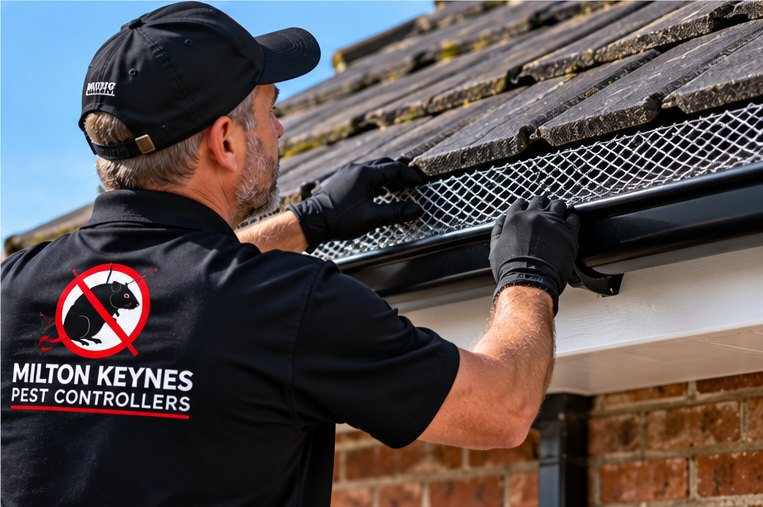
Photographs on this page are for illustration purposes only.
Where they go
In the Loft, on the Route
Traps are set inside the roof space, on the runs the animals are already using — along a wall plate, at the point of entry, on the timber they are travelling over. Sign in the dust tells the technician where those runs are, which is part of what the first inspection is for.
They are placed where nothing else will reach them. That means away from anywhere a cat could get to, away from a loft hatch a child might open, and away from stored possessions. If you have anything in the loft you would rather was not disturbed, say so before the visit rather than after it.
Traps are not set outdoors in gardens as a matter of course. An outdoor trap catches whatever is passing, which is neither the point nor lawful in the case of most of what is passing.
The checks
At Least Daily, and Why
A live-capture trap holding an animal is a welfare situation from the moment it closes. So they are checked frequently — at least once a day, and that is a floor rather than a target.
What that means for you practically is access. Somebody has to get into the loft daily, which means either the technician attending or, on some jobs, the householder checking and ringing in. If you are away for a week, the traps come out first. That is not flexible and any firm treating it as flexible is one to avoid.
The animal
Said Plainly
A grey squirrel that has been caught cannot lawfully be released, so it is dispatched. Done properly this is immediate, and it is done out of sight of the household — not at the doorstep, not in the garden, and not in front of children.
You are entitled to ask what method is used and to be told straightforwardly. You are also entitled to say that you do not want to know, which most people do, and that is respected without comment.
What you will not get from us is a euphemism dressed up as a different outcome. "Humane removal" is accurate as far as it goes, but it describes how it is done, not whether it happens.
The young
The Reason Timing Matters
Grey squirrels breed twice a year, broadly late winter into early spring and again around midsummer, and a female with a litter in your loft changes the job completely.
Remove the adult and leave dependent young and they starve in the roof. That is a welfare failure and it is also weeks of smell in your ceiling and, eventually, flies. So the inspection checks for it, and where young are present the approach changes — which may mean waiting, and may mean the drey itself is dealt with rather than trapping the adult and hoping.
If nobody raises this with you at all, that tells you something about the survey you have had.
How long
A Fortnight Is Normal
Set, check, reset. A straightforward single-animal job in a house with clear access is often finished inside a week or two. A loft with several animals, or a building with more than one way in, takes longer.
And trapping is only the first half. The proofing — closing the roofline so the next one cannot get in — is separate work and it is the part that decides whether you are doing this again next year. Trapping without proofing is renting a solution.
Squirrel work here carries a guarantee with follow-up support if it is needed. Ask what the wording covers when you book, and get the price agreed before anything starts.
Short answers
Squirrel Questions
Will you release it somewhere else?
No, and nobody lawfully can. Releasing a grey squirrel into the wild is an offence other than under licence.
How often are traps checked?
At least daily, on welfare grounds. It is not optional, and it is why access has to be arranged.
Can you use poison instead?
There is no approved poison for grey squirrels in the UK. Trapping is the method.
Will it happen where I can see it?
No. It is done out of sight of the household, and not at the doorstep or in front of children.
What if there are babies up there?
The approach changes. Removing the adult and leaving dependent young means they starve in the loft, which is both a welfare failure and weeks of smell.
How many visits is it?
More than one, always. A straightforward job is often a week or two of trapping, then the proofing as separate work.
Going further
Squirrel Guides
Where we cover
Squirrel Control Across the Area
Across Buckinghamshire, Bedfordshire and into Hertfordshire. Houses, bungalows, flats, commercial roof voids and listed buildings.
Still Not Sure What You Have?
The time of day answers it before anyone attends. There is no call-out fee for coming to look.
Get in touch
Book an Ant Treatment
Tell us what you have heard or seen, where, and at what time of day.
- Phone
- 01908 465226
- Message us on WhatsApp
- sales@miltonkeynespestcontroller.co.uk
- Milton Keynes Pest Controller Service
- Address
- South Row
Milton Keynes
MK9 3DQ - Covering
- Milton Keynes, Buckinghamshire, Bedfordshire and parts of Hertfordshire