
Home › Bed Bug Control
Homes · Rentals · Hotels & Guest Houses
Bed Bug Control
Bed bug treatment for homes, flats, rentals and businesses across Milton Keynes, Buckinghamshire, Bedfordshire and into Hertfordshire — finding every harbourage first, then treating all of them at once.
Bed Bugs: the Short Version
Bed bugs are the pest that makes people feel worst and act fastest, and almost every instinct people have in the first twenty-four hours makes the job harder. Moving to the spare room spreads them. Throwing out the mattress loses the evidence and rarely loses the bugs. A shop-bought fogger scatters them into the skirting and the next room.
So the first thing worth saying is the least dramatic: stop, don't move anything out of the room, and ring us.
We treat bed bugs in houses, flats, HMOs and student lets, rented property, hotels, guest houses and holiday lets across Milton Keynes and the towns around it. Same-day appointments are usually available, including evenings and weekends, and there is no call-out fee.
Two things also worth knowing before you read any further. Bed bugs are not a sign of a dirty home — they travel on luggage, on second-hand furniture and between adjoining flats, and a spotless house is as easy to infest as any other. And they are not known to transmit disease to people. What they cost you is sleep, not health.
Ring 01908 465226.
Bedrooms, sofas and shared walls, including HMOs and student lets.
Discreet visits for hotels, guest houses, Airbnbs and holiday lets.
Every harbourage found and treated together, not just the bed.
Including evenings and weekends, with no call-out fee.
Signs
How To Know It Is Actually Bed Bugs
Bites are what sends people looking, and bites are the one sign that proves nothing. Reactions vary enormously: two people can sleep in the same bed and only one of them marks. Some people never react at all. Others come up in rows or clusters of raised red welts, usually on skin that was uncovered in bed — most often arms, shoulders, neck and back.
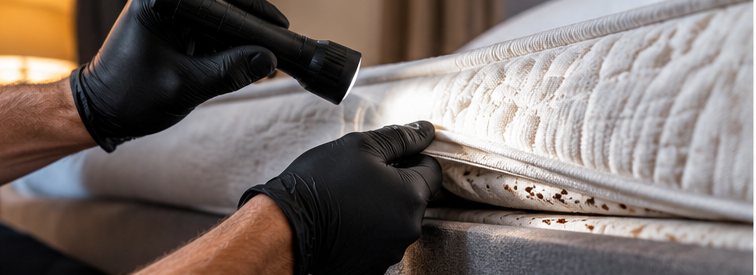
What does confirm it is what you find on the bed. Work along the seams and piping of the mattress, the folded edge of the divan base, the joints and screw holes of the headboard and the bed frame, and then outwards.
- Faecal spotting. Small black or very dark brown dots, the size of a full stop or a little bigger, often in runs along a seam. It is digested blood, so it smears rust-brown if you touch it with a damp cloth. This is the sign to trust.
- Live bugs. Adults are about 4 to 5mm, flat, oval and reddish-brown — an apple pip with legs. After a feed they are swollen and darker. The young are smaller and much paler, and easy to miss on a light mattress.
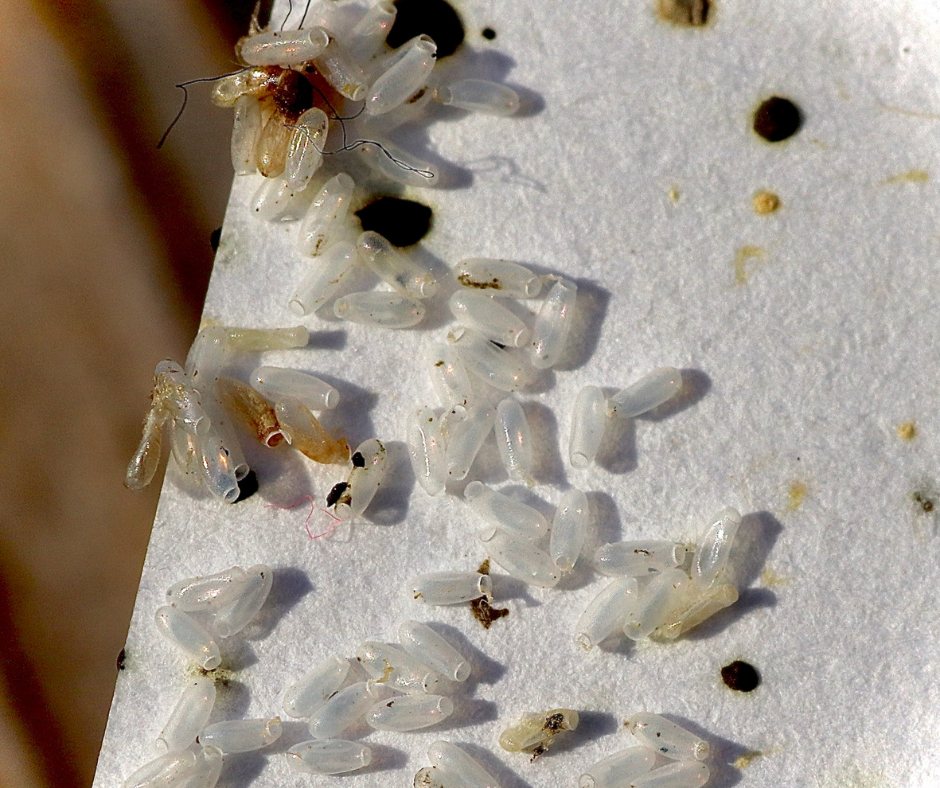
- Shed skins. Translucent, straw-coloured, empty shells the same shape as the bug. They moult five times on the way to adulthood, so skins pile up where they sit.
- Eggs. Pearly white, about a millimetre, cemented in place rather than loose, usually tucked into a seam or a crack in the frame.
- Blood spots on the bedding. Small, rust-coloured, usually where an arm or a shoulder rested.
Take a photograph of anything you find and send it to us. A fair proportion of the bed bug calls we take turn out to be carpet beetle or something else altogether, and a clear picture of a seam settles that before anybody books a visit.
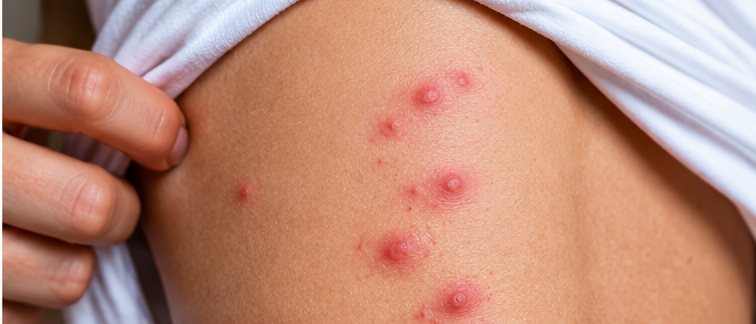
Photographs on this page are for illustration purposes only.
Inspection
The Visit Starts With Finding Them All
A bed bug treatment is only as good as the inspection in front of it. Treat the bed and miss the chair two metres away and you have not solved the problem, you have moved it.
Early on, they stay close to where people sleep — the bed, the base, the headboard, the bedside table. As numbers build they push outwards: sofas and armchairs, curtain hems, the underside of drawers, behind loose wallpaper and skirting, inside plug sockets and light switches, the backs of picture frames, and along the cable runs that pass through a wall.
So we go through the room with a torch before anything else: seams, piping, joints, screw holes, edges and undersides. Where there is a sofa in use, or someone has been sleeping on it, the sofa gets the same treatment as the bed. In a flat with shared walls we check the sockets and the pipe runs on the party wall, because that is the route between one address and the next.
The inspection is also what decides the method, and it is why nobody can honestly quote a bed bug job properly over the phone without knowing how many rooms are involved.
Treatment
Two Methods, and Which One Suits the Room
There are two ways to finish bed bugs properly, and we run both. They are not rivals; they suit different rooms.
Heat treatment
The room is brought up to a temperature bed bugs cannot survive and held there long enough for that temperature to reach inside the furniture, not just the air around it. Eggs are the most heat-tolerant stage and need roughly 48°C sustained for about an hour and a half, which is why the room itself is run hotter than that. Done properly it is the method least likely to leave viable eggs behind. It uses no insecticide, which matters in a nursery, and it leaves no residue, which is why a hotel room can go back into service the same evening.
Nobody can be in the treated area while it runs, and for a whole-house job that means everyone out — typically four to twelve hours depending on how much is being treated. A single room in a working hotel is a smaller version of the same thing: that room and the ones immediately adjoining it are closed off for the day, not the building. Anything that must come out of the room first is listed on the preparation checklist we give you.
There is a full section on this on the site: bed bug heat treatments.
Insecticide treatment
A thorough, targeted application to every harbourage found during the inspection, left in place to deal with bugs as they move over it. It is well suited to properties where heat is impractical, to large or cluttered rooms, and to cases caught early.
It comes with one honest caveat. Most residual products do not kill eggs, and bed bug eggs hatch roughly a week to ten days after they are laid at normal room temperature. So an insecticide treatment is planned as a course, with a follow-up timed to catch what hatches after the first visit. Anyone who tells you a single spray ends it is either selling you something or has not done many.
Resistance is the other reason the inspection matters. Bed bugs in the UK are widely resistant to the pyrethroid insecticides sold over the counter, which is a large part of why the supermarket sprays disappoint people. What we use and how we use it is chosen around that.
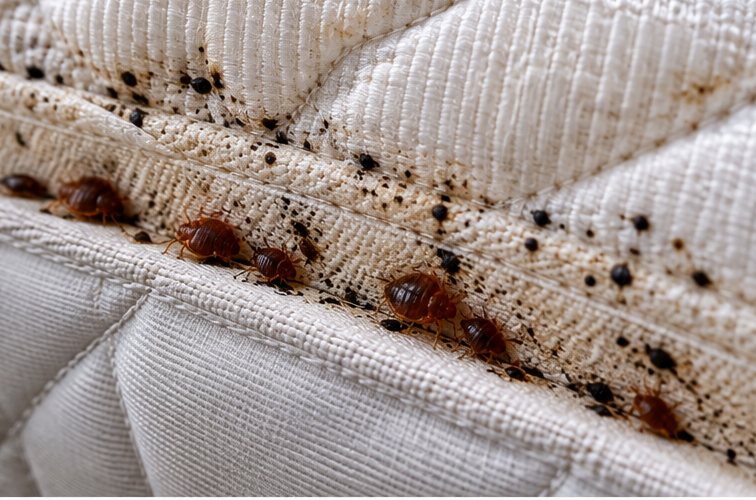
Photographs on this page are for illustration purposes only.
What not to do
The Four Things That Make It Worse
Every one of these is something we are told on the doorstep, and every one of them costs the customer time.
- Don't sleep somewhere else in the house. This is the big one. Bed bugs follow carbon dioxide and body heat. Move to the sofa and within a fortnight you have bugs in the sofa too, and a treatment that was one room becomes two. Keep sleeping in the bed until it is treated. It feels wrong; it is right.
- Don't throw the mattress out. Not yet. It carries the evidence we need, the bugs are rarely only in it, and a bagged mattress dragged down a communal stair sheds them all the way. If it does need to go, it goes after treatment and it goes wrapped.
- Don't set off a fogger or a bug bomb. They do not reach into seams and joints, and the repellent effect drives the survivors deeper into the structure and out into neighbouring rooms.
- Don't strip and redistribute the room. Clothes moved to another bedroom, cushions to the lounge, bags into the loft — each of those is a lift to a new harbourage. Leave things where they are and we will tell you what to move and how.
What does help before we arrive: hot-wash and tumble-dry bedding on the highest setting the fabric allows, vacuum the bed area and empty the cylinder straight into an outside bin, and pull the bed a few inches off the wall so we can get behind it.
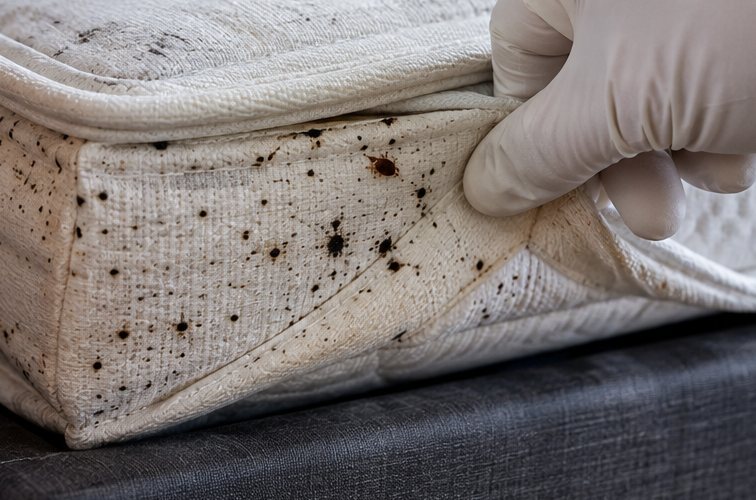
Photographs on this page are for illustration purposes only.
Rentals
Landlords, Agents and Shared Buildings
A large share of our bed bug work is rented property, and it has its own problems that have nothing to do with insects.
In a block or a converted house, bed bugs move along pipe runs, cable routes and socket boxes in the party wall. Treating one flat while the flat next door is untreated is money spent on a problem that walks back. Where we find evidence at a shared wall we will say so plainly, in writing, so the managing agent has something to act on.
In an HMO or a student let the same applies room to room. The honest answer is often that the whole floor needs doing at once rather than the one room that complained.
For changeovers and voids we can attend at short notice, including evenings and weekends, and provide a written account of what was found and what was done. Landlords and agents generally need that for their own records as much as for the next tenant.
Hotels
Hotels, Guest Houses and Holiday Lets
For accommodation the priority is different: it is discretion and turnaround. A room out of service is the cost, not the treatment.
We attend in unmarked clothing where that is wanted, work around occupancy, and can usually get a single room treated and back in use the same day. Heat is often the right choice here for exactly that reason — there is no residue to wait on and no smell in the room afterwards.
Where a guest has reported bites we also check the adjoining rooms and the rooms above and below, because by the time one room is reported it is rarely the only one. Housekeeping staff can be shown what to look for on a changeover, which is far cheaper than finding out from a review.
Photographs on this page are for illustration purposes only.
Afterwards
What Happens After the Treatment
You will be told what was found, where, which method was used and what is expected to happen next. If a follow-up is part of the plan it is booked before we leave, not left for you to chase.
Expect to see the odd bug for a short period after an insecticide treatment — that is the treatment working on bugs that were tucked away during the visit, not a failure. What matters is whether the numbers fall and whether the bites stop. Keep sleeping in the room; it is still the monitor.
After a heat treatment the room is usable as soon as it has cooled. There is no residue and nothing to wash down.
If you are still finding live bugs after the course is complete, ring us and say so. It usually means a harbourage outside the treated area — a sofa, a second bedroom, a neighbour — and that is a thing to find, not a thing to re-spray blindly.
Photographs on this page are for illustration purposes only.
Why us
Why Milton Keynes Pest Controllers
- Local, covering fifteen towns across three counties
- Same-day appointments, including evenings and weekends
- No call-out fee
- Full inspection before any treatment, not just the bed
- Heat and insecticide treatments, chosen to suit the room
- Fully trained and insured technicians
- Written account of what was found and done, for landlords and businesses
- Discreet unmarked visits on request
Ring 01908 465226 and tell us what you have seen.
Reading
Bed Bugs: the Questions We Get Asked
Ten things people ring and ask us about bed bugs, answered properly rather than in a sentence.
How To Check a Mattress for Bed Bugs
Ten minutes, a torch and an old bank card is all it takes, and it will give you a far better answer than staring at a bite.
Read it →What Bed Bug Eggs and Shed Skins Look Like
Eggs and skins are the two signs that tell you how old the problem is, and they are easier to find than the bugs themselves.
Read it →What Bed Bug Bites Do and Do Not Tell You
Bites are what send people searching, and they are the one sign that proves almost nothing on their own.
Read it →How Bed Bugs Get Into a Home
Nobody gets bed bugs because their house is dirty. They get them because something came through the door, or something came through the wall.
Read it →Heat Treatment or Insecticide: Which One?
They are not rivals. They suit different rooms, and the thing that separates them is what happens to the eggs.
Read it →Preparing a Room for Bed Bug Treatment
Good preparation makes the difference between a treatment that ends it and one that has to be repeated. Most of it is about not moving things.
Read it →Bed Bugs in Flats and Shared Walls
If you live in a flat and the bed bugs arrived with no travel and no new furniture, the explanation is usually on the other side of a wall.
Read it →Why One Visit Is Rarely the Whole Job
It comes down to eggs, and to the seven to ten days it takes them to hatch.
Read it →Second-Hand Furniture and Bed Bugs
Second-hand furniture is one of the two main routes bed bugs take into a home. Five minutes with a torch on the doorstep prevents most of it.
Read it →Bed Bugs in Hotels, Guest Houses and Holiday Lets
For accommodation the cost is not the treatment, it is room-nights and reviews. Both are decided by how early it is found.
Read it →Before you book
Bed Bug Control — Questions
How do I know it is bed bugs and not fleas?
Bed bug bites tend to be on skin that was uncovered in bed — arms, shoulders, neck, back — while flea bites cluster around the ankles and lower legs. Neither pattern is conclusive. Check the mattress seams for black faecal spotting. Fleas leave no spotting on a mattress seam, and they jump, which bed bugs cannot do.
Does a bed bug problem mean the house is dirty?
No. Bed bugs are brought in on luggage, second-hand furniture, bags and clothing, or they arrive along a shared wall from a neighbouring flat. They feed on blood, not on crumbs or mess, so cleanliness makes no difference to whether you get them. Clutter only matters because it gives them more places to hide once they are in.
Can bed bugs make me ill?
Bed bugs are not known to transmit disease to people. The real costs are broken sleep, itching, and in some cases a fair amount of anxiety. Bites can become infected if they are scratched open, so it is worth seeing a pharmacist or GP about any bite that looks infected or reacts badly.
Should I sleep in another room until it is treated?
No, and this is the advice people most often ignore. Bed bugs follow breath and body heat. If you move to the spare room or the sofa they follow, and a one-room job becomes a two-room job. Keep sleeping where you have been sleeping until the room is treated.
Do I have to throw the mattress away?
Usually not. The bugs are rarely confined to the mattress, so binning it alone does not end the problem, and dragging a bagged mattress through the building spreads them. If it does need to go it goes after treatment and wrapped. Wait until we have looked at it.
How long does a treatment take?
A heat treatment typically runs four to twelve hours depending on how much is being treated, and you need to be out of the property while it does. An insecticide treatment of a bedroom is usually a couple of hours on site, with a follow-up booked to catch what hatches afterwards.
Why does insecticide need a second visit when heat does not?
Because of the eggs. Bed bug eggs are cemented into cracks and seams, and most residual insecticides do not kill them. They hatch roughly a week to ten days later at room temperature, so the second visit is timed for that. Sustained heat kills eggs as well as bugs, which is why it can finish the job in a single pass.
Can I just use a spray from the supermarket?
It is very unlikely to work. Bed bugs in the UK are widely resistant to the pyrethroid insecticides those products are based on, and the sprays cannot reach into the seams, joints and screw holes where the bugs actually sit. Foggers are worse than useless: they repel, and scatter the survivors further into the building.
I live in a flat — could they be coming from next door?
It happens often. Bed bugs travel along pipe runs, cable routes and socket boxes in party walls. If we find evidence at the shared wall we will tell you, and put it in writing so the managing agent or landlord has something to act on. Treating one flat in isolation when the neighbour is infested is money badly spent.
Do you work with hotels and holiday lets?
Yes, and discreetly. We can attend in unmarked clothing, work around occupancy, and usually get a single room treated and back in service the same day. Where one room is reported we normally recommend checking the adjoining rooms and those above and below at the same time.
Where we cover
Bed Bug Control Across the Area
Across Buckinghamshire, Bedfordshire and into Hertfordshire, and the villages between them. Homes, flats, student lets, landlords and managed property, hotels, guest houses and holiday lets.
Tell Us What You Have Found
Bites, spotting on the mattress seam, or something you have found and cannot identify — send us a photograph or ring and describe it. Same-day appointments are usually available, including evenings and weekends.
Get in touch
Book a Bed Bug Visit
Tell us which rooms are affected, how long it has been going on, and what you have actually found. A photograph of a mattress seam is worth more than any description.
- Phone
- 01908 465226
- Message us on WhatsApp
- sales@miltonkeynespestcontroller.co.uk
- Milton Keynes Pest Controller Service
- Address
- South Row
Milton Keynes
MK9 3DQ - Covering
- Milton Keynes, Buckinghamshire, Bedfordshire and parts of Hertfordshire