
Outside first
The Roofline Tells You Before the Loft Does
Most squirrel evidence is visible from the garden with a pair of binoculars, and it is worth looking before going up a ladder or into a loft.
- A gap that has been made bigger. This is the signature. Squirrels gnaw, so an opening they use tends to have clean, enlarged, pale edges where timber or plastic has been cut back — quite unlike a gap that was simply always there.
- Damaged soffit, fascia or bargeboard, usually at a joint or a corner, and usually where something has rotted first.
- A lifted or slipped tile, particularly near the ridge or at a valley.
- A chewed or displaced vent or grille. Plastic roof vents are a common way in.
- Branches touching or overhanging the roof. Not damage, but the route that makes the rest possible.
- Traffic. Stand back at first light or late afternoon and watch. Squirrels are active in daylight, so unlike a rodent you can simply see them use the entrance.
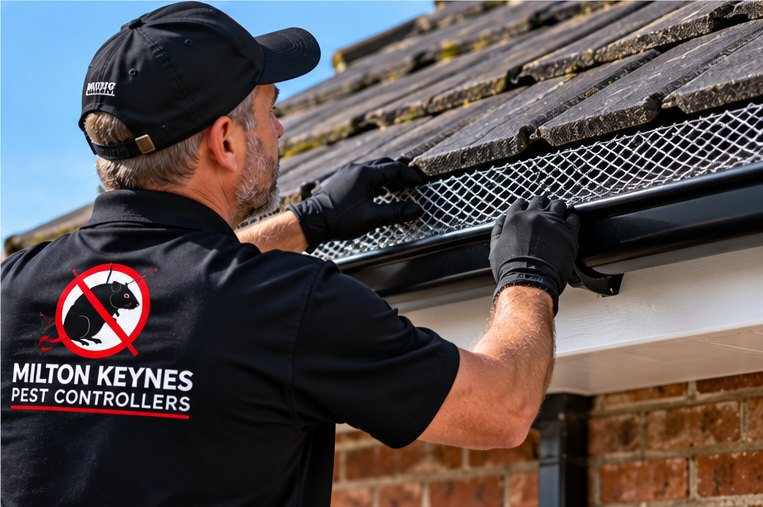
Photographs on this page are for illustration purposes only.
Inside
Four Things in the Loft
If you can get in safely, with a torch:
Stripped cable. The one that matters. Squirrels gnaw to manage continuously growing incisors and cable sheathing is a convenient thing to gnaw. Bare copper in a loft is a fire risk and it is the single best reason not to leave this.
Drey material. A substantial heap of shredded insulation, leaves, moss and paper, usually in a corner or between joists. Much bigger than a rodent nest and unmistakable once seen.
Fouled and flattened insulation. Urine staining and compressed runs. This is what has to be lifted and replaced afterwards, and it is a real cost.
Gnawed timber and pipework. Rafters, joists and plastic water pipe. A chewed pipe in a loft is how a squirrel problem becomes a ceiling collapse.
Telling them apart
Squirrel, Rat or Mouse
The three get confused constantly and the distinction changes the whole job.
Time of day settles it. Squirrels are active in daylight, particularly early morning and late afternoon, and quiet at night. Rats and mice are the exact opposite. If it wakes you at two in the morning it is not a squirrel.
Droppings. Squirrel droppings are rounder and more barrel-shaped than a rat's, which tend to be more tapered, and considerably bigger than a mouse's. They are also scattered rather than concentrated along a run.
Scale of damage. A squirrel enlarges an opening a rodent would have squeezed through. Gnawing on a roofline from the outside is squirrel; a neat hole through interior skirting is rodent.
Noise. Squirrels sound heavy, energetic and bounding, sometimes with a distinct thump. Rats sound like walking. Mice sound like something light being dragged.
What to do
Two Things Now, One Thing Not Yet
Do get an electrician to look if you have found stripped cable. That is the part of this that is genuinely dangerous and it is not a pest control job.
Do cut back overhanging branches, which is frequently the cheapest useful thing available and removes the route rather than the animal.
Do not seal the gap yet. This is the mistake to avoid. Closing the entrance with something inside leaves an animal shut in your roof, and if it is spring or midsummer it may leave dependent young shut in with no adult. Find out what is in there first, deal with it, and close up behind it in that order.
Short answers
Questions, Briefly
How do I know it is squirrels and not rats?
The time of day. Squirrels are active in daylight and quiet at night; rats and mice are the opposite. Damage helps too - squirrels enlarge roofline openings from outside.
Is chewed cable really a fire risk?
Yes. Bare conductors in a loft full of insulation and drey material is a genuine hazard, and it should be looked at by an electrician.
Can I just block the hole?
Not until you know nothing is inside. Sealing an animal into a roof is worse than leaving the gap, and in the breeding season it can shut dependent young in.
What does a drey look like inside a loft?
A substantial heap of shredded insulation, leaves, moss and paper, usually between joists or in a corner. Much larger than a rodent nest.
Does the insulation have to be replaced?
Where it has been fouled and compressed, yes. That is usually part of the clearing up afterwards.
Where to go next
The Pages That Answer This
Ring and Describe It
No call-out fee, same-day appointments where we can, and evenings and weekends.
Get in touch
Ask Us About It
Tell us what you have seen and where in the property. If you have a photograph, it is worth more than a description.
- Phone
- 01908 465226
- Message us on WhatsApp
- sales@miltonkeynespestcontroller.co.uk
- Milton Keynes Pest Controller Service
- Address
- South Row
Milton Keynes
MK9 3DQ - Covering
- Milton Keynes, Buckinghamshire, Bedfordshire and parts of Hertfordshire