
Home › Squirrel Control › Chewed Wiring and Fire Risk
Electrical damage
Chewed Wiring and Fire Risk
This is the part of a squirrel problem that costs real money, and it needs an electrician as well as a pest controller.
Why they chew cable
It Is Not About Eating It
Squirrels have incisors that grow continuously and have to be worn down. Gnawing is maintenance, not appetite, and it is directed at whatever is the right hardness — which is why cable sheathing, plastic pipe, conduit and structural timber all get chewed by an animal that has no interest in any of them as food.
Cable is particularly attractive because it is the right diameter to work on and it runs conveniently along the timbers they are already travelling on. A squirrel does not seek out your ring main. It travels the joists and the cable is stapled to them.
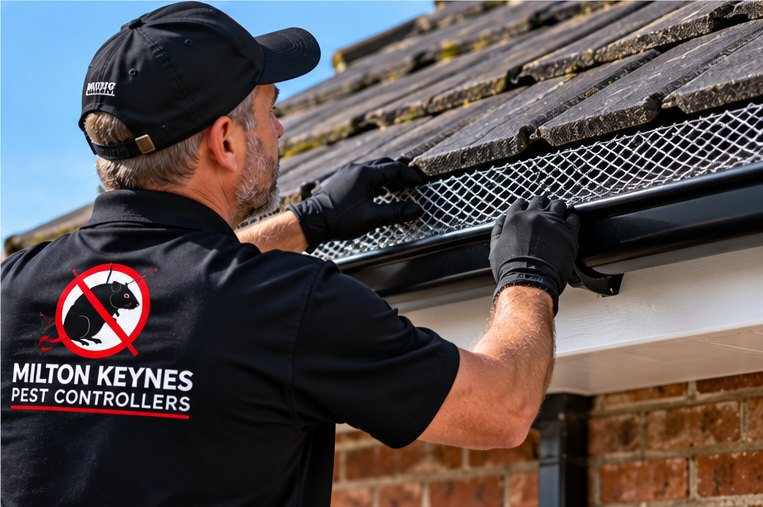
Photographs on this page are for illustration purposes only.
The actual mechanism
Why This Is a Real Fire Risk
The risk is not a cartoon short-circuit. It is this: gnawing removes insulation from a conductor, and a bare or nearly bare conductor sitting in loose-fill insulation and dry drey material is a heat source in a bed of fuel.
Two things make it worse than it sounds. Arcing at a damaged point generates far more local heat than the cable's normal load, and it can do so intermittently for a long time without tripping anything. And a circuit breaker protects against overload and short circuit — it is not designed to detect a small arc at a partially damaged cable, which can smoulder loft insulation without ever drawing enough current to operate.
An RCD improves the odds considerably where a fault goes to earth. It is not a guarantee, and it is not a reason to leave chewed cable in place.
What to look for
In the Loft, With a Torch
If you are going up to look, tread only on joists, keep off the insulation, and do not touch cable. What you are looking for:
- Bright copper anywhere. Exposed conductor is the thing that matters most and it stands out against grey sheathing.
- Missing sheath in short sections, often with neat parallel tooth marks at the edges.
- Cable pulled away from its clips or staples, sometimes into a drey.
- Sooting or scorch marks on timber or insulation near a cable. This is the one to act on immediately.
- A smell of hot plastic, with or without anything visible.
The wider set of signs — roofline evidence, loft evidence, and how to tell squirrel sign from rat and mouse sign — is covered in identifying the signs of squirrel damage.
Also worth checking: chewed plastic water pipe, and the lid of a cold water tank. A squirrel drowning in an open tank is a different problem and an unpleasant one.
Who to call
Two Trades, Not One
We deal with the animal, the way in and the clearing up. The cable is not a pest control job and we will not pretend otherwise.
Damaged wiring needs a competent electrician — someone registered with one of the recognised schemes, who can inspect and test the affected circuits and issue the appropriate certification for what they replace. Cable that has been gnawed gets replaced rather than taped, because tape restores neither the insulation rating nor the mechanical protection.
If you have scorching, or a smell of hot plastic, or lights and sockets behaving oddly, that is an electrician today rather than at your convenience. Turning off the affected circuit at the consumer unit in the meantime is reasonable, and safer than waiting with it live.
Insurance
Worth Asking Before You Spend
Some home policies cover damage caused by wild animals and some specifically exclude damage by rodents or vermin, and grey squirrels can fall on either side depending on the wording. It is worth reading yours rather than assuming, because the cost here is rarely the pest control — it is the rewiring and the insulation.
What helps a claim, whichever way the wording goes: photographs before anything is disturbed, a written record of what was found and where, dates, and the electrician's report on what needed replacing. We can provide our part of that as a matter of course. Ask for it at the time rather than afterwards.
We are not insurance advisers and we do not deal with insurers on anyone's behalf. What we can do is make sure you have the evidence in a form you can submit.
Short answers
Squirrel Questions
Why do squirrels chew wires?
Their incisors grow continuously and have to be worn down. Cable is the right hardness and it runs along the timbers they travel on.
Is it genuinely a fire risk?
Yes. A damaged conductor in loose insulation and dry drey material can arc and generate far more local heat than normal load, sometimes without tripping anything.
Will my circuit breaker catch it?
Not reliably. Breakers protect against overload and short circuit, not a small intermittent arc. An RCD improves the odds but is not a reason to leave it.
Can you repair the wiring?
No - that needs a registered electrician. We deal with the animal, the entry point and the clearing up.
Can I just tape the damaged bit?
No. Tape restores neither the insulation rating nor the mechanical protection. Damaged cable gets replaced.
Will my insurance cover it?
It depends entirely on the wording - some policies cover wild animal damage and some exclude rodents or vermin. Photograph everything before it is disturbed either way.
Going further
Squirrel Guides
Where we cover
Squirrel Control Across the Area
Across Buckinghamshire, Bedfordshire and into Hertfordshire. Houses, bungalows, flats, commercial roof voids and listed buildings.
Still Not Sure What You Have?
The time of day answers it before anyone attends. There is no call-out fee for coming to look.
Get in touch
Book an Ant Treatment
Tell us what you have heard or seen, where, and at what time of day.
- Phone
- 01908 465226
- Message us on WhatsApp
- sales@miltonkeynespestcontroller.co.uk
- Milton Keynes Pest Controller Service
- Address
- South Row
Milton Keynes
MK9 3DQ - Covering
- Milton Keynes, Buckinghamshire, Bedfordshire and parts of Hertfordshire