

Home › Drain Rat Blockers
Drains · Sewers · Exclusion
Drain Rat Blockers
A one-way valve in the drain stops rats coming up from the sewer. It only closes that one route — so the first job is finding out whether that is the route they are using.
First question
Is It Actually the Drains?
Rats get into buildings from underneath as well as from outside, and the two look different from the start. Drainage is worth suspecting when:
- There is no outside entry point to find. The brickwork is sound, the airbricks are intact, the roofline is closed, and there are still rats. This is the strongest single indicator.
- The activity is under the floor rather than in the loft — scratching and running below you at night, not above.
- Droppings turn up in a basement, a utility room or under the stairs, near where pipework enters.
- There is a smell that is sharp and ammonia-like, or a drain smell that has appeared and stayed.
- It arrived suddenly, in a property with no history and no obvious food source outside.
Against that: activity in the loft, in the roofline, or in a wall at first-floor level is usually not a drainage problem, and a blocker will not touch it. That is rat control rather than this.
The product
What a Blocker Actually Is
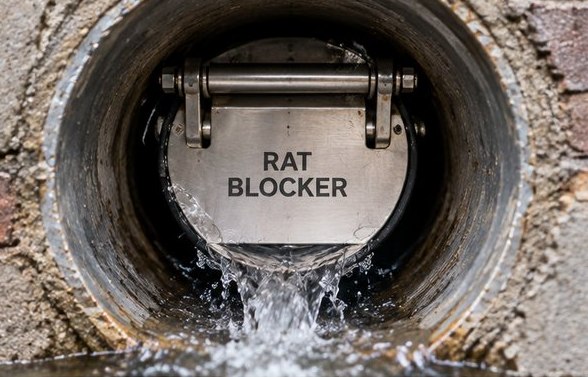
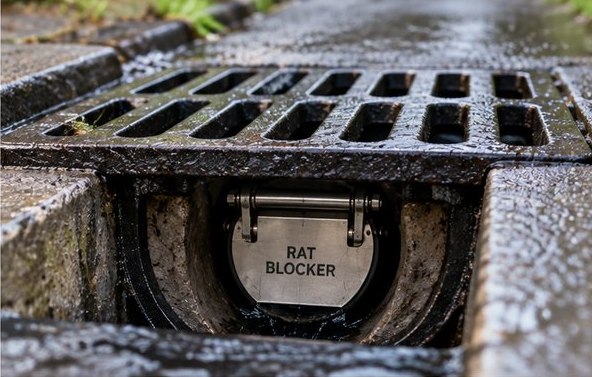
A drain rat blocker — also sold as a rat stopper or a non-return valve — is a one-way flap that fits inside the pipe. Stainless steel or heavy PVC, hinged at the top, hanging closed.
Water and waste flowing out push it open and pass underneath. Anything trying to travel the other way pushes it shut. That is the whole mechanism: no moving parts to fail, no power, nothing to replace.
It is fitted into the pipe leaving an inspection chamber, on the house side of the boundary, so that everything downstream of it — including the sewer — is on the far side of a closed flap.
- The blocker. A one-way flap in the pipe leaving the chamber, hinged at the top. Flow out pushes it open; anything coming back pushes it shut.
- Your drain. The pipe serving your building, inside the boundary. Yours to maintain, and the part a blocker is fitted into.
- The boundary. Where responsibility changes hands. Beyond it the lateral drain and the sewer belong to the water company, and a defect on that side is theirs to repair, not yours to pay for.
- The sewer. Where the rats are coming from. It is a permanent population and nothing you do to your own property changes that — which is why closing the route matters more than treating the animal.
- The routes a blocker does not close. The airbrick, the gap where a soil pipe passes through the wall, and anything higher up. These are a separate job, and on most properties there are only a handful of them.
The right one for your system is a matter of pipe diameter and chamber type, and it matters more than it sounds. In the firm's own words on the live page: installing the wrong size, or placing it incorrectly, can cause drainage problems or leave a gap for rats to get round. That is the argument for having it fitted rather than bought online.
Images on this page are illustrations only.
The honest part
It Closes One Route, and Only One
This is on the live page already and it is worth repeating rather than burying: a blocker stops rats using the drainage. If rats are still getting in afterwards, they are coming through something else — gaps in brickwork, an airbrick, a vent, a gap where a service pipe passes through a wall, or the roofline.
Which leads to the thing that decides whether this is money well spent: a blocker on a drain the rats were never using achieves nothing at all. It is a perfectly good product fitted to the wrong problem, and you will not know the difference until the noise carries on.
So the order matters. Find out where they are coming from first. If the answer is the drain, the blocker is an excellent answer and it is permanent. If the answer is a hole behind the bin store, the blocker is an expensive way of not fixing it.
Where a blocker genuinely earns its place as prevention — no current problem, but a property near an old sewer, or one that has had drain rats before — that is a different and reasonable decision, and worth saying so plainly.
Who owns what
Some of This Pipe Is Not Yours
Worth knowing before you pay for anything, because it can change who does the work.
- A drain serves your building alone. Inside your boundary, it is yours.
- A lateral drain is the length running from your boundary to the sewer, usually under the pavement or road. That is the water company's.
- A sewer collects from more than one building. Also the water company's.
The line falls at the property boundary. So if a survey finds the defect letting rats into the system is on the public side, that is the water company's to repair, and it is not billed to you. Two companies serve this patch, Anglian Water and Thames Water, and which one you have depends where you are — your bill says.
A blocker still goes on your side, and it still works. But if a broken public sewer is the source, reporting it is free and it fixes the problem for the street rather than for one house. There is a fuller account in who owns which drain.
The survey
Looking Before Fitting
Sometimes a survey is unnecessary: an accessible chamber, obvious activity, a straightforward layout, and the blocker goes in.
Where it earns its money is when the picture does not add up — rats indoors with no outside entry, a property that has been baited repeatedly without the problem ending, drainage that has been altered by an extension, or an older system nobody has mapped.
A CCTV drain survey puts a camera through the system and finds what is actually there: a cracked or displaced pipe, a collapsed section, a disused connection left open, a redundant branch capped at one end only, a defective interceptor trap. Any of those is both the way in and, usually, the thing that needs repairing regardless of rats.
It also tells you where the blocker should go, and whether a blocker is the right answer at all.
Images on this page are illustrations only.
What we do
The Four Steps
Set out on the live page and worth restating in order:
- Survey, if it is needed. CCTV or a manual inspection of the chambers, to establish where rats are entering the system and whether there is a defect.
- Selection. The correct size and type of blocker for the pipe and the chamber, which is not a one-size decision.
- Installation in the appropriate chamber, so flow is unaffected and the valve is accessible.
- Follow-up advice on the other places that need sealing, because the drain is one route and there are usually others.
The products are made for permanent immersion in a waste system. They need no power, no chemicals and effectively no maintenance, and there is nothing inside the house at any stage — no bait, no traps, no disruption indoors. Quotes are free and the price is agreed before anything happens.
The rest of the job
Where Else They Get In
Once the drainage is closed, the remaining routes are the ordinary ones, and on most properties there are only a handful:
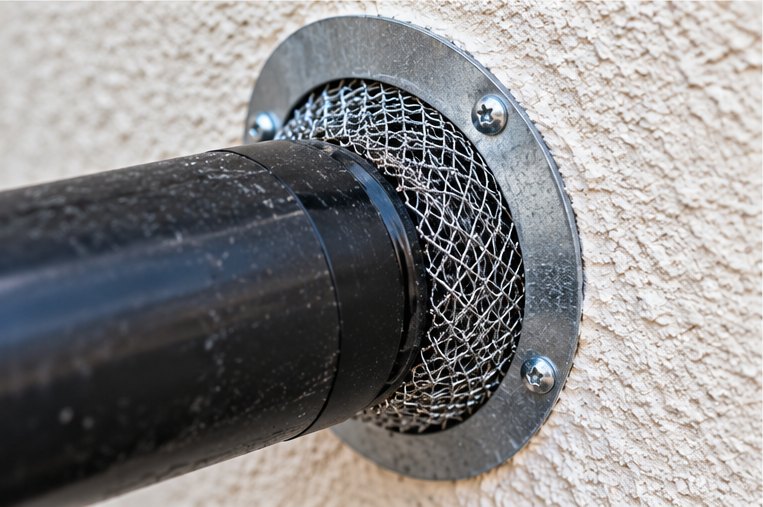
- Where a soil pipe or service pipe passes through a wall, which is very often a gap somebody filled with expanding foam years ago.
- Airbricks and weep holes — meshed over, never blocked up, because they ventilate the structure.
- Gaps under door thresholds and around garage doors.
- Where the extension meets the original, and any void created by building work.
- Roofline and eaves, for anything getting in high up rather than low down.
A rat needs a gap about the width of your thumb. Proofing is unglamorous and it is the part that lasts, on this job as on every other one.
Images on this page are illustrations only.
Going further
Drain and Rat Guides
Short answers
Drain Blocker Questions
What is a drain rat blocker?
A one-way flap valve that fits inside the drain pipe. Waste flowing out pushes it open; anything travelling the other way pushes it shut. Stainless steel or heavy PVC, hinged at the top, no moving parts to fail.
Will it stop all the rats?
It stops the ones using the drainage. If rats keep getting in afterwards they are coming through something else - brickwork, a vent, a gap round a pipe, or the roofline. That is the honest limit of the product.
Will it affect my drains?
A correctly sized and correctly placed one does not. Flow out is unaffected. A wrong size or a bad position can cause problems, which is the main argument against fitting one yourself.
Do I need a drain survey first?
Not always. Where the chamber is accessible and the picture is clear, no. Where rats are indoors with no outside entry point, or baiting has not ended it, a CCTV survey finds the actual defect.
How do I know it is the drains and not the loft?
Listen to where it is. Activity under the floor, droppings near where pipework enters, a sharp ammonia smell, and no findable entry point outside all point downwards. Noise in the loft does not.
Can I fit one myself?
They are sold online, and the two ways it goes wrong are the wrong diameter and the wrong position - one causes drainage problems, the other leaves a gap to get round.
Is any of this pipe the water company’s?
Yes. Your drain within the boundary is yours; the lateral drain from the boundary to the sewer, and the sewer itself, are the water company’s. If the defect is on their side, the repair is theirs.
How long does a blocker last?
They are made for permanent immersion in a waste system and need effectively no maintenance. Expect years rather than seasons.
Does anything have to happen inside the house?
No. There is no bait and no trapping indoors as part of this. The work is in the chamber outside.
What does it cost?
It depends on the system, the chamber and whether a survey is needed, so the quote is free and the price is agreed before any work starts.
Where we cover
Drain Rat Blockers Across the Area
Across Buckinghamshire, Bedfordshire and into Hertfordshire. Houses, flats, managed blocks, yards and food premises — survey, sizing and installation.
Hearing Them Under the Floor?
Tell us what you are hearing and whether you can find a way in outside. Free quote, no call-out fee.
One Last Thing
If you are hearing something under the floor and cannot find a way in outside, that is the pattern worth ringing about. Tell us what you are hearing, where, and whether there is an inspection chamber you can lift — that is usually enough to say whether a survey is worth doing.
Get in touch
Book an Ant Treatment
Tell us what you are hearing or finding and roughly where, and whether you have an inspection chamber you can lift. That is usually enough to say whether a survey is worth it.
- Phone
- 01908 465226
- Message us on WhatsApp
- sales@miltonkeynespestcontroller.co.uk
- Milton Keynes Pest Controller Service
- Address
- South Row
Milton Keynes
MK9 3DQ - Covering
- Milton Keynes, Buckinghamshire, Bedfordshire and parts of Hertfordshire