
Home › Bedbug Heat Treatments
Homes · Hotels · Guest houses · Lets
Bed Bug Heat Treatments
Heat kills every life stage including the eggs, it uses no insecticide at all, and it can usually be done in a single visit. Across Milton Keynes and Buckinghamshire.
The short version
Why Heat, and When It Is Worth It
Bed bugs are hard to finish with insecticide for two reasons. The eggs are well protected, so a treatment that kills everything walking about still leaves the next generation to hatch. And bed bug populations worldwide have developed substantial resistance to pyrethroids, which are the active ingredient in most products sold to the public and in a good deal of what is used professionally.
Heat sidesteps both. It is physics rather than chemistry, so nothing can be resistant to it, and it reaches every life stage including the eggs in one pass. There is no insecticide involved and nothing is left behind on the surfaces afterwards.
It is worth the money in particular circumstances:
- More than one room is affected, or you are not confident it is confined to one.
- It has been going on a while and is well established in furniture rather than just the bed.
- The room has to go back into use quickly — a hotel room, a let between bookings, a room somebody has to sleep in.
- No insecticide is wanted in the property at all, which comes up with small children, with pets, and in some food and care settings.
- Insecticide has already been tried and has not worked.
For a single bed in a single room caught early, a conventional treatment may be the more sensible spend. We will say so.
How it works
What Actually Happens on the Day
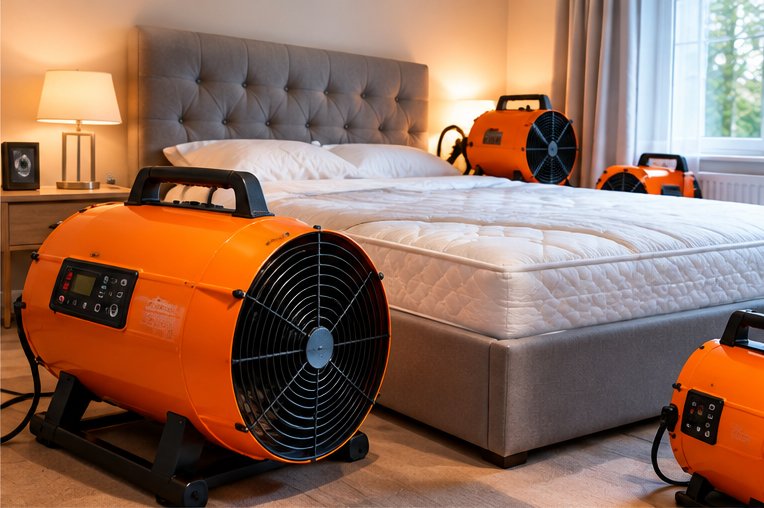
Specialist heating equipment is positioned in the affected rooms and used to raise the air temperature under controlled conditions, then hold it there. Fans move the hot air so it reaches into the places bed bugs actually are rather than simply making the room feel hot.
That distinction is the whole job. Bed bugs are not sitting in the open. They are inside mattress seams and divan bases, in the joints and screw holes of a bed frame, behind a headboard, under carpet edges, in skirting gaps, behind a loose piece of wallpaper, inside a bedside drawer runner and, as often as not, behind an electrical faceplate. Those places lag a long way behind the air temperature, which is why the treatment runs for hours rather than minutes.
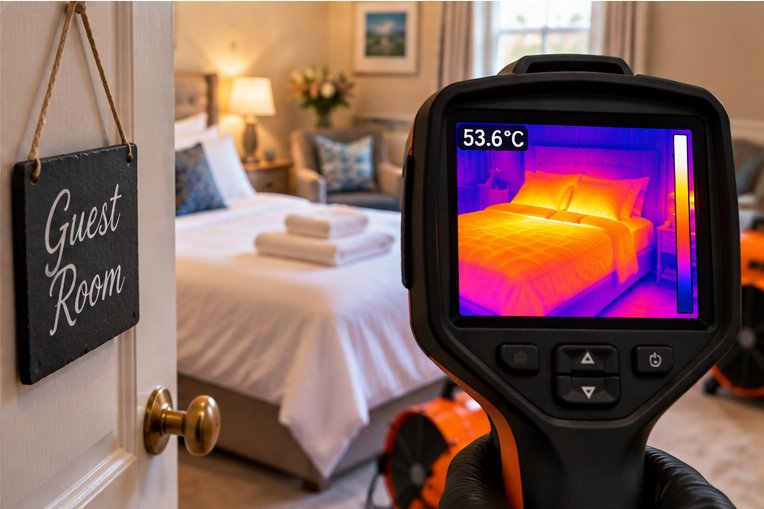
The numbers, which are standard published entomology rather than anything we are claiming: bed bugs die within minutes at around 48°C and within roughly ninety minutes at around 45°C. Eggs are the resistant stage and need sustained temperature at the upper end of that. So room air is taken to roughly 50 to 56°C and held, because the surfaces and voids need to get there too.
Photographs on this page are for illustration purposes only.
Monitoring
The Number That Matters Is the Coldest One
Temperature monitoring is not a flourish. It is the part that decides whether the treatment worked.
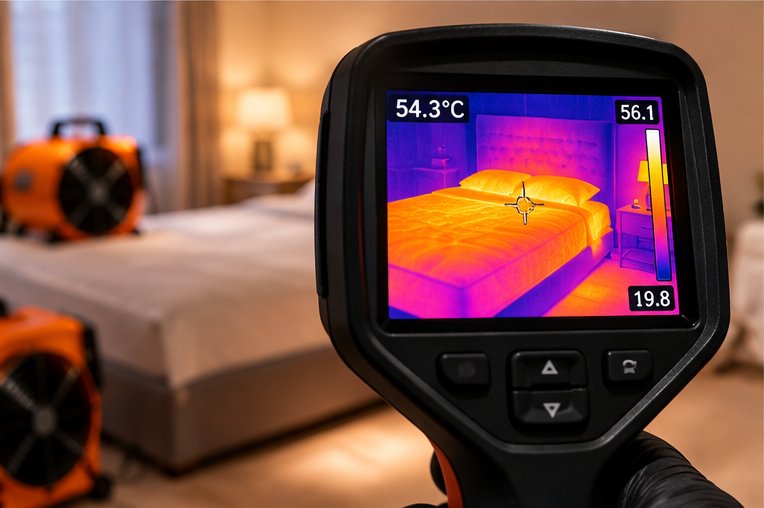
Probes go into the places that heat slowest — inside the divan base, under the mattress, behind the headboard, at the skirting on an external wall — and they are watched throughout. A thermal camera shows where the room is lagging so the equipment can be repositioned while there is still time to fix it.
A room can read 55°C in the middle and still have a cold pocket behind a wardrobe on an outside wall that never got above 40°C, and that pocket is where the survivors come from. Reaching temperature on average is not the same as reaching it everywhere, and it is the reason a treatment that was hot enough can still fail.
Photographs on this page are for illustration purposes only.
More than one room
Multi-Room and Whole-Property Treatments
A bed bug problem does not politely stay in the room where it was found. They are carried between rooms on clothing, bedding, luggage and furniture, and in a building they will also move themselves along service voids, under skirtings and through the gaps around pipework.
So the first question is not which room to treat, it is how far it has got. We would rather inspect properly and treat three rooms once than treat one room three times.
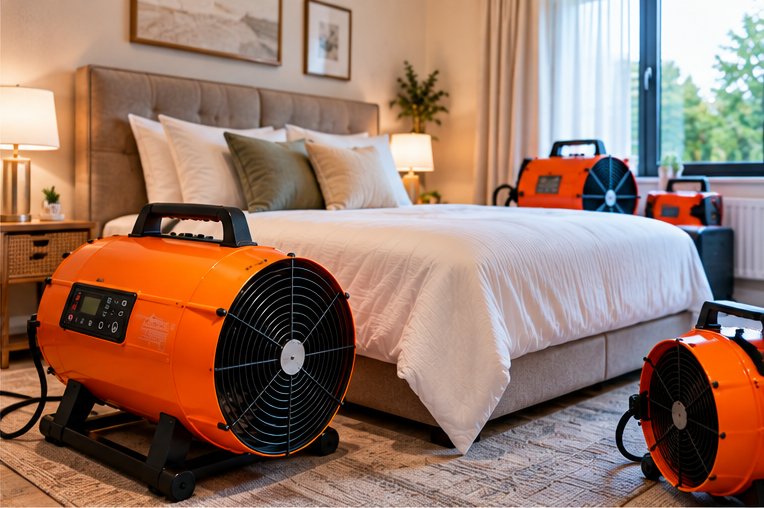
Multi-room treatment is routine for us and is what most of the commercial work involves:
- Houses with activity in more than one bedroom
- Flats and apartments, where the neighbours matter
- HMOs and shared accommodation
- Hotels, guest houses and B&Bs
- Short-term and holiday lets
- Student accommodation
- Rental property, for landlords and managing agents
Photographs on this page are for illustration purposes only.
At home
Bed Bug Heat Treatment for Homes
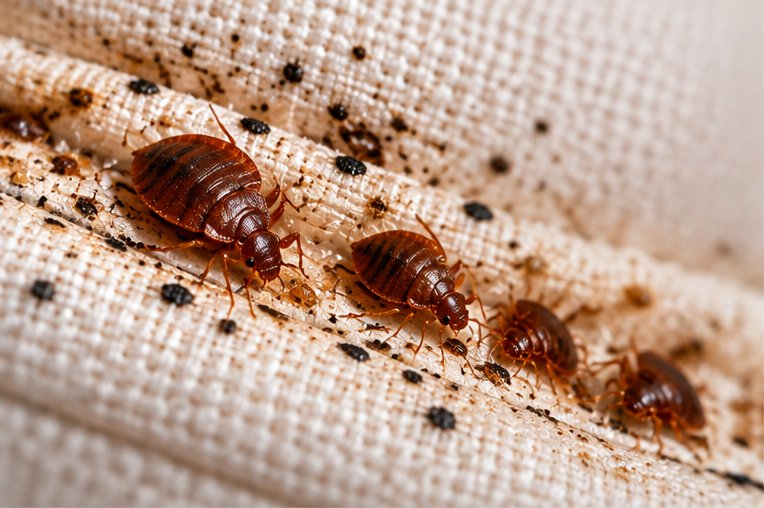
Finding bed bugs at home is genuinely distressing, and the thing that makes it worse is the bites carrying on after you have stripped the bed, washed everything at sixty and hoovered twice. That is not a failure on your part. It is that the mattress is only one of the places they are.
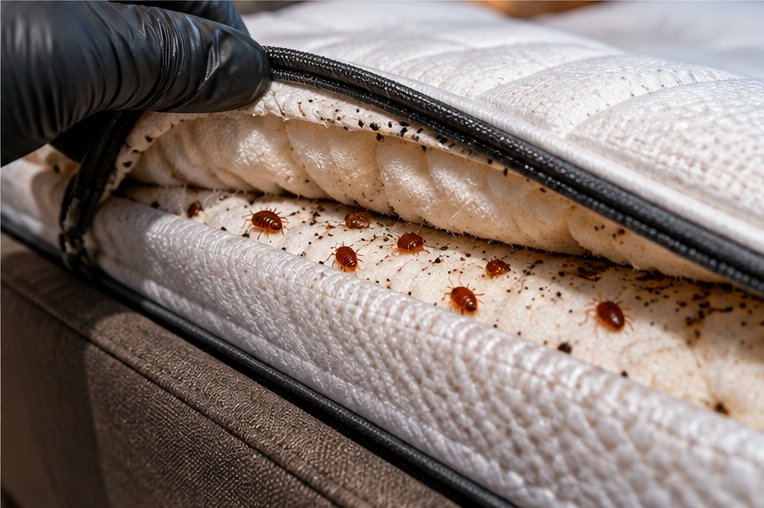
Typical harbourage in a domestic bedroom: the mattress seams and piping, the divan base and its access panels, the joints and fixings of the bed frame, the back of a headboard, bedside furniture, the carpet edge at the gripper rod, skirting gaps, and any upholstered furniture in the room. A sofa in a living room where somebody has been sleeping is a common second site.
Two things worth knowing before you ring anyone. Do not start carrying things out of the room — moving an infested mattress through a house is one of the main ways a one-room problem becomes a three-room one. And do not move to the spare room or the sofa, because they follow the host and you will simply take them with you.
Photographs on this page are for illustration purposes only.
Discretion
Nobody Needs to Know We Were There
For a homeowner this is about neighbours. For a hotel, a guest house, a landlord or anyone letting a property it is about the business, and it is often the deciding factor in who gets the call.
Where it is arranged in advance we can attend in an unmarked vehicle. Technicians work without discussing the job in front of guests or neighbours, equipment goes in and out in one movement rather than being left in a corridor, and visits can be timed around changeover.
Say what you need when you book. Discretion arranged beforehand is straightforward; discretion requested when a van with a bed bug on the side is already on the drive is not.

Photographs on this page are for illustration purposes only.
Preparation
What You Need to Do Before We Arrive
You get written preparation guidance for your specific property before the day, because the detail depends on the rooms and the equipment. The general shape of it:
- Heat-sensitive items come out. Candles, aerosols and pressurised containers, medicines, cosmetics, vinyl records, musical instruments, some electronics, anything with a battery in it, wax, chocolate, houseplants and pets including fish.
- Anything flammable comes out, and this one is not negotiable.
- Leave the room otherwise as it is. Do not strip it out. The heat needs to reach the things that are in it, and things removed to another room take bed bugs with them.
- Do not spray anything beforehand. A repellent product scatters them and makes the job harder.
- Open drawers and wardrobes and pull furniture away from walls where you can, so air can move around it.
If you are not sure about an item, ask rather than guess. The technician would far rather answer a question the day before than find an aerosol behind a headboard.
Photographs on this page are for illustration purposes only.
Afterwards
What to Expect When the Equipment Comes Out
The room needs time to cool, and then it can go back into normal use. There is no insecticide residue to avoid, nothing to wipe down and no exclusion period for children or pets — which is one of the practical reasons hotels and families choose heat.
Heat kills what is in the treated space at the time. What it does not do is stop a new one arriving next week in a suitcase. So where there is a source that keeps re-supplying the problem — an adjoining flat, a regular traveller, a communal area — that gets dealt with too, or you will be doing this again.
The live page describes the treatment as guaranteed, and a post-treatment check is part of the process. Ask what the wording covers when you book.
Photographs on this page are for illustration purposes only.
Accommodation and rental property
If You Manage Somewhere People Sleep
The problem is different when the bed is not yours. These set out what changes.
Short answers
Heat Treatment Questions
Can you heat treat more than one bedroom?
Yes, and it is routine. Where bed bugs are present or suspected in several rooms the treatment is planned across them after an inspection, rather than doing one room at a time and hoping.
Does it use chemicals?
No. Heat treatment uses no insecticide at all and leaves no residue, which is why it comes up with small children, pets, food premises and anyone who does not want products in the property.
Does it kill the eggs?
Yes, and that is the main reason to use it. Eggs are the stage that survives most insecticide treatments, which is why those usually need a second visit timed against the hatch.
Is one treatment enough?
Often, which is unusual for bed bugs. It depends on the extent of it and on whether there is a source still feeding the problem. A post-treatment check is part of the process.
How hot does the room get?
Room air is taken to roughly 50 to 56 degrees and held there, because the places bed bugs hide lag well behind the air. Temperatures are monitored with probes and a thermal camera throughout.
Do I need to leave the property?
You need to be out of the treatment area while the equipment is running. Your technician will tell you what that means for your property before the day.
Will it damage my things?
Heat-sensitive items are removed beforehand and you get written guidance on what those are. Anything you are unsure about, ask rather than guess.
Can you come in an unmarked vehicle?
Where it is arranged in advance, yes. It is worth saying when you book rather than on the day.
Does having bed bugs mean the property is dirty?
No. They feed on people, not on dirt, and they arrive in luggage, clothing and second-hand furniture. Clutter gives them more places to hide, which makes treatment harder, but that is all.
Can I tell from the bites?
Not reliably. People react very differently and several things bite. The evidence that settles it is on the mattress seam and the bed frame rather than on the skin.
Where we cover
Heat Treatments Across the Area
Across Buckinghamshire, Bedfordshire and into Hertfordshire. Homes, flats, hotels, guest houses, lets and shared accommodation.
Not Sure Whether You Need Heat?
Send a photograph of the mattress seam and we will tell you straight. There is no call-out fee.
One Last Thing
If you have found something and you are not sure what it is, send a photograph of the mattress seam and the bed frame joints before you move anything. It is usually enough to tell you whether this is a heat treatment job or a smaller one, and there is no call-out fee for coming to look.
Get in touch
Book a Heat Treatment
Tell us how many rooms are affected, what sort of property it is, and whether anyone is sleeping in it. If you have a photograph of the mattress seam, send it.
- Phone
- 01908 465226
- Message us on WhatsApp
- sales@miltonkeynespestcontroller.co.uk
- Milton Keynes Pest Controller Service
- Address
- South Row
Milton Keynes
MK9 3DQ - Covering
- Milton Keynes, Buckinghamshire, Bedfordshire and parts of Hertfordshire