

Home › Mice Control
Homes · Lofts · Businesses
Mice Control
Mice control for homes and business premises across Milton Keynes, Buckinghamshire, Bedfordshire and into Hertfordshire — finding the gap they are using and closing it, not just catching the ones inside.
Mice: the Short Version
Mice are the pest people live with longest before ringing anybody. A bit of scratching in the ceiling, a few droppings behind the toaster, nothing that feels like an emergency — and six weeks later it is three rooms and the loft.
That is not carelessness. It is arithmetic. In good conditions a female mouse can produce a litter every three or four weeks, and the young are breeding themselves at about six weeks old. A problem that looks small in week one is a different problem in week eight, which is the best argument there is for ringing early.
We treat mice in houses, flats, lofts, cavity walls, garages and business premises across Milton Keynes and the towns around it — shops, offices, warehousing, restaurants and food premises. Same-day appointments are available, evening and weekend visits are at no extra cost, and there is no call-out fee.
The half of the job that decides whether you see us again is the proofing. Catching what is inside is the easy part; finding the gap they are walking through is the part that ends it, and it is included rather than quoted separately.
Ring 01908 465226.
Lofts, cavity walls, under floors, kitchens, garages and sheds.
Restaurants, kitchens, shops, warehousing and storage.
Finding the gap and closing it, which is what stops it happening again.
Evenings and weekends at no extra cost, with no call-out fee.
Signs
How To Tell It Is Mice
Mice are quiet, small and mostly nocturnal, so you generally meet the evidence long before you meet the animal.
- Droppings. The clearest sign. Three to six millimetres, dark, shaped like a grain of rice with pointed ends, and scattered rather than piled — a mouse produces dozens a day and does not choose a spot. Find them behind the kettle, in the back of a cupboard, along the top of a skirting board, in a drawer.
- Scratching at night. Usually between the ceiling and the floor above, in a cavity wall, or under floorboards. Light, quick and scurrying not heavy.
- Gnawing. Rodent incisors grow continuously, so mice gnaw to keep them worn down. Look for it on food packaging, the corner of a cupboard door, cable insulation and plastic pipework.
- Runs. Mice have poor eyesight and travel by touch, keeping to walls and edges. You read the run from where the droppings are densest, because a mouse defecates as it goes rather than at a chosen spot — so the droppings are scattered, and the route is the line they are thickest along. In a long-standing infestation you may also find a faint grey-brown smudge where they rub the same edge, though it is far less obvious than the smears a rat leaves and its absence tells you nothing.
- The smell. An established population has a distinct stale, musky ammonia smell. People often notice it in a cupboard or a loft hatch before anything else.
If what you are finding is much bigger — droppings 12 to 18mm, tapered like a large grain of rice, heavy movement overhead, holes you could put a fist through — that is a different animal. There is an article about the difference on the rat pages: rat or mouse, telling them apart.
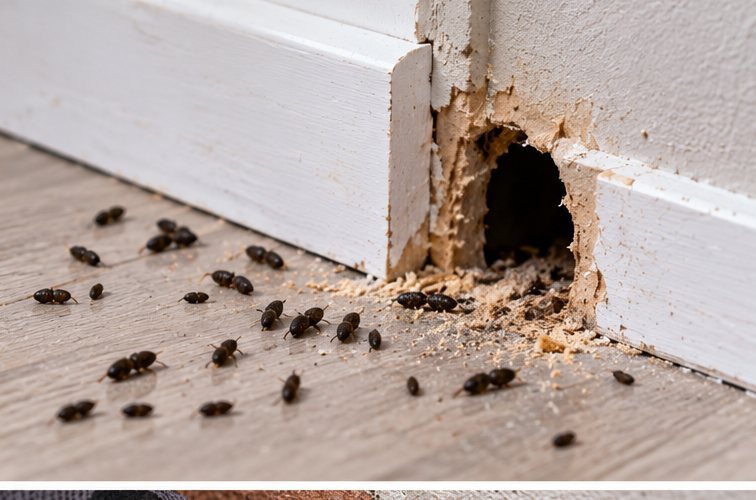
Photographs on this page are for illustration purposes only.
The gap
How Little a Gap a Mouse Needs
This is the fact that changes how people look at their own house.
An adult house mouse is roughly seven to ten centimetres in the body with a tail about as long again, and weighs somewhere between 15 and 25 grams — two pound coins, near enough. What matters is not its length but its skull: if the head goes through, the rest follows, because the body has no rigid barrel to it. In practice that means a gap about the width of a pencil is enough.
Once you know that, you know where to look. The gap under a badly hung door. The hole where a waste pipe or a boiler flue passes through a wall, almost never filled properly. An airbrick with a broken corner. The gap where a kitchen unit meets the floor and the service pipes come up. The point where a soil stack enters the building. Weep holes and the gap at the eaves. Cable and broadband entries drilled through and left open around the cable.
Mice also climb well and are perfectly happy at height, so the roofline matters as much as the ground floor. A gap at the eaves, a lifted tile or an open soffit is a front door, and it is the reason so many mouse problems present as noise in an upstairs ceiling.
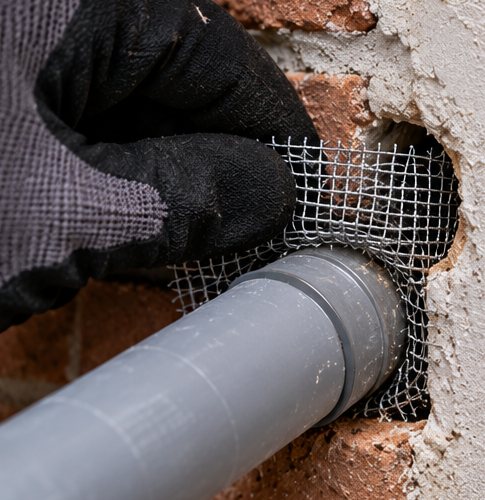
Photographs on this page are for illustration purposes only.
Behaviour
Why Mice Behave Differently From Rats
Two differences matter for the treatment, and both of them are the reason a rat approach applied to mice disappoints.
They nibble everywhere rather than eat in one place. A rat tends to find a food source and work it. A mouse takes very small amounts from a large number of points across a night, which is why you get nibbled packaging in four different cupboards rather than one raided bag. For treatment that means several points spread along the routes they actually use, not one station in the middle of a room.
They are far less wary of new objects. Rats are famously suspicious of anything that was not there yesterday and can take days to approach it. Mice are curious and will investigate something new within hours. That is useful — it is why a mouse job often shows results quickly — and it is also why mice reappear so readily through a gap nobody closed.
One more thing that catches people out: mice get most of the water they need from their food. Drying up a kitchen and fixing a dripping tap helps with rats. It does very little about mice.
The visit
What the Visit Involves
The inspection comes first and it decides everything else. We follow the runs — along skirting, behind units, through the cupboard under the sink, into the void, up into the loft — reading droppings, smear marks and gnawing to work out where they are travelling and where they are getting in.
Then treatment goes in on those routes rather than where the droppings were most noticeable, using a combination of targeted traps, bait where it is appropriate, and proofing. Which combination depends on the property: a food premises, a house with a toddler and a dog, and an empty garage are three different problems and get three different answers.
Proofing is part of the job, not an upsell. Gaps get closed properly — steel wool and sealant, or mesh, or a metal plate where something is being gnawed at — because expanding foam and a bit of filler on their own are a meal, not a barrier.
The methods we use are safe for children, pets and food-handling environments when they are applied correctly, and the technician assesses each property to decide what suits it. That condition is the part that matters, and it is why the survey happens before anything goes down.
Speed
Why Waiting Is the Expensive Option
Mice breed fast. In good conditions a female can produce a litter every three or four weeks, a litter is commonly five to eight, and the young are old enough to breed themselves at around six weeks. Nothing about that is dramatic on any given day and all of it compounds.
The practical shape of it: a problem caught in the first fortnight is usually one route, one entry point and a handful of animals. At two months it is several routes, the loft, the cavity and a population that is producing its own next generation. Same method, several times the work, and considerably more mess to deal with.
There is a second cost that does not show up until later. Mice gnaw cable insulation, and damaged insulation on a live cable is a fault worth taking seriously as well as an electrician's bill. They also foul insulation and stored goods, and in a business that becomes a stock write-off and an environmental health conversation.

Photographs on this page are for illustration purposes only.
Business
Restaurants, Shops, Offices and Warehousing
For a business, mice are a compliance problem before they are a pest problem. Droppings in a food preparation area or a store room is a finding an environmental health officer will act on, and it is not a conversation anybody wants to be having during an inspection.
We work around trading hours, including evenings and weekends, and can put what was found, what was done and what proofing is still outstanding in writing for your records. Ask for it when you book if you want it, and say who it is for.
In food premises the useful findings are usually structural rather than about cleaning: the gap behind a stainless steel bench, the service duct behind the kitchen, the gap under the delivery door, the void above a suspended ceiling, and pallets stacked against a wall so nothing can be inspected behind them. Those are what we will point you at.
Afterwards
What Happens After the Visit
You will be told what was found, where the entry points are, what was treated and what proofing is done or still outstanding. If a follow-up is part of the plan it is booked before we leave.
Expect some activity to continue for a short period. Mice already inside the building carry on using their routes, and the routes are where the treatment is. What matters is whether droppings in the places you were finding them reduce week on week. A useful trick: damp-wipe an area completely clean, then check it in a few days. Fresh droppings on a clean surface tell you far more than the accumulation you started with. Damp, not dry — dry-sweeping droppings puts dust into the air.
If activity is not falling, ring us and say where you are still finding them. It usually means either an entry point we have not found yet or an adjoining property feeding the problem, and both are things to locate rather than reasons to put down more of the same.
Neighbours
Terraces, Flats and the Property Next Door
In a terrace, a semi or a block of flats, mice travel in the parts of the building nobody owns individually: the cavity, the void under a shared floor, the service riser, and the holes drilled for pipework and cable that pass from one home into the next.
That is why a house can be proofed thoroughly on the outside and still have mice. They are not coming in from the garden; they are coming through the wall from next door, or from an empty unit, or from a communal bin store.
Where the evidence points that way we will say so and put it in writing, which is usually what gets a managing agent or a neighbour to act. Treating one house in a terrace where the problem is structural gets you a quiet few weeks and then the same call.
Why us
Why Milton Keynes Pest Controllers
- Local, covering fifteen towns across three counties
- Same-day appointments, evenings and weekends at no extra cost
- No call-out fee, and fixed pricing with no hidden fees
- Entry-point proofing included, not quoted separately
- Fully qualified and insured technicians
- Methods chosen to suit the property, including food premises
- What was found and done can be put in writing for your records
- Straight advice when the problem is structural or next door
Ring 01908 465226 and tell us what you have seen.
Reading
Mice: the Questions We Get Asked
Ten things people ring and ask us about mice, answered properly rather than in a sentence.
How Small a Gap Can a Mouse Get Through?
About the width of a pencil. Once you know that, you start seeing your own house differently.
Read it →Reading Mouse Droppings and Smear Marks
Droppings tell you what you have got. Smear marks tell you where it goes. Between them they plan the whole visit.
Read it →Why Mice Ignore One Trap and Take Another
Nearly always placement, not the trap. Mice will investigate something new within hours, so if nothing has happened in three days the trap is in the wrong place.
Read it →Scratching in the Walls and Ceiling at Night
The noise is the most useful diagnostic you have, and most people describe it well enough over the phone for us to know where to start.
Read it →Mouse Proofing: What Actually Closes a Gap
Mice gnaw through filler, foam, plastic and softwood. What stops them is a short list.
Read it →How Fast a Mouse Problem Grows
Nothing about mice is dramatic on any given day. All of it compounds, which is why waiting is the expensive option.
Read it →Mice in the Kitchen, and What To Throw Away
The question we are asked most, and the answer is narrower than most people fear.
Read it →Mice in a Food Business
For a food business mice are a regulatory problem before they are a pest problem, and the clock is different.
Read it →Why the Cat Is Not the Answer
A cat may catch the occasional mouse. It will not clear an infestation, and its dinner may be part of why they are there.
Read it →What To Do Before We Arrive
Half an hour of preparation and four pieces of information change how much a visit achieves.
Read it →Before you book
Mice Control — Questions
How do I know it is mice and not rats?
Mostly by the droppings. Mouse droppings are three to six millimetres, like a dark grain of rice with pointed ends, and scattered widely. Rat droppings are 12 to 18mm, tapered at the ends like a large grain of rice or an olive pip, and turn up in lines along a joist or a worktop edge. Sound helps too: mice are light and scurrying, rats are heavy enough that people describe them as someone moving about. There is a fuller comparison on the rat pages.
How small a gap can a mouse get through?
About the width of a pencil. If the head goes through the rest follows, because there is no rigid barrel to the body. That is why the gap under a badly hung door, a broken airbrick, or the unfilled hole where a pipe passes through a wall are all entry points, and why proofing has to be done to that standard not approximately.
Can you come the same day?
Usually, yes. Evening and weekend visits are available at no extra cost, and there is no call-out fee.
Is it safe with children, pets or a food business?
The methods we use are safe when they are applied correctly, and the technician assesses each property to decide what suits it. That is why the survey happens before anything is put down, and why a house with a toddler and a dog gets a different answer from an empty garage.
Will sealing the gaps on its own get rid of them?
Not on its own, and done in the wrong order it makes things worse: seal a building with mice already inside and they stay inside. Proofing and treatment go together, in that order of thinking but not always that order of work, which is one of the things the survey decides.
Do I need to throw all my food away?
Not all of it. Anything in a cardboard box, a paper packet or a plastic bag that has been gnawed or has droppings on or near it goes. Anything in glass, metal or a sealed rigid container is fine once the outside is cleaned. There is an article on this because it is the question we are asked most.
Why do they keep coming back?
Almost always an entry point that has not been found, or a structural route from an adjoining property. Mice are not wary of new things, so a gap that is still open gets used again quickly. That is the whole reason the proofing matters more than the catching.
Will a cat sort it out?
A cat may catch the occasional mouse and will not clear an infestation. Worse, cat and dog food left down is one of the most reliable food sources a mouse can have. There is an article about this.
There are mice next door too. Does that change anything?
It changes the scope. In a terrace, a semi or a block, mice move through the cavity, the shared floor void and the holes drilled for pipework. Where the evidence points at a shared boundary we say so in writing, which is generally what gets a neighbour or a managing agent to act.
Do you work with restaurants and food premises?
Yes, and with shops, offices and warehousing. We work around trading hours, including evenings and weekends, and provide a written account of what was found and done for your records, which is what an environmental health officer or an auditor will want to see.
Where we cover
Mice Control Across the Area
Across Buckinghamshire, Bedfordshire and into Hertfordshire, and the villages between them. Houses, flats, lofts and cavity walls, shops, offices, warehousing, restaurants and food premises.
Tell Us Where You Are Finding Them
Where the droppings are, where you hear them and whether anything has been gnawed. Same-day appointments are available, with evenings and weekends at no extra cost.
Get in touch
Book a Mice Control Visit
Tell us where you are finding droppings, where you hear them, and whether it is a home or a business. If anything has been gnawed, say what and where — it tells us which route they are using.
- Phone
- 01908 465226
- Message us on WhatsApp
- sales@miltonkeynespestcontroller.co.uk
- Milton Keynes Pest Controller Service
- Address
- South Row
Milton Keynes
MK9 3DQ - Covering
- Milton Keynes, Buckinghamshire, Bedfordshire and parts of Hertfordshire