
Home › Wasp Control › What Actually Happens
The visit
What Actually Happens
It takes less time than people expect, and the nest usually stays exactly where it is.
Before the visit
Three Things Worth Doing
Work out where the traffic goes. Not where individual wasps are — where the steady two-way line enters the building. Watch from a window for a minute. This is the single most useful thing you can do and it often saves the longest part of the visit.
Say if anyone reacts badly to stings. It changes how and when we attend and it is the most important thing you can tell us.
Say if you have already sprayed it. Not a telling-off. A nest that has been attacked is defended differently and the technician needs to know before walking up to it.
Beyond that: plan to keep people and pets indoors and away from that side of the building for a while, and close the windows nearest the nest.
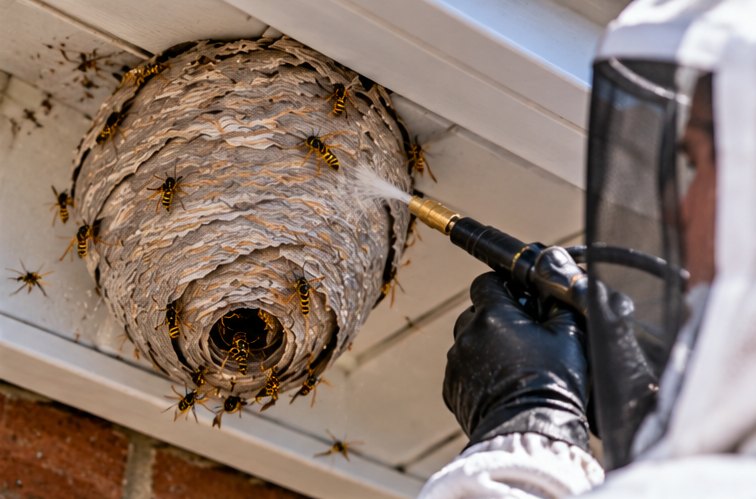
Images on this page are illustrations only.
The treatment
Dust at the Entrance, and Why It Works
The method for a wasp nest is an insecticidal dust applied at and into the entrance, usually with a lance or a duster so it can be done from a distance.
The reason it is dust rather than spray is worth understanding, because it explains why a shop aerosol does not work. The dust sits at the entrance, every returning forager walks through it, and they carry it inside on their bodies and distribute it through the colony by contact. It reaches the parts of the nest nobody can see or get to, including the queen and the brood. You do not need to reach the nest; you need to reach the doorway.
That is also why it suits cavity nests, ground nests and nests deep in a roof void, where physically reaching the nest would mean opening up the structure.
The application itself takes a couple of minutes. Most of the visit is finding the entrance and getting safely into position.
Afterwards
Hours, Not Weeks
Activity usually drops sharply within a few hours. The colony is normally dead inside a day or two.
What you will see in between is returning foragers — wasps that were out when it happened, coming back to a nest that is no longer functioning. They mill about the entrance, they can look agitated, and they die off over the following day or so. It is expected and it is not a sign that the treatment failed.
Keep away from the entrance for the rest of the day. There is more on what to expect in the days after in after the treatment.
The nest itself
Why It Usually Stays
People often expect the nest to be taken away, and usually it is not. That is deliberate.
A wasp nest is used for one season only. Once the colony is dead nothing moves into it, it does not rot into anything unpleasant, and it is simply an empty paper shell. Cutting a dead nest out of a wall cavity, a roof void or a soffit means opening up the structure and making good afterwards, for no benefit at all.
Where the nest is somewhere it genuinely cannot stay — hanging in a porch, in a loft about to be converted, in a shed you are clearing — it can be taken away once it is dead. Ask on the day.
The one place removal is worth considering is a loft you use for storage, not because the nest is harmful but because a large dead nest is a nuisance to work around.
The guarantee
What It Covers
In the firm's own words: if the wasps return to the same nest location, they come back and re-treat at no extra cost.
That is a guarantee with a boundary, which is the useful kind. It covers the job not working — a colony that survives, or re-establishes at the same spot. It is not a promise that no wasp will ever nest on the property again, and no honest firm can offer that: a new queen next spring choosing the same good site is a new job, not a failure of this one.
If you are seeing real traffic at the same entrance a week later, ring. That is what it is for.
Short answers
Wasp Questions
How long does the visit take?
The treatment itself is a couple of minutes. Finding the entrance and getting into position is most of it.
Do I need to be in?
Someone needs to give access if the nest is inside or in a locked area. For a nest on the outside of the building, often not.
Do I need to leave the house?
No. Keep people and pets indoors and away from that side for a while, and close the nearest windows.
Why dust rather than spray?
Because the wasps carry it in. It reaches the parts of the nest nobody can get to, including the queen, which a spray at the surface does not.
Why is the nest still there?
Because it is only used for one season and nothing will move into it. Cutting a dead nest out of a wall or roof means opening up the structure for no benefit.
There are still wasps the next day.
Returning foragers, and expected. They come back to a nest that no longer works and die off over a day or so.
Going further
Wasp Guides
Where we cover
Wasp Nest Treatment Across the Area
Across Buckinghamshire, Bedfordshire and into Hertfordshire. Houses, gardens, sheds, flats, pubs and food premises — fixed price £90, no call-out fee.
Not Sure What You Have?
Describe the size, the colour and where the traffic goes. If it turns out to be bees we will say so, free.
Get in touch
Book an Ant Treatment
Tell us what you have seen, roughly where it is going, and how high up.
- Phone
- 01908 465226
- Message us on WhatsApp
- sales@miltonkeynespestcontroller.co.uk
- Milton Keynes Pest Controller Service
- Address
- South Row
Milton Keynes
MK9 3DQ - Covering
- Milton Keynes, Buckinghamshire, Bedfordshire and parts of Hertfordshire