
Home › Wasp Control › A Nest in the Wall
Cavity nests
A Nest in the Wall
You will never see this one. And the obvious thing to do about it is the one thing that makes it much worse.
What it looks like
Nothing. That Is the Point.
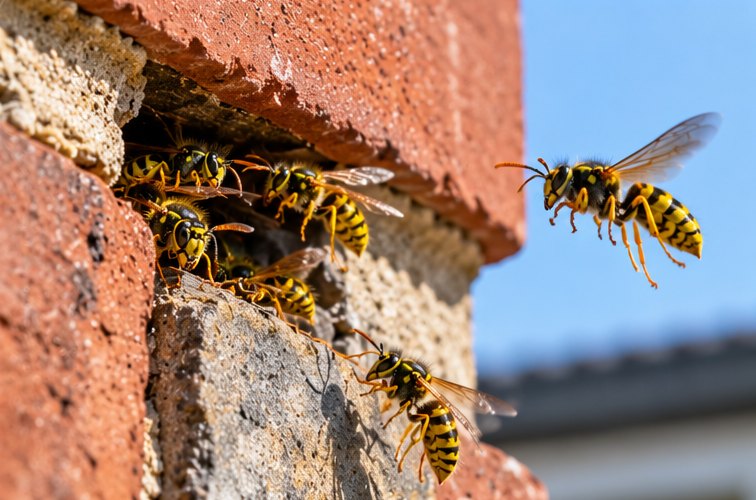
There is no nest to see. A cavity nest is built inside the wall — in the gap between the outer and inner leaf, or in the void behind render or cladding — and the only visible sign is a steady stream of wasps going in and out of one small hole.
The usual entrances are an airbrick, a weep hole (the deliberate open vertical joint above a window or a damp course), a gap in perished mortar, the slot under a window sill, or a gap where a pipe or cable passes through the wall.
It is common and it is not a sign of anything wrong with the building. A cavity is dry, insulated, sheltered and completely undisturbed, which is close to the ideal nest site.
Images on this page are illustrations only.
Do not block it
The Single Worst Thing You Can Do
This is the reason this article exists.
Sealing the entrance of an active cavity nest with foam, filler, cement or tape does not trap the wasps. It redirects them. Wasps chew their way out, and inside a wall the path of least resistance is very often inward — through the plasterboard, round a socket, past a pipe, into the room on the other side.
Every summer somebody fills an airbrick on a Saturday and has wasps in a bedroom by Monday, and the second problem is considerably worse than the first: the colony is now inside the house, disoriented and defending, and the entrance it made is somewhere you cannot see.
The order is: treat, wait until it is dead, then block. Never the other way round.
How it is treated
The Doorway, Not the Nest
A cavity nest is one of the situations the standard method is best suited to. The dust goes in at the entrance, the returning wasps walk through it and carry it back into a nest nobody can see or reach. Nothing has to be opened up.
That is worth knowing if you have been told the wall needs opening or the render needs coming off. For a wasp nest, it does not.
Activity drops within hours and the colony is normally dead within a day or two, same as anywhere else.
And the dead nest?
Leave It Where It Is
A dead cavity nest stays in the wall and that is fine. It is dry paper, nothing moves into it, and it will not be reused next year.
There is one consequence worth knowing about. Over the following months an abandoned nest can be worked over by other insects — mostly the larvae of small beetles and moths that feed on the paper and on what is left inside. That is normal, it stays in the cavity, and it is not a second infestation. It is another argument for not leaving a nest somewhere you store clothes or textiles, but in a wall it does not matter.
Blocking it properly
Afterwards, and With the Right Thing
Once the colony is dead, closing the entrance is sensible if you do not want a new queen choosing the same spot next April. Good sites get reused, by different colonies.
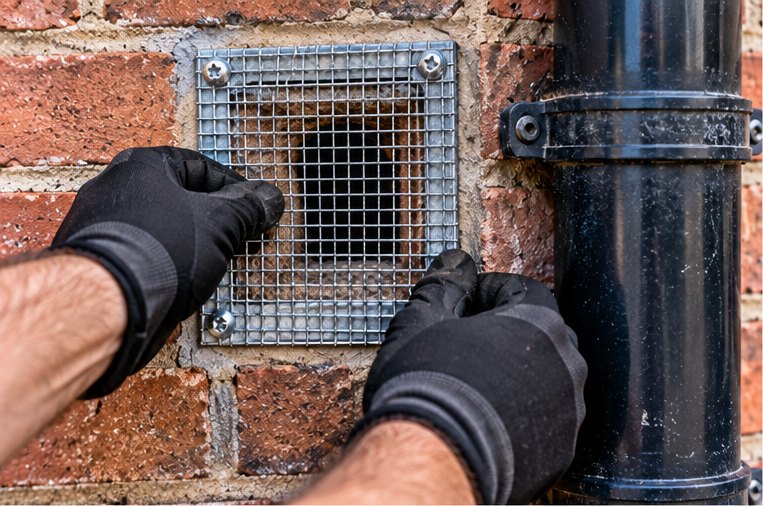
The right approach depends on what the hole is for. Airbricks and weep holes exist to ventilate the cavity and must not be sealed — blocking them causes damp, which is a much more expensive problem than wasps. Those get a fine stainless mesh over them instead, which keeps insects out and air moving.
A genuine defect — perished mortar, an unsealed gap round a pipe — gets repaired properly, which is worth doing anyway.
What not to use: expanding foam, which is unsightly, traps moisture and gets chewed; and anything that seals a vent.
Images on this page are illustrations only.
Short answers
Wasp Questions
I can see wasps at an airbrick but no nest.
That is a cavity nest. The nest is inside the wall and you will not see it. It does not change the treatment or the price.
Can I fill the hole in?
Not while it is active. They chew their way out and the easiest route is often inward, through the plasterboard into the room.
Will you have to open up the wall?
No. The dust goes in at the entrance and the wasps carry it to the nest, which is exactly why this method suits cavity nests.
Should the dead nest come out?
No. It is dry paper in a cavity, nothing moves into it and it is never reused.
Can I block the airbrick once they are gone?
Not with filler. Airbricks ventilate the cavity and sealing them causes damp. Fine stainless mesh over the outside keeps insects out and air moving.
Will they come back to the same wall next year?
Not the same colony - it dies in autumn. A new queen may well pick the same spot, which is the argument for meshing it afterwards.
Going further
Wasp Guides
Where we cover
Wasp Nest Treatment Across the Area
Across Buckinghamshire, Bedfordshire and into Hertfordshire. Houses, gardens, sheds, flats, pubs and food premises — fixed price £90, no call-out fee.
Not Sure What You Have?
Describe the size, the colour and where the traffic goes. If it turns out to be bees we will say so, free.
Get in touch
Book an Ant Treatment
Tell us what you have seen, roughly where it is going, and how high up.
- Phone
- 01908 465226
- Message us on WhatsApp
- sales@miltonkeynespestcontroller.co.uk
- Milton Keynes Pest Controller Service
- Address
- South Row
Milton Keynes
MK9 3DQ - Covering
- Milton Keynes, Buckinghamshire, Bedfordshire and parts of Hertfordshire