
Home › Ant Control › Ants Under Paving, Patios and Drives
Ant control
Ants Under Paving, Patios and Drives
The version of this job people leave longest, because it does not happen in the kitchen. It is also the one that costs money.
Why they choose it
A paved surface is close to ideal for a nest. The slab or block holds the day's warmth and releases it slowly, which suits brood rearing. The bedding underneath is sand or fine material, which is easy to excavate. It is dry, because rain runs off rather than through. And it is completely undisturbed.
Compared with open soil, which is cold, wet, dug over and walked on, it is not a close contest. That is why the nest is so often under something hard, and why a new patio or drive gets colonised so readily.
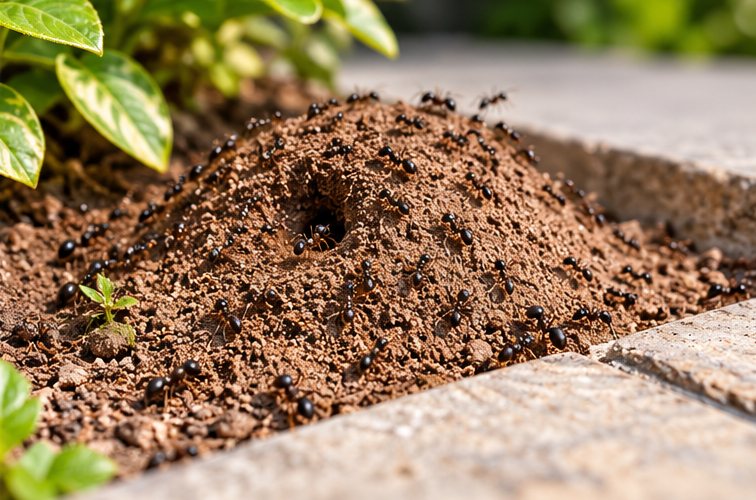
Photographs on this page are for illustration purposes only.
What the damage actually is
Ants do not eat or attack the paving. What they do is remove what it is sitting on.
Excavated material comes up through the joints, grain by grain, and over a season or two that is a surprising volume of bedding sand gone. The result is slabs that rock underfoot, joints that open and stay open, edges that drop, and on block paving the characteristic sunken patch that people assume was a laying fault.
Re-sanding the joints without dealing with the colony is pouring fresh material into a working nest. It disappears, and the money goes with it.
It is worth saying they do not damage the house itself. UK garden ants do not tunnel in sound timber or mortar. The cost here is the hard standing.
Telling whether it is active
A two-minute test that settles it.
Brush the soil out of the affected joints completely, so the area is clean, and note the date. Then look again in a day or two.
A fresh pile back within forty-eight hours means the colony underneath is active and working, and that is what to treat. Nothing back after a week means it has moved or the nest has failed, and the piles you found were old spoil.
Do it on dry, warm days; a wet spell suppresses activity and will give you a false negative.
The order to do it in
Three steps, and doing them out of order is what wastes money.
- Treat the colony. Bait at the entry points, taken down to the queen. Days, not minutes.
- Confirm it has stopped. Brush clean, wait, check. No fresh spoil after a week or two of decent weather.
- Then re-sand or repoint the joints. Kiln-dried sand for block paving, and a proper pointing mortar for slabs, which is considerably harder for a future colony to work.
Where a patio has been running for several summers, expect more than one nest under it. Tell us how many separate places soil is coming up, because it changes how the visit is planned.
Before you book
Ant Questions, Briefly
Will the slabs need lifting?
Generally no. Treatment goes in at the entry points and the workers take it down themselves. Lifting is occasionally useful for access on a large nest, but it is not how the job is normally done.
Can I just re-sand the joints?
Not first. Re-sanding over a live colony gives it fresh bedding to excavate and the sand disappears. Treat, confirm it has stopped, then re-sand - in that order it lasts.
Tell Us Where the Trail Goes
Which room the trail is in, where it goes when it leaves the building, and whether soil is coming up between paving outside.
Get in touch
Book an Ant Treatment
Tell us which room the trail is in, where it goes when it leaves the building, and whether you have found excavated soil outside. A photograph of the trail is worth more than any description.
- Phone
- 01908 465226
- Message us on WhatsApp
- sales@miltonkeynespestcontroller.co.uk
- Milton Keynes Pest Controller Service
- Address
- South Row
Milton Keynes
MK9 3DQ - Covering
- Milton Keynes, Buckinghamshire, Bedfordshire and parts of Hertfordshire