
Home › Ant Control › Why They Come Back Every Summer
Ant control
Why They Come Back Every Summer
A house that gets ants every June does not have bad luck. It has a nest that was never dealt with.
The colony was there all along
Ants are seasonal above ground, not seasonal as a colony. A garden ant nest is perennial: the queen can live for many years, and the colony overwinters deep in the soil in a quiet, torpid state.
Nothing about winter kills it. As the ground warms in spring the workers start foraging again, and by May or June they have found their way back to the same reliable food source they used last year, along, very often, the same route.
So the pattern people describe as "they come back every summer" is usually one colony, in one place, doing the same thing on the same schedule.
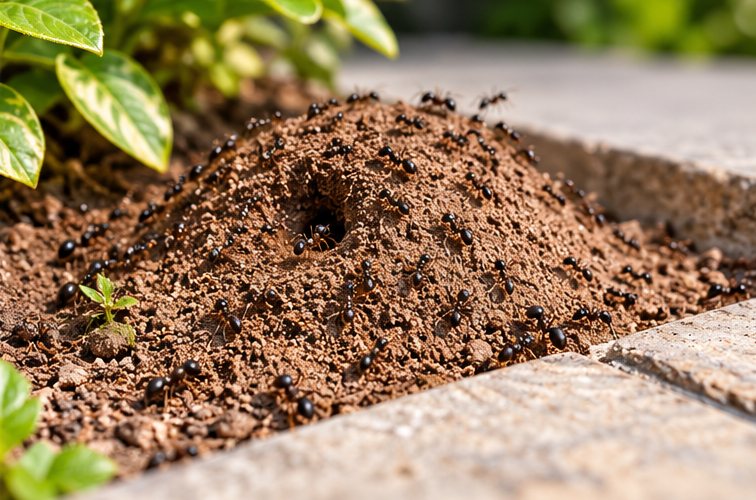
Photographs on this page are for illustration purposes only.
What each pattern tells you
- Same room, same time, every year. One established nest that has never been treated, close to the building, with a route it already knows.
- Different rooms each year. More than one colony around the property, or one that has relocated. Worth a proper look at the whole perimeter and not just the room that complained.
- Worse every year. The colony is maturing. A nest big enough to produce winged ants is a mature one, and it will keep growing until something stops it.
- Started this year, new build or new patio. A young queen founded it recently. Good news: a young colony is small and straightforward to deal with.
What actually breaks the cycle
One thing, and it is the same thing every article on this section comes back to: treat the colony rather than the trail.
A nest dealt with properly does not come back to life next spring. What can happen is that a different colony moves into the same good spot, because the warm dry ground under your patio is just as attractive to the next queen as it was to the last. That is why the second half of the job is worth doing too.
After the treatment: re-sand or repoint the paving joints so they are harder to work, seal the low-level gaps into the building, and keep the obvious food sources away from the wall. None of that stops a colony founding in your garden, but it does make your patio a less attractive address than the alternatives.
When to do it
Spring and early summer, if you have the choice.
Treating in April or May catches the colony while it is smaller and before it has produced the year's winged queens, and it deals with the problem before the season it would otherwise ruin. A nest treated in August has already had its summer.
That said, any time is better than another year of it. If you are reading this in September because the patio is lifting, ring anyway: autumn treatment works, and the colony will still be there in the spring if it is left.
Before you book
Ant Questions, Briefly
Does frost kill the nest off?
No. The colony overwinters deep in the soil and comes back up as the ground warms. A cold winter delays the start of the season; it does not end the colony.
If you treat it, will we get ants again next year?
Not from that colony. What can happen is that a new queen founds a nest in the same good spot, which is why re-pointing the paving joints and sealing the low-level gaps afterwards is worth doing.
Tell Us Where the Trail Goes
Which room the trail is in, where it goes when it leaves the building, and whether soil is coming up between paving outside.
Get in touch
Book an Ant Treatment
Tell us which room the trail is in, where it goes when it leaves the building, and whether you have found excavated soil outside. A photograph of the trail is worth more than any description.
- Phone
- 01908 465226
- Message us on WhatsApp
- sales@miltonkeynespestcontroller.co.uk
- Milton Keynes Pest Controller Service
- Address
- South Row
Milton Keynes
MK9 3DQ - Covering
- Milton Keynes, Buckinghamshire, Bedfordshire and parts of Hertfordshire