
Home › Ant Control › Pharaoh Ants: the One That Is Different
Ant control
Pharaoh Ants: the One That Is Different
Everything else on these pages assumes the nest is outside. This is the case where it is not, and it changes the whole approach.
How to tell
Size and colour do most of the work.
A pharaoh ant is very small, noticeably smaller than a garden ant at around a couple of millimetres, and yellowish, amber or pale brown instead of black, often with a darker tip to the abdomen. In poor light people describe them as looking almost translucent.
The behaviour is the bigger clue. Garden ants are seasonal and come from outdoors; pharaoh ants are present all year round, because the inside of a heated building is their climate. If you have small pale ants in January, that is not a garden ant.
They also turn up in places a foraging garden ant would not persist in: bathrooms, airing cupboards, around heating pipes, in wall voids, near anything warm and humid.
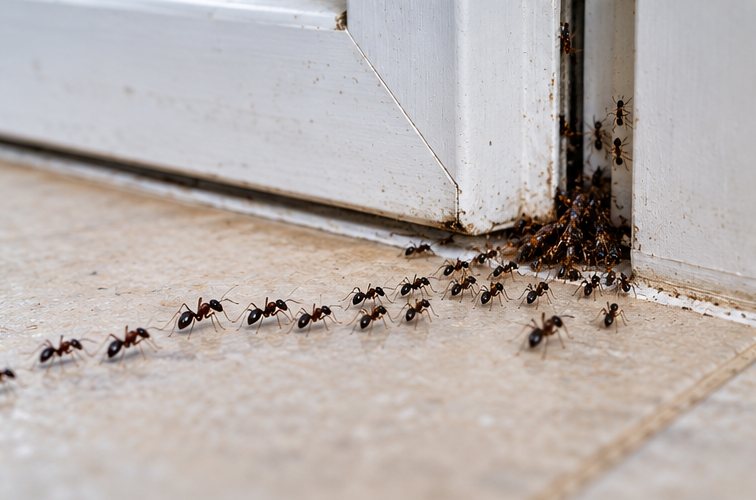
Photographs on this page are for illustration purposes only.
Why they are a problem
They are a tropical species living entirely indoors in the UK, and the buildings that suit them are the ones with continuous warmth: blocks of flats, hospitals and care settings, bakeries and commercial kitchens, hotels, anywhere with long runs of heated services.
They nest in inaccessible voids and not in soil: behind pipework, in ducting, in cavities, under floors. And unlike a garden ant colony, they have many queens, not one.
In a food or care setting that combination matters, because they get everywhere, including into sterile and sealed areas, and they are genuinely difficult to remove once established in a building's structure.
Why spraying is the worst possible response
This is the part worth knowing even if you never see one.
A multi-queen colony under chemical stress does not die. It buds: groups of workers leave with a queen and set up somewhere else in the building. One colony becomes three, in places nobody knows about, and the problem is now distributed through the structure rather than concentrated.
So the single most damaging thing anyone can do with pharaoh ants is attack them with a repellent household spray. It feels like action and it multiplies the problem, and it is why we would rather establish what we are dealing with before anything at all is applied.
What is done instead
Bait, patiently, and nothing repellent anywhere near it.
The approach is to give the colony something it will take back and distribute to its queens, and then leave it entirely alone to do that. It usually takes more than one visit, and in a large or shared building it needs to cover more than the flat or unit that reported it. Treating one home while the colony runs through the block is how these jobs go on for years.
If you think this is what you have, say so when you ring, and say what size and colour they are and whether you have them in winter. It changes the visit before anyone arrives.
Before you book
Ant Questions, Briefly
We live in a flat and have had small pale ants for years. Is that them?
It is a strong indicator - small, pale, present year round and in a heated block are all pharaoh ant characteristics. It also explains why nothing has worked, because treating one flat in a building-wide colony rarely does.
Do pharaoh ants carry disease?
They are taken seriously in hospitals and care settings because they can move between areas that should be separated, which is a contamination route. In an ordinary home the practical problem is that they are very hard to shift and they spread if treated wrongly.
Tell Us Where the Trail Goes
Which room the trail is in, where it goes when it leaves the building, and whether soil is coming up between paving outside.
Get in touch
Book an Ant Treatment
Tell us which room the trail is in, where it goes when it leaves the building, and whether you have found excavated soil outside. A photograph of the trail is worth more than any description.
- Phone
- 01908 465226
- Message us on WhatsApp
- sales@miltonkeynespestcontroller.co.uk
- Milton Keynes Pest Controller Service
- Address
- South Row
Milton Keynes
MK9 3DQ - Covering
- Milton Keynes, Buckinghamshire, Bedfordshire and parts of Hertfordshire