
Home › Ant Control › Why Spraying the Trail Never Works
Ant control
Why Spraying the Trail Never Works
It is the most natural thing in the world to do, and it is aimed at the part of the problem that does not matter.
What you are actually killing
The ants crossing your worktop are workers out foraging. A colony produces them continuously and it does not value them: they are the disposable part of the organism, sent out precisely because losing some of them costs nothing.
So a spray that kills every ant on the trail has removed a few hours of one colony's labour. The queen is untouched, the brood is untouched, and the nest goes on producing replacements. That is why the trail is back in a few days, along the same route, doing the same thing.
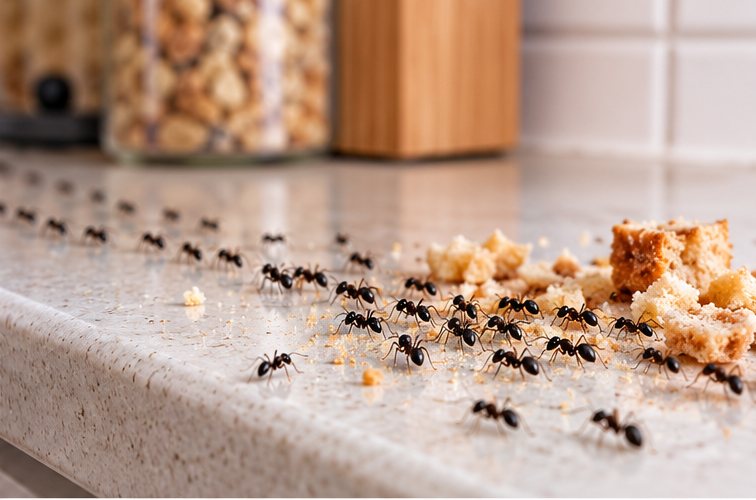
Photographs on this page are for illustration purposes only.
The part that makes it worse
Killing foragers is merely futile. Some household products go further and are actively counterproductive, because they repel.
A repellent residue does not clear a colony. It tells the ants that this particular route is unpleasant, so they stop using it and find another. What that means in practice is that a trail you could see, along a route you had identified, becomes a trail you cannot see, running somewhere you have not looked, often into a wall cavity or under a floor.
On a garden ant that is an inconvenience. On pharaoh ants it is a serious mistake, because repellent products make those colonies split and spread through a building. There is a separate article on that.
What a bait does instead
A bait works by being taken seriously as food. Workers find it, feed, and carry it home, and inside the nest it is passed mouth to mouth through the colony: to other workers, to the brood, and to the queen. The colony distributes it for you, into the one place you could never reach.
Two consequences follow, and both look wrong if you do not know what you are watching.
First, you want to see ants on the bait. Lots of them, for a couple of days. A busy trail running to a bait point is the treatment being delivered. People ring us on day two worried that there are more ants than before; there often are, and it is the best sign there is.
Second, it takes days, not minutes. The live page says the same: some ants go immediately, the colony takes a few days. Anything that killed the foragers instantly would never get carried home.
What to do instead of spraying
- Wipe the trail with hot soapy water on surfaces that have to stay clean. That removes the pheromone, not the ants, and it breaks the line up temporarily. It is not a treatment, and it is genuinely useful.
- Take away the reward: the bin lid that does not shut, the spill behind the kettle, the pet bowl left down, the open sugar. It makes the bait more attractive by comparison.
- Leave one trail running if you can, somewhere it does not matter. Following it out of the building is how the nest gets found.
- Do not spray near a bait point. If treatment is already down, a household spray will drive ants off it and stop the treatment reaching the colony.
Before you book
Ant Questions, Briefly
I have already sprayed. Does that change anything?
It can. Repellent residues push ants off the route and away from bait, so tell us what you used and where. Sometimes it means waiting, sometimes it means baiting somewhere else.
Why are there more ants after the treatment went down?
Because they are feeding at the bait and recruiting others to it. That is the delivery mechanism working. What matters is the trail thinning over the following days, not the count on day two.
Tell Us Where the Trail Goes
Which room the trail is in, where it goes when it leaves the building, and whether soil is coming up between paving outside.
Get in touch
Book an Ant Treatment
Tell us which room the trail is in, where it goes when it leaves the building, and whether you have found excavated soil outside. A photograph of the trail is worth more than any description.
- Phone
- 01908 465226
- Message us on WhatsApp
- sales@miltonkeynespestcontroller.co.uk
- Milton Keynes Pest Controller Service
- Address
- South Row
Milton Keynes
MK9 3DQ - Covering
- Milton Keynes, Buckinghamshire, Bedfordshire and parts of Hertfordshire