
Home › Ant Control › Why Ants March in a Line
Ant control
Why Ants March in a Line
Understanding the line tells you why the sprays fail and why hot soapy water does something useful.
A chemical breadcrumb trail
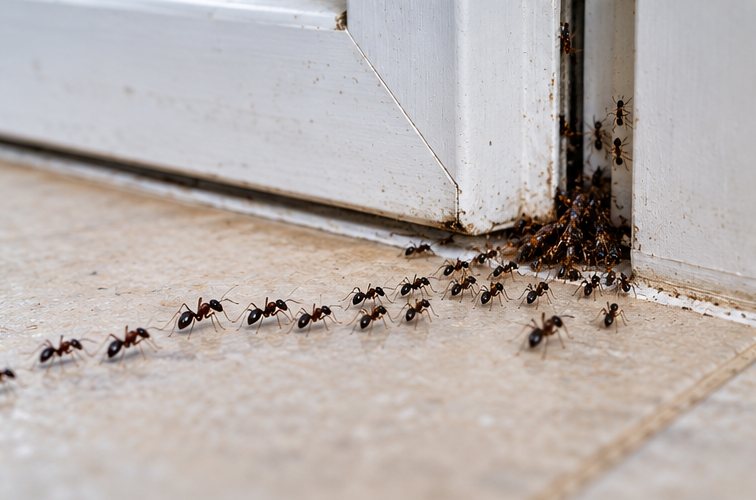
Ants navigate mostly by scent. A worker that finds something worth having lays a chemical trail on the way home, and any ant that follows that trail, finds the food still there, and returns lays more on top.
The trail therefore strengthens itself in proportion to how good the food is and how many ants are using it. That is the whole system: no decision made anywhere, no instruction issued, just a line that gets stronger while it pays and fades when it stops paying.
It also explains the speed. A crumb nobody noticed at ten o'clock can have a hundred ants on it by midnight, because the mechanism is designed to recruit fast.
Photographs on this page are for illustration purposes only.
Why it follows edges
Look at where a trail runs and it is almost never across open floor. It hugs the join between worktop and wall, the top of a skirting board, the edge of a floor tile, the frame of a door, the line of a pipe.
Two reasons. Ants navigate partly by touch and prefer to keep contact with a surface, and an edge protects the chemical trail from being scuffed away or dried out. A trail on an open floor degrades quickly; one tucked into a join lasts.
For anyone looking for where the ants come in, that is useful: follow the edges instead of scanning the middle of the room.
Disrupting the trail, properly
Because the line is made of chemistry and not memory, you can erase it.
Hot soapy water, or a detergent spray, wiped firmly along the route removes the pheromone. The ants that arrive next lose the thread and mill about looking for it. If the food has gone too, the line does not re-form; if the food is still there, they find it again and lay a fresh trail.
Two things worth knowing about this. It is not a treatment, because the colony is untouched and the workers are fine. And it is genuinely diagnostic: wipe a trail thoroughly, and where it re-forms tells you the route they actually prefer, which is often not the one you first noticed.
What it is not is a reason to use a proprietary spray. A detergent wipe removes the trail; an insecticide spray kills disposable workers and may repel, which moves the line somewhere you cannot see it.
When the trail is the treatment
One important exception. If bait has been put down, the trail running to it is the delivery system and it must be left completely alone.
Do not wipe it, do not spray near it, do not move the bait. Every ant on that line is carrying treatment back to the nest, and a busy trail there is exactly what you want to see. Clean the routes that go anywhere else; leave that one running.
Before you book
Ant Questions, Briefly
Does vinegar or lemon juice work?
They will break up a trail much as detergent does, by masking or removing the scent. Neither does anything to the colony, so treat them as a way to clear a worktop and not as a solution.
Do chalk lines, cinnamon or coffee grounds keep ants out?
Not reliably. A repellent barrier at best moves the route somewhere else, which is the same problem as a repellent spray - the trail goes where you cannot watch it.
Tell Us Where the Trail Goes
Which room the trail is in, where it goes when it leaves the building, and whether soil is coming up between paving outside.
Get in touch
Book an Ant Treatment
Tell us which room the trail is in, where it goes when it leaves the building, and whether you have found excavated soil outside. A photograph of the trail is worth more than any description.
- Phone
- 01908 465226
- Message us on WhatsApp
- sales@miltonkeynespestcontroller.co.uk
- Milton Keynes Pest Controller Service
- Address
- South Row
Milton Keynes
MK9 3DQ - Covering
- Milton Keynes, Buckinghamshire, Bedfordshire and parts of Hertfordshire