

Home › Mice Control › How Small a Gap Can a Mouse Get Through?
Mice control
How Small a Gap Can a Mouse Get Through?
About the width of a pencil. Once you know that, you start seeing your own house differently.
Why the number is so small
An adult house mouse is roughly seven to ten centimetres in the body, with a tail about as long again, and weighs somewhere between 15 and 25 grams. But its length is not what decides whether it gets in.
What decides it is the skull, because that is the only rigid part. The ribcage flexes and the body has no barrel to it, so if the head passes through an opening the rest follows. In practice that puts the working figure at about the width of a pencil.
A young mouse needs less again, which matters because a house with an established population is producing young continuously.
Photographs on this page are for illustration purposes only.
Where those gaps actually are
Go round the outside of the building slowly, at knee height and below first, then look up. The list is shorter than people expect and it is much the same house to house.
- Under the doors. A door that has dropped, or a worn threshold, is the single commonest one. Hold a torch on the outside at night and look from inside.
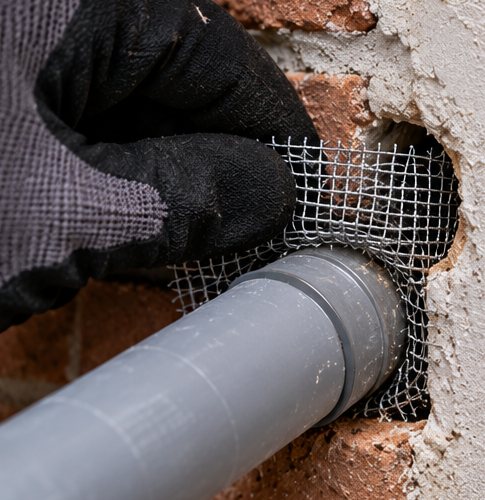
- Pipe and cable penetrations. Waste pipes, the boiler flue, the condensate pipe, gas and water service entries, broadband and alarm cable drilled through after the house was built. Almost none of them are sealed properly around the pipe.
- Airbricks. A cracked or broken corner is a direct route into the floor void.
- Where the kitchen units meet the floor, and where the pipes come up through the boards behind them.
- The eaves and soffits. Mice climb well. A gap at the wall plate, a lifted tile or an open soffit is a front door, and it is why so much mouse noise is heard in an upstairs ceiling.
- The garage, particularly where it is integral and has a connecting door, and where the up-and-over door meets the frame.
A test you can do tonight
If you want to know whether a gap is being used rather than whether it exists, dust a thin layer of plain flour or talc across it and along the floor either side, and look in the morning. Footprints and a tail drag across flour are unambiguous, and they tell you which of six candidate gaps is the live one.
The other simple check is to clean an area completely, then look again in two or three days. Fresh droppings on a surface you know was clean is current activity; the pile you found originally could be six months old.
What to do with what you find
Do not seal everything up before anything has been treated, because a building sealed with mice already inside keeps them inside.
Note where the gaps are, photograph the ones you can, and tell us when you ring. It turns a general survey into a targeted one, and the proofing is part of the job rather than a separate quote.
Before you book
Short Answers
If I block every hole will they starve out?
No, and it is not the aim. Mice already inside carry on, and sealing a building with a population in it removes your ability to control where they go. Treatment and proofing go together, which is what the survey is for.
Is steel wool really better than filler?
Yes. Filler and expanding foam are gnawed through easily - they are an obstacle, not a barrier. Steel wool packed tight and sealed over, stainless mesh, or a metal plate where something is being worked at repeatedly are what actually hold.
Tell Us Where You Are Finding Them
Where the droppings are, where you hear them at night, whether anything has been gnawed, and whether it is a home or a business.
Get in touch
Book a Mice Control Visit
Tell us where you are finding droppings, where you hear them, and whether it is a home or a business. If anything has been gnawed, say what and where — it tells us which route they are using.
- Phone
- 01908 465226
- Message us on WhatsApp
- sales@miltonkeynespestcontroller.co.uk
- Milton Keynes Pest Controller Service
- Address
- South Row
Milton Keynes
MK9 3DQ - Covering
- Milton Keynes, Buckinghamshire, Bedfordshire and parts of Hertfordshire