
Home › Mice Control › Mouse Proofing: What Actually Closes a Gap
Mice control
Mouse Proofing: What Actually Closes a Gap
Mice gnaw through filler, foam, plastic and softwood. What stops them is a short list.
Why most filling fails
Rodent incisors grow continuously, and gnawing is what keeps them in check, so a mouse works at things whether or not it is hungry. Anything soft enough to get purchase on is a project, not a barrier.
Expanding foam is the classic. It goes in beautifully, looks finished, and is gone in a fortnight — often with a neat mouse-sized hole straight through the middle. Decorator's caulk, powder filler, plastic trunking and softwood all go the same way.
The test is simple: if a determined animal with chisels for teeth could get purchase on it, it will not hold on its own.
Photographs on this page are for illustration purposes only.
What actually holds
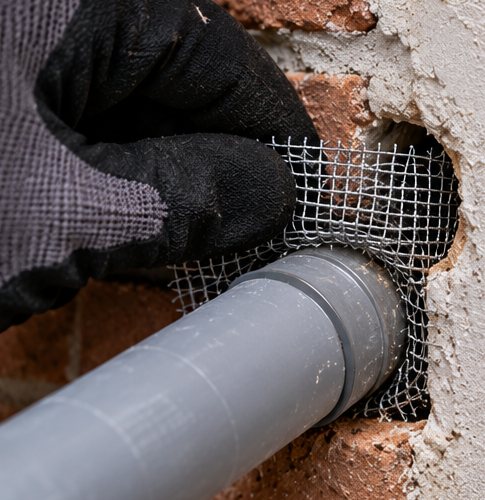
- Steel or stainless wool, packed tight, sealed over. The workhorse. Mice cannot get a grip on the fibres and will not work at it. Packed hard into the gap around a pipe and sealed over, it lasts. Ordinary wire wool from a supermarket rusts and stains a wall, so use stainless where it is visible or exposed to weather.
- Stainless or galvanised mesh. For anything larger than a pipe gap, and for openings that have to stay ventilated — airbricks, weep holes, the gap at the eaves. Aperture no greater than 6mm, and 5mm is the usual choice, in wire heavy enough not to be pushed aside and fixed at every edge. "Fine enough to keep leaves out" is not the same standard.
- Metal plate or kick plate. Where something is being gnawed at repeatedly, particularly the bottom corner of a door or a timber threshold.
- Cement or mortar over steel wool, for larger masonry holes. Mortar alone can be gnawed at the edges; with steel wool behind it, it holds.
- A proper brush strip or a new threshold on a door that has dropped. It fixes the draught at the same time.
The order matters
Do not seal a building that still has mice in it.
This is the mistake that turns a straightforward job into an unpleasant one. Close every entry point with a population inside and you have not excluded them, you have trapped them, and they will keep using the internal voids while you have removed your best information about where they were getting in. Worse, some of them die in a cavity you cannot reach.
The sequence that works is: survey, treat, then proof as the numbers fall, keeping the main routes open until last. On a visit we do a good deal of proofing on the day and stage the rest deliberately. When we leave you will know which gaps are closed and which are being kept open on purpose.
The ones people miss
The garage, particularly an integral one with a connecting door into the house. The gap where an up-and-over door meets its frame is usually wide enough, and the garage is where the birdseed and the dog food are.
Cable entries drilled after the house was built — broadband, alarm, an outside socket, an EV charger. They are the newest holes in the building and the least likely to be sealed.
The gap under kitchen units where the pipes come up through the floor. From inside the cupboard it looks like a finished floor; from the void below it is wide open.
And the roofline. People proof at ground level and leave the eaves, and mice climb.
Before you book
Short Answers
Can I do the proofing myself?
A lot of it, yes - steel wool and sealant round pipework, a brush strip on a door, mesh over a broken airbrick are all straightforward. What is harder is finding every gap, and knowing which ones to leave open until the treatment has worked.
Is proofing extra, or included?
Entry-point proofing is part of the service on this site, not a separate quote. Where something turns out to be a building repair rather than proofing - a rotten threshold, a collapsed airbrick - we will tell you so you can get it done properly.
Tell Us Where You Are Finding Them
Where the droppings are, where you hear them at night, whether anything has been gnawed, and whether it is a home or a business.
Get in touch
Book a Mice Control Visit
Tell us where you are finding droppings, where you hear them, and whether it is a home or a business. If anything has been gnawed, say what and where — it tells us which route they are using.
- Phone
- 01908 465226
- Message us on WhatsApp
- sales@miltonkeynespestcontroller.co.uk
- Milton Keynes Pest Controller Service
- Address
- South Row
Milton Keynes
MK9 3DQ - Covering
- Milton Keynes, Buckinghamshire, Bedfordshire and parts of Hertfordshire