

Home › Mice Control › Reading Mouse Droppings and Smear Marks
Mice control
Reading Mouse Droppings and Smear Marks
Droppings tell you what you have got. Smear marks tell you where it goes. Between them they plan the whole visit.
What mouse droppings look like
Three to six millimetres long, dark brown to black, shaped like a grain of rice with pointed ends. Fresh ones are soft and shiny; older ones dry out, go grey and crumble when pressed with something other than your finger.
The distribution is as informative as the shape. A mouse produces dozens a day and does not choose a spot, so mouse droppings turn up scattered along routes — a line of them on top of a skirting board, a handful in a drawer, some behind the kettle, a few in the back of a cupboard.
Rat droppings are a different proposition: 12 to 18mm, tapered at the ends like a large grain of rice or an olive pip, and left in lines along a joist or the back edge of a worktop. If that is what you are looking at, it is a different job. There is a full comparison on the rat pages: rat or mouse, telling them apart.
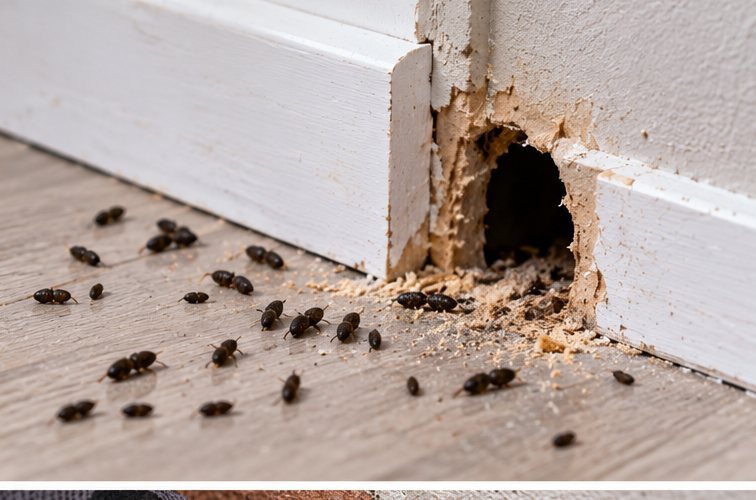
Photographs on this page are for illustration purposes only.
Where to look for them
Mice run against walls and edges rather than across open floor, so look where a surface meets another surface.
- Along the top edge of skirting boards.
- In the back corners of base cupboards, particularly under the sink.
- Behind and under the cooker, the fridge and the washing machine.
- In drawers, especially a seldom-used one.
- On the joists and in the insulation in the loft.
- In the airing cupboard and on top of a boiler casing.
- In the garage, along the wall and behind stored boxes.
Smear marks, and what they tell you
Mice have poor eyesight and navigate by touch, keeping their whiskers and flank against a surface as they run. Where a route has been used for a long time, the grease in their coat can leave a faint grey-brown smudge along the top of a skirting, around the lip of a hole, or where they squeeze under a cupboard plinth.
Do not go looking for it too hard. Smear marks are really a rat sign — a rat is heavy, oily and faithful to one route, and leaves an obvious dark track. On most domestic mouse jobs there is nothing to see, and its absence tells you nothing at all.
Which brings up the apparent contradiction in how mice behave. They do travel fixed edge routes, and they also defecate constantly as they go not at a chosen spot. Both are true, and together they tell you how to read a room: the droppings are scattered, and the route is the line along which they are thickest. That is why a technician spends the first part of a visit at floor level along edges and undersides rather than at the spot where you happened to notice them.
Judging how long it has been going on
The honest answer is that a pile of droppings tells you very little about the present, because they persist for months. What tells you about the present is a clean surface.
Damp-wipe an area completely — damp rather than dry, because dry-sweeping puts dust into the air — note the date, and look again in three days. Nothing means the activity has moved or stopped. A scatter of fresh, shiny droppings means it is live, and how many there are gives you a rough sense of scale.
Do that before we arrive if you can, and tell us the result. It is the single most useful thing a customer can hand us.
Before you book
Short Answers
Are mouse droppings dangerous to clean up?
Treat them as a contamination not a hazard to panic about. Do not sweep or vacuum them dry, because that puts dust into the air. Damp them with a disinfectant solution, pick them up with kitchen paper, bag it, and wash your hands. Gloves are sensible.
How many droppings a day does one mouse produce?
Dozens. That is why droppings are a poor guide to how many mice there are - a small number of animals produces a startling amount of evidence. What you can read from them is the route and whether it is current.
Tell Us Where You Are Finding Them
Where the droppings are, where you hear them at night, whether anything has been gnawed, and whether it is a home or a business.
Get in touch
Book a Mice Control Visit
Tell us where you are finding droppings, where you hear them, and whether it is a home or a business. If anything has been gnawed, say what and where — it tells us which route they are using.
- Phone
- 01908 465226
- Message us on WhatsApp
- sales@miltonkeynespestcontroller.co.uk
- Milton Keynes Pest Controller Service
- Address
- South Row
Milton Keynes
MK9 3DQ - Covering
- Milton Keynes, Buckinghamshire, Bedfordshire and parts of Hertfordshire