

Home › Mice Control › Mice in a Food Business
Mice control
Mice in a Food Business
For a food business mice are a regulatory problem before they are a pest problem, and the clock is different.
What an inspector is actually looking at
Not whether you have ever had mice — a food business in a town centre will — but whether you knew, what you did, and whether you can show it.
So the findings that cause trouble are droppings in a food preparation or storage area with no corresponding record of action, no proofing history, and stored goods packed so tightly against walls that nothing can be inspected behind them. Evidence of a live problem with nothing being done about it is the serious one.
A business that can produce a survey, a record of what was found and treated, and a list of proofing done and outstanding is in a completely different conversation from one that cannot.
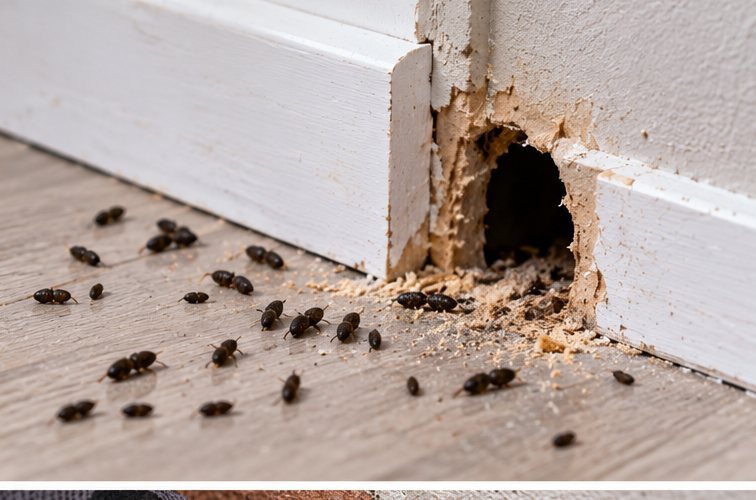
Photographs on this page are for illustration purposes only.
Where they get in
In a commercial kitchen it is almost never the front door.
- The gap under the delivery or fire door, and the door propped open during service.
- Service ducts and the riser, particularly in a building shared with other units.
- The void above a suspended ceiling, which usually runs over more than one tenancy.
- Extract and ventilation penetrations through an external wall, sealed around the duct or not.
- The bin store, which is the food source rather than the entry, and is often the actual cause.
Where they live once inside
Behind and under the equipment. The void behind a stainless bench, the cavity under a cold room, the space behind a dishwasher or an ice machine, the base of a fitted counter, and inside the boxing around pipework.
All of those are warm, undisturbed and unreachable during a normal clean, which is why a kitchen can be spotless to look at and still have a population in it. When somebody tells you it is a cleaning problem, this is the thing they have not understood.
A 450mm inspection gap around the perimeter of a store room, and equipment that can be pulled out or is sealed to the floor, are worth more than any amount of additional cleaning.
How the visit is run
We work around trading hours, including late evenings and weekends, because taking a kitchen out of service is the real cost.
Ask for what was found, what was done and what proofing is completed or outstanding in writing, with dates, and keep it in your due-diligence file. Say when you book that you need it and who it is for.
Where the finding is structural — a duct, a door, a shared ceiling void — we will say so, including when the fix belongs to your landlord. That is usually the thing that gets it dealt with.
Before you book
Short Answers
We have an inspection this week. What can you do?
Attend quickly, survey, treat and proof what can be proofed on the day. Ask for it in writing and we will set out what was found, what was done and what is outstanding. Being able to show a competent response in progress is what matters.
The problem is coming from the unit next door. What then?
We put that in writing, which is what a landlord or managing agent needs in order to act. In a shared building with a common ceiling void or riser, treating one unit alone rarely holds.
Tell Us Where You Are Finding Them
Where the droppings are, where you hear them at night, whether anything has been gnawed, and whether it is a home or a business.
Get in touch
Book a Mice Control Visit
Tell us where you are finding droppings, where you hear them, and whether it is a home or a business. If anything has been gnawed, say what and where — it tells us which route they are using.
- Phone
- 01908 465226
- Message us on WhatsApp
- sales@miltonkeynespestcontroller.co.uk
- Milton Keynes Pest Controller Service
- Address
- South Row
Milton Keynes
MK9 3DQ - Covering
- Milton Keynes, Buckinghamshire, Bedfordshire and parts of Hertfordshire