

Home › Drain Rat Blockers › The Interceptor Trap
Older systems
The Interceptor Trap
Victorian drainage already had an answer to this. On most properties it stopped working decades ago and nobody noticed.
What it is
A Water Seal at the Boundary
On property built roughly between the 1870s and the 1950s, the last chamber before the boundary very often contains an interceptor trap: a U-shaped bend built into the outgoing pipe, holding a permanent plug of water.
It was installed to do two things. Stop foul air from the sewer reaching the house, and stop sewer rats travelling up into private drainage. Victorian engineers understood the rat problem perfectly well and designed it out.
Beside it there is usually a rodding arm, a short branch angled back towards the sewer with a stopper in it, so the run could be rodded through without disturbing the trap.
Why it stopped working
Three Ways, All Common
The stopper is missing. This is the classic. The rodding arm was opened at some point — to clear a blockage, decades ago — and the stopper was never replaced, or was replaced with something that has since perished. That leaves a permanently open pipe bypassing the trap entirely, pointing straight at the sewer. It is the single most common drain rat route on older property and it is invisible unless you lift the cover and look.
The trap is broken. Rodding through a trap with force cracks it, and a cracked trap holds no water.
It has been deliberately removed. Interceptors block easily and many were taken out in the twentieth century for exactly that reason. That is a defensible engineering decision; the problem is that the rat defence went with it and usually nothing replaced it.
Why a broken one is worse than none
It Reassures You
A property with no interceptor has a known condition: the drainage is open to the sewer, and if rats become a problem you fit a blocker.
A property with a broken interceptor looks protected. The chamber has a trap in it, somebody once mentioned it, and everyone assumes the route is closed. Meanwhile an open rodding arm has been pointing at the sewer since 1978.
It also breaks the diagnosis. People rule out drainage because "we've got an interceptor", and go looking for holes in the brickwork that are not there.
So on any older property the first thing worth doing is lifting the last chamber and looking at the state of it — is there a trap, does it hold water, and is there a stopper in the rodding arm.
What to do about it
Stopper, Blocker, or Both
If the rodding arm is simply open, the cheapest fix in this entire subject is a new stopper. It is a few pounds' worth of fitting and it closes a route that has been open for decades. Worth checking before anything else is considered.
If the trap itself is broken, replacing it is drainage work and it is not always worth doing — interceptors block, and a modern non-return valve does the rat job better with less nuisance.
If it has been removed, a blocker is the direct modern equivalent, and it is the sensible answer.
In all three cases the valve goes in the same place the Victorians put their trap, for the same reason: it is the last point you control before the system stops being yours.
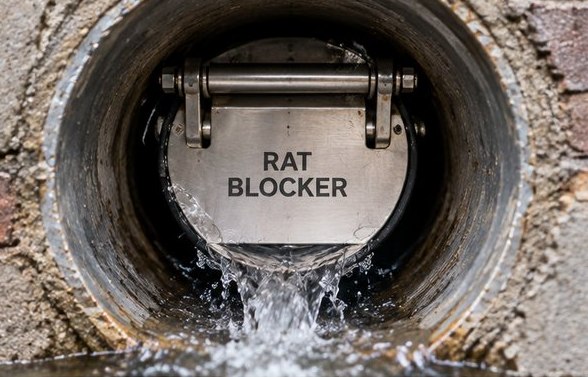
Images on this page are illustrations only.
Short answers
Drain Blocker Questions
What is an interceptor trap?
A U-bend built into the outgoing pipe at the last chamber on older property, holding a water seal to stop sewer gases and sewer rats.
How do I know if I have one?
Lift the last chamber before the boundary and look. There will be a trap in the outgoing pipe and usually a rodding arm beside it.
Why would a broken one be worse than none?
Because it reassures you. People rule out drainage on the strength of having a trap, while an open rodding arm points at the sewer.
The rodding arm has no stopper.
That is the commonest drain rat route on older property, and a new stopper is the cheapest fix in the whole subject.
Should I replace a broken interceptor?
Not necessarily. Interceptors block easily, and a modern non-return valve does the rat job better with less nuisance.
Where does a blocker go on an older system?
The same place the Victorians put the trap - the last point you control before the system stops being yours.
Going further
Drain and Rat Guides
Where we cover
Drain Rat Blockers Across the Area
Across Buckinghamshire, Bedfordshire and into Hertfordshire. Houses, flats, managed blocks, yards and food premises — survey, sizing and installation.
Not Sure It Is the Drains?
Describe what you are hearing and where. If it points somewhere else we will say so.
Get in touch
Book an Ant Treatment
Tell us what you are hearing or finding, and roughly where in the building.
- Phone
- 01908 465226
- Message us on WhatsApp
- sales@miltonkeynespestcontroller.co.uk
- Milton Keynes Pest Controller Service
- Address
- South Row
Milton Keynes
MK9 3DQ - Covering
- Milton Keynes, Buckinghamshire, Bedfordshire and parts of Hertfordshire