
Home › Drain Rat Blockers › How a Blocker Works
The product
How a Blocker Works
One hinged flap, no moving parts worth the name, and two ways to get it wrong.
The mechanism
A Flap That Only Opens One Way
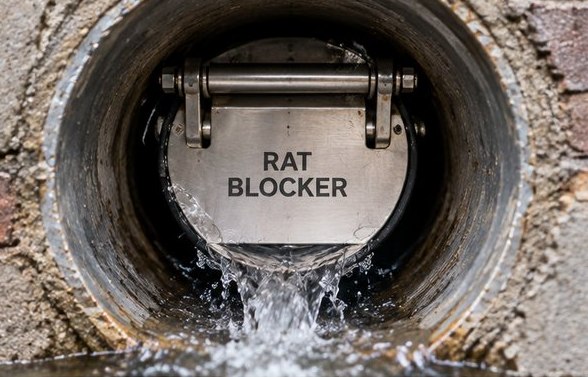
A drain rat blocker is a non-return valve: a circular flap hinged at the top of the pipe, hanging closed under its own weight.
Waste flowing out of your property pushes against the back of it, swings it open and passes underneath. When flow stops, it falls shut. Anything travelling the other way — up from the sewer — pushes it against its seat and closes it harder the more it pushes.
That is the whole thing. No power, no chemicals, no springs to tire, nothing that has to be reset, and nothing that can be triggered at the wrong moment. Its simplicity is the reason it is a permanent answer rather than a treatment.
Images on this page are illustrations only.
What it is made of
Stainless, Mostly
The good ones are stainless steel — the flap, the frame and the hinge pin — because a drain is a permanently wet, mildly corrosive environment with grit moving through it. Heavy-grade PVC versions exist and have their place, particularly in smaller domestic pipe.
What matters more than the material is the hinge. It is the only part that moves and it is the only part that can seize or wear, so a generously made pin and bearing in stainless is what separates a fitting that lasts years from one that sticks.
A stuck-open valve stops working. A stuck-shut valve is worse, because it blocks your drain, and that is the failure mode worth paying to avoid.
Where it goes
The Last Chamber Before the Boundary
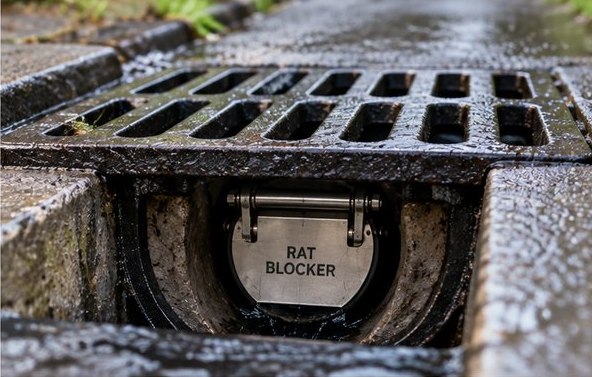
The standard position is the outgoing pipe of the last inspection chamber on your property, before the run leaves your boundary.
That placement does two things. Everything downstream of the flap — the lateral drain, the sewer, the whole network — is on the far side of a closed valve. And everything upstream is still accessible from a chamber you own, for rodding, for inspection and for the valve itself.
On a property sharing a run with neighbours, the blocker goes into your own branch before it joins, rather than into the shared pipe, which is not yours to fit anything into.
What it must never do is sit where it cannot be reached. A valve buried under a patio, or fitted into a run with no chamber, is a future problem rather than a solution.
Images on this page are illustrations only.
The two ways it goes wrong
Size and Position
The live page says this plainly and it is worth repeating: installing the wrong size, or placing it incorrectly, can cause drainage problems or leave a gap for rats to get round.
Wrong size. Too large and it will not seat, so it never fully closes. Too small and there is an annulus round the outside — a gap between the valve body and the pipe wall — which a rat will use, because a rat only needs the width of its skull. UK domestic drainage is usually 100mm or 110mm and the difference matters.
Wrong position. Fitted where the pipe is not straight, or where flow is turbulent, or where the fall is steep enough that the flap chatters, and it will not seat cleanly. Fitted downstream of a junction and it may close off something it should not.
Neither failure is visible from the surface. The drain looks normal, the valve looks fitted, and the rats carry on.
Living with one
What Changes Afterwards
Almost nothing, which is the point.
Flow out is unaffected, so sinks, baths and toilets behave exactly as before. There is no smell, because the valve is below water level in a system that already has traps. There is nothing to service and nothing to replace.
The one thing worth knowing is where it is. If you ever have the drains rodded or jetted, tell whoever is doing it that there is a non-return valve in the run and roughly where — a drainage engineer will work around it happily, and will be irritated to find it by hitting it.
It is also worth lifting the chamber once a year and glancing at it, in the same spirit as checking a smoke alarm.
Short answers
Drain Blocker Questions
How does a drain blocker work?
It is a flap hinged at the top of the pipe. Flow out pushes it open; anything coming back pushes it shut. No power, no chemicals, nothing to reset.
What is it made of?
Usually stainless steel, sometimes heavy PVC. The hinge matters more than the material, because it is the only part that moves.
Where does it go?
In the outgoing pipe of the last inspection chamber on your property, before the run leaves the boundary.
Will it affect my drains?
A correctly sized and placed one will not. Flow out is unaffected and there is nothing to service.
What if the size is wrong?
Too big and it does not seat; too small and there is a gap round the outside that a rat will use. Neither is visible from the surface.
Do I need to do anything to it?
Effectively nothing. Lift the chamber and glance at it once a year, and tell anyone rodding the drains that it is there.
Going further
Drain and Rat Guides
Where we cover
Drain Rat Blockers Across the Area
Across Buckinghamshire, Bedfordshire and into Hertfordshire. Houses, flats, managed blocks, yards and food premises — survey, sizing and installation.
Not Sure It Is the Drains?
Describe what you are hearing and where. If it points somewhere else we will say so.
Get in touch
Book an Ant Treatment
Tell us what you are hearing or finding, and roughly where in the building.
- Phone
- 01908 465226
- Message us on WhatsApp
- sales@miltonkeynespestcontroller.co.uk
- Milton Keynes Pest Controller Service
- Address
- South Row
Milton Keynes
MK9 3DQ - Covering
- Milton Keynes, Buckinghamshire, Bedfordshire and parts of Hertfordshire