
Home › Drain Rat Blockers › What Else to Seal
Proofing
What Else to Seal
The drain is one route. Here are the others, and the right material for each.
The rule
The Width of Your Thumb
An adult rat gets through a gap of roughly 20 to 25mm — about the width of a thumb — because the skull is the limiting dimension and the rest follows. A young one needs considerably less.
So the survey is not "where are the holes", it is "where are the gaps", and the answer is almost always more places than expected and all of them below waist height.
They also gnaw, so a gap that is currently too small is a gap that can be made bigger. Lead, aluminium, plastic, soft mortar, timber and expanding foam are all workable to a rat. Steel, concrete and hard mortar are not.
Images on this page are illustrations only.
Pipe entries
The Commonest One by a Distance
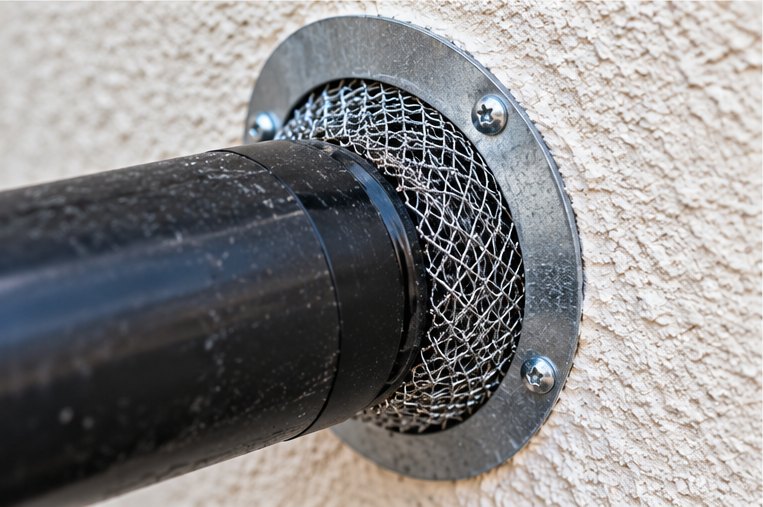
Every soil pipe, waste pipe, gas service, water main, electricity duct and data cable enters the building through a hole, and that hole was made bigger than the pipe. What fills the difference decides whether it is a route.
What is usually there: nothing, or expanding foam, or a collapsed bit of mortar. Foam is the one to look for — it is everywhere, it looks like a repair and it is chewed through easily.
What holds: a mesh collar or a proprietary pipe seal, packed and then sealed, so there is metal in the gap rather than plastic foam.
Check inside as well as out. Under a sink, behind a washing machine and inside a kitchen plinth are where these gaps are visible from the other side, and finding daylight is conclusive.
Airbricks and vents
Mesh Over, Never Fill
Airbricks ventilate the underfloor void and the wall cavity, and they are doing a job. Blocking one causes damp and rot, which is a far more expensive problem than rats.
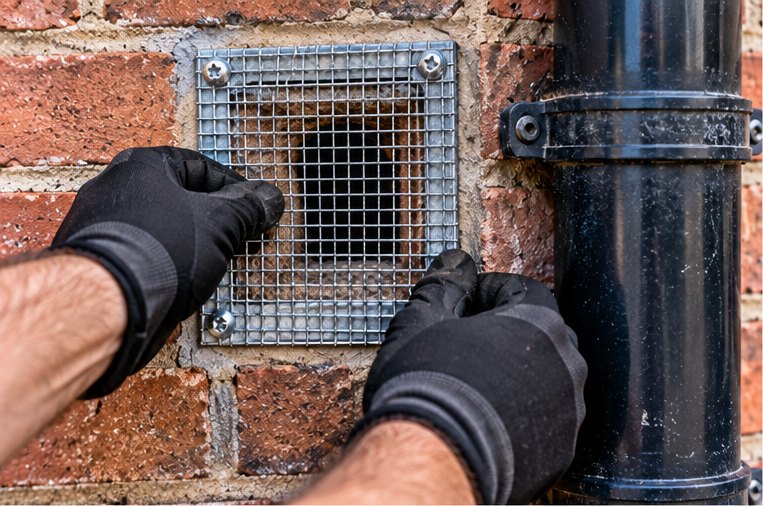
So they get meshed over the outside with stainless mesh, which keeps rodents out and air moving. A cracked or broken airbrick gets replaced rather than patched.
The ones that get missed are behind planting, behind bin stores, under decking and where a path or raised border has been built up against the wall and half-buried them. Those are also the ones most likely to be damaged, because nobody has looked at them in years.
The same applies to any vent: tumble dryer outlets, extract grilles, cooker hood terminals. A guard on the outside, not a bag over it.
Images on this page are illustrations only.
Thresholds, doors and voids
The Rest of the List
- Garage doors. The seal along the bottom perishes and the gap at each corner is usually the biggest opening on the property.
- External door thresholds, particularly on an old or settled frame.
- Where an extension meets the original building, and any void created where two structures were joined.
- Under decking and steps, which is harbourage rather than entry, but it puts them against the wall while they look for one.
- Cavity closers and weep holes — meshed, not filled, same as airbricks.
- Old coal chutes, cellar lights and redundant openings, which are usually covered with something that was never meant to last.
What not to use
Four Things That Do Not Hold
Expanding foam. Chewed through in an evening, it traps moisture, and it looks like a repair so nobody checks it again.
Silicone and mastic. Fine for weather, useless against teeth.
Wire wool on its own. It does work as packing, which is why it is popular, but on its own it rusts away and it needs to be captured by mortar or a mechanical fixing to last.
Anything soft at ground level. Timber fillets, plastic trim and soft mortar are all temporary.
The test is simple: if you could get through it with a penknife in ten minutes, a rat has all night.
Short answers
Drain Blocker Questions
How small a gap can a rat use?
Around 20 to 25mm - the width of a thumb - because the skull is the limiting dimension. A young one needs less.
What is the most common way in?
Where a pipe or a service enters the building. The hole is always bigger than the pipe, and what fills the difference is usually expanding foam.
Can I just block the airbricks?
No. They ventilate the structure and blocking them causes damp. Mesh over the outside instead.
Is expanding foam any good?
No. It is chewed through easily, it traps moisture, and it looks enough like a repair that nobody checks it again.
Does wire wool work?
As packing, yes, but not on its own - it rusts away unless it is captured by mortar or a mechanical fixing.
Where do people usually miss one?
Behind bin stores, under decking, behind planting, and the corners of a garage door seal.
Going further
Drain and Rat Guides
Where we cover
Drain Rat Blockers Across the Area
Across Buckinghamshire, Bedfordshire and into Hertfordshire. Houses, flats, managed blocks, yards and food premises — survey, sizing and installation.
Not Sure It Is the Drains?
Describe what you are hearing and where. If it points somewhere else we will say so.
Get in touch
Book an Ant Treatment
Tell us what you are hearing or finding, and roughly where in the building.
- Phone
- 01908 465226
- Message us on WhatsApp
- sales@miltonkeynespestcontroller.co.uk
- Milton Keynes Pest Controller Service
- Address
- South Row
Milton Keynes
MK9 3DQ - Covering
- Milton Keynes, Buckinghamshire, Bedfordshire and parts of Hertfordshire