
Home › Bed Bug Control › Heat Treatment or Insecticide: Which One?
Bed bug control
Heat Treatment or Insecticide: Which One?
They are not rivals. They suit different rooms, and the thing that separates them is what happens to the eggs.
What heat does
Heat treatment raises the whole room above the temperature bed bugs can survive and holds it there long enough for that temperature to reach into every void, seam and crack. It is a dose rather than a threshold: adults go at around 45°C given long enough, but eggs are the most tolerant stage and need roughly 48°C for about ninety minutes. That is why the room is run hotter still — so the lethal temperature is reached inside a divan base, not just in the air above it.
Its two real advantages follow from that. It reaches places nobody can see or aim at, and it deals with eggs, which means it can finish a job in a single pass. It also leaves no insecticide behind, which matters in a nursery and in accommodation that has to be back in service quickly. What it is not is an easier option for pets and fish: a room at treatment temperature is lethal to them, so tanks, cages and plants come out first. Heat avoids residue, not preparation.
The costs are practical. Nobody can be in the treated area while it runs — for a house that means everyone out, typically four to twelve hours depending on how much is being treated; for a single hotel room it means that room and its immediate neighbours closed for the day rather than the building. Heat-sensitive items, pets and plants come out of the room first, and we provide a preparation checklist so nothing gets caught by it.
There is a full section on the site: bed bug heat treatments.
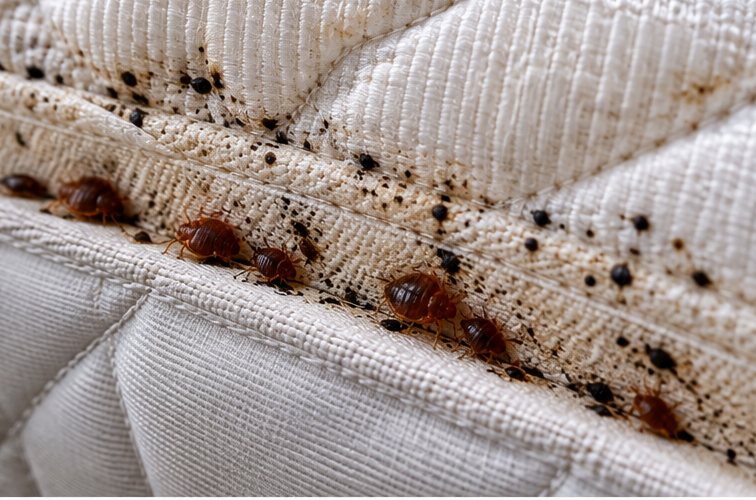
Photographs on this page are for illustration purposes only.
What insecticide does
A professional insecticide treatment is a targeted application to every harbourage the inspection found, left in place so that bugs moving over it afterwards pick it up. Done properly it is thorough and effective, and it does not require the property to be vacated for a day.
It has one honest limitation, which is eggs. Most residual products do not reliably kill them, and an egg cemented into a crack is protected anyway. Bed bug eggs hatch about seven to ten days after laying at room temperature, so a treatment that dealt with everything alive on the day still has a generation arriving the following week.
That is why it is planned as a course, with a follow-up timed to catch what hatches. It is not an upsell and it is not a sign the first visit failed. Anyone offering a single spray as a complete answer is describing something that does not work.
Resistance, and why supermarket sprays disappoint
Bed bug populations in the UK are widely resistant to the pyrethroid insecticides that over-the-counter products are based on. That resistance is real and well documented, and it is the main reason people tell us they sprayed for three weeks and it made no difference.
The second reason is reach. A spray aimed at a mattress surface does not get into the piping, the screw holes or the void behind the skirting, which is where the population actually is.
Foggers and bug bombs are worse than ineffective. They repel, which drives survivors deeper into the structure and out into adjoining rooms, turning a one-room job into a two- or three-room one.
Which one for your room
Broadly: heat suits cluttered or complicated rooms, period property with lots of voids, cases that have been running a long time, situations where no insecticide is wanted, and accommodation that needs turning round fast. Insecticide suits cases caught early, properties where the building will not hold temperature, and jobs where vacating for most of a day is not practical.
Plenty of jobs use both. What decides it is the inspection, which is why we look before quoting a method rather than after.
Before you book
Quick Answers
Does heat treatment damage furniture or electronics?
Most household contents are fine, but some things are not, which is why there is a preparation checklist. Anything heat-sensitive - certain cosmetics, aerosols, candles, vinyl records, some electronics and medicines - comes out of the room beforehand.
Can I stay in the house during an insecticide treatment?
You will need to be out of the treated rooms while the work is done and until surfaces are dry. We give you a time on the day, and it is usually a couple of hours rather than most of one.
Tell Us What You Have Found
Bites, spotting on a mattress seam, or something you have found and cannot identify — tell us what you have seen and where.
Get in touch
Book a Bed Bug Visit
Tell us which rooms are affected, how long it has been going on, and what you have actually found. A photograph of a mattress seam is worth more than any description.
- Phone
- 01908 465226
- Message us on WhatsApp
- sales@miltonkeynespestcontroller.co.uk
- Milton Keynes Pest Controller Service
- Address
- South Row
Milton Keynes
MK9 3DQ - Covering
- Milton Keynes, Buckinghamshire, Bedfordshire and parts of Hertfordshire