
Home › Bed Bug Control › What Bed Bug Eggs and Shed Skins Look Like
Bed bug control
What Bed Bug Eggs and Shed Skins Look Like
Eggs and skins are the two signs that tell you how old the problem is, and they are easier to find than the bugs themselves.
Eggs
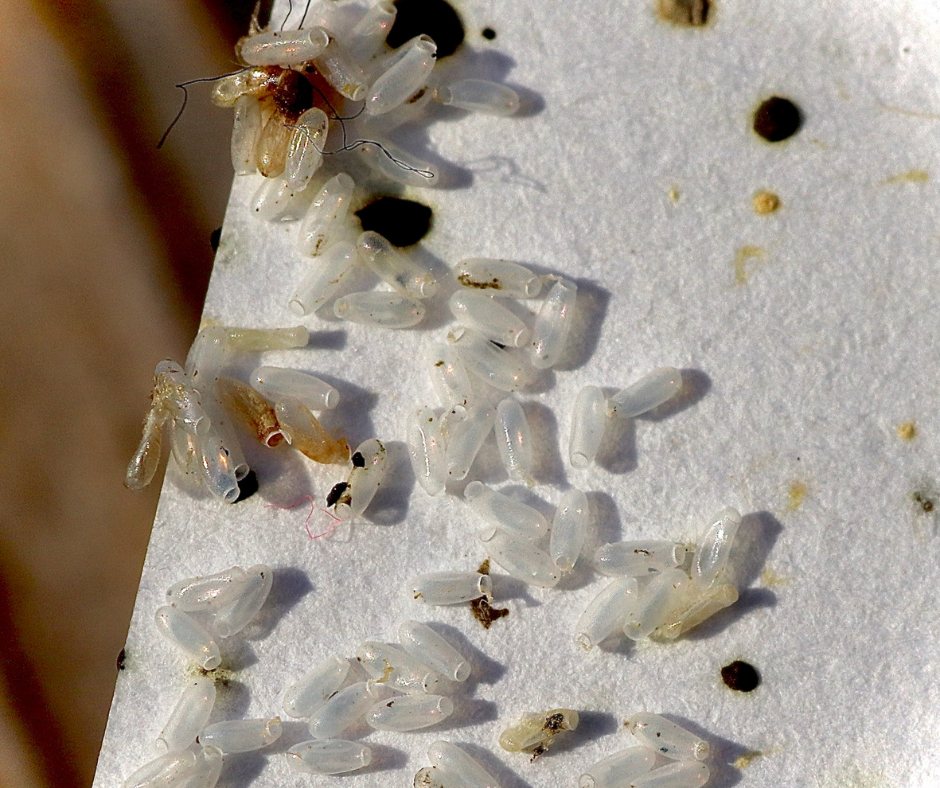
A bed bug egg is about a millimetre long, pearly white and slightly curved, a bit like a very small grain of rice with one rounded end. They are not loose: the female cements them in place, which is why they turn up wedged into a seam, a screw hole or a crack in a frame rather than rolling about on a surface.
They are laid in small batches, so you rarely see one. You see a patch of a dozen or more, usually with faecal spotting nearby, because the female lays where she sits.
In a warm room they hatch in about seven to ten days. In a cool one — and a British bedroom in February is a cool one — it can be a fortnight or more. That interval is the most important number in bed bug treatment, and the next section explains why.
Photographs on this page are for illustration purposes only.
Hatched shells, and why they matter so much
Once an egg hatches, the shell stays cemented in place. It stays pearly white but the top is pushed open, so a cluster of hatched eggs looks like a group of tiny open barrels or funnels.
That is a useful thing to find, because it dates the infestation. A patch of live eggs on its own might only be a few days old. Live eggs and hatched shells together mean eggs have been laid on more than one occasion and at least one batch has come through, so the bed has been in use for a fortnight at the very least and usually a good deal longer. By that point the population is rarely still confined to the mattress.
It also explains why most insecticide treatments are planned as a course. Residual products do not reliably kill eggs, and eggs cemented in a crack are protected. Left alone they hatch about a week later into nymphs that were never exposed to the first treatment. The follow-up visit is timed for exactly that.
Heat is the exception. Eggs are the most heat-tolerant stage and need around 48°C sustained for about ninety minutes, which is exactly what a whole-room heat treatment is designed to deliver — and why it can finish the job in one pass where a spray cannot.
Shed skins
A bed bug grows through five nymphal stages, and it has to take a blood meal before each moult. Every moult leaves an empty skin behind — translucent, straw-coloured, and exactly bug-shaped, with the legs and antennae still attached. People often describe them as looking like the bug but hollow, which is precisely what they are.
Skins are useful for two reasons. First, they persist: a population can be knocked back and the skins stay there, so they tell you the history rather than just the present. Second, their size range tells you about the population. A spread of sizes from about 1.5mm to nearly adult means breeding is established, not that something was carried in last week.
Putting the three together
Spotting alone: something has been feeding there. Spotting and skins: it has been there long enough to moult. Spotting, skins, live eggs and hatched shells across a range of sizes: it is an established, breeding population and it is very unlikely to be confined to the mattress.
You do not need to make that call yourself. Photograph what you find, send it over, and we will tell you what we are looking at. It shapes the inspection before anyone arrives.
Before you book
Quick Answers
Can I just vacuum the eggs off?
Not reliably. They are cemented in place, usually in a crack or a seam, and vacuuming removes some while leaving plenty behind. Vacuuming is useful for reducing numbers before a treatment, not as a treatment.
How many eggs does one bed bug lay?
Published figures put it at roughly one to five a day while she is well fed, and a few hundred over a lifetime. They go down in small batches rather than all at once, which is why a population builds steadily instead of suddenly, and why time is the main thing working against you: the longer it runs, the more of the room is involved.
Tell Us What You Have Found
Bites, spotting on a mattress seam, or something you have found and cannot identify — tell us what you have seen and where.
Get in touch
Book a Bed Bug Visit
Tell us which rooms are affected, how long it has been going on, and what you have actually found. A photograph of a mattress seam is worth more than any description.
- Phone
- 01908 465226
- Message us on WhatsApp
- sales@miltonkeynespestcontroller.co.uk
- Milton Keynes Pest Controller Service
- Address
- South Row
Milton Keynes
MK9 3DQ - Covering
- Milton Keynes, Buckinghamshire, Bedfordshire and parts of Hertfordshire