

Home › Bedbug Heat Treatments › Bed Bug Heat Treatments for HMOs & Landlords
For landlords, agents and HMO operators
Bed Bug Heat Treatments for HMOs & Landlords
In a shared building the room that reported it is rarely the whole problem. Treating one at a time is how it becomes permanent.
The Situation
A house in multiple occupation is one habitat with partitions in it. The occupants are separate households; the bed bugs are not. They move along joist ends and service voids, under skirtings and through the gaps around pipework, and they cross on shared sofas, in shared laundry and on people.
Which is why piecemeal treatment fails here more reliably than anywhere else. Treat room four, and in three weeks room four has it again from room three, which nobody inspected because nobody in room three had complained yet.
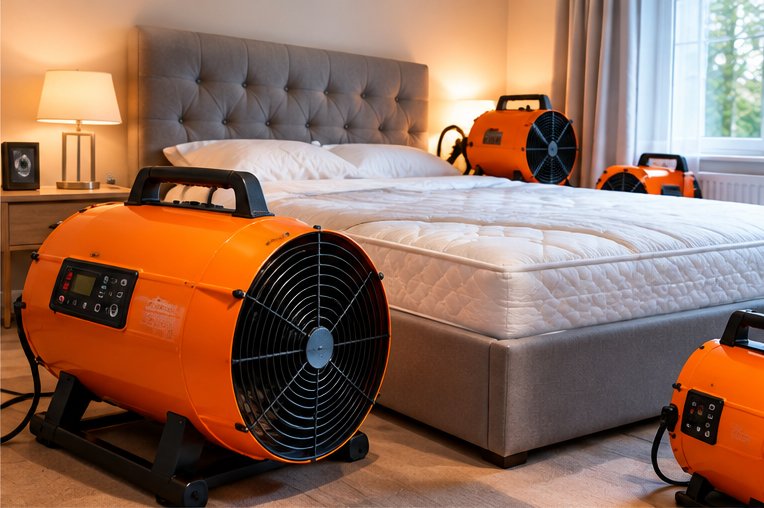
Photographs on this page are for illustration purposes only.
The approach
Inspect the Building, Treat What Is Affected
The method that holds is straightforward and it is not the cheapest first invoice: inspect every room and the communal spaces, establish the actual extent, then treat everything affected in one co-ordinated operation rather than as a series of call-outs.
Communal areas matter more than landlords expect. A shared sofa is a harbourage and a crossing point at the same time; a shared laundry moves infested textiles between rooms; a corridor with a carpet gripper is a route.
Treating rooms that are genuinely clear is money wasted, and we will tell you which they are. Treating one room out of four that are affected is money wasted too, and rather more of it.
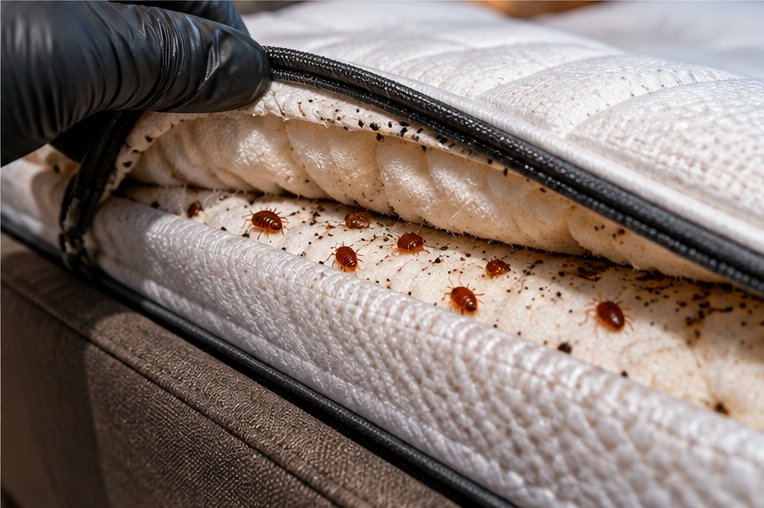
Photographs on this page are for illustration purposes only.
Who pays
Getting It Moving Before It Spreads
The commonest cause of a small HMO problem becoming a large one is the fortnight spent establishing responsibility.
Broadly, a problem arising from the condition of the building tends to sit with the landlord and one arising from how a room is being used tends to sit with the tenant, but the tenancy agreement governs. In an HMO there is a further point: once it is in the communal parts or in more than one room, it is a building problem, and building problems are the landlord's.
We are content to quote to landlord, agent or tenant, and to inspect and report first so that the discussion is about what is actually there rather than what everyone assumes.

Photographs on this page are for illustration purposes only.
Records
What to Keep, and Why
For a licensed HMO, a written record of what was found, what was done and what remains outstanding is worth having on file. It demonstrates that a report was acted on, with dates, which is the thing that matters if a tenant complains to the council or if licensing asks.
Ask for it when you book. It also gives you something concrete to give tenants, which tends to reduce the temperature of the conversation considerably.
Between tenancies, a check of the four usual places at changeover costs nothing and catches things before the next tenant does.
Short answers
Heat Treatment Questions
Can you treat a whole HMO in one operation?
Yes, and in a shared building that is usually the only approach that holds.
Do the communal areas need treating?
Where they are affected, yes. Shared sofas and laundries are common crossing points and are often missed.
Who is responsible, landlord or tenant?
The tenancy agreement governs. Broadly, building condition tends to be the landlord and use of the room tends to be the tenant - but once it is in communal areas or several rooms it is a building problem.
Can we have it in writing?
Yes - what was found, what was done and what is outstanding, with dates.
Do you treat rooms that are clear?
No. We will tell you which rooms are clear and you do not pay to treat them.
Can you work around tenants?
Occupants need to be out of the treatment area while equipment runs. Timing can be planned, and evening and weekend visits are available.
Accommodation and rental property
If You Manage Somewhere People Sleep
The problem is different when the bed is not yours. These set out what changes.
Where we cover
Heat Treatments Across the Area
Across Buckinghamshire, Bedfordshire and into Hertfordshire. Homes, flats, hotels, guest houses, lets and shared accommodation.
Talk to Somebody Who Has Done It Before
No call-out fee, discreet attendance where arranged, and a straight answer about how far it has got.
Get in touch
Book a Heat Treatment
Tell us how many rooms the property has, how many have reported anything, and whether there are shared living areas.
- Phone
- 01908 465226
- Message us on WhatsApp
- sales@miltonkeynespestcontroller.co.uk
- Milton Keynes Pest Controller Service
- Address
- South Row
Milton Keynes
MK9 3DQ - Covering
- Milton Keynes, Buckinghamshire, Bedfordshire and parts of Hertfordshire