
Home › Flea Control › Why You Still See Fleas After the Treatment
Flea control
Why You Still See Fleas After the Treatment
It is the commonest call we get after a flea job, and usually the answer is that it is working.
What is actually happening
The treatment deals with the adults and, over time, with the larvae that move across it. What it cannot do is reach a flea inside its cocoon: the silk casing, matted with fibres and dust, keeps residual insecticide off whatever is inside.
So on the day of the visit, a proportion of the population is sealed away and untouched. Those adults emerge over the following days and weeks, triggered by the warmth, vibration and breath of people moving around the house. They come out onto a treated surface and pick the treatment up.
That is what you are seeing. They are new arrivals walking into the treatment, not survivors of it.
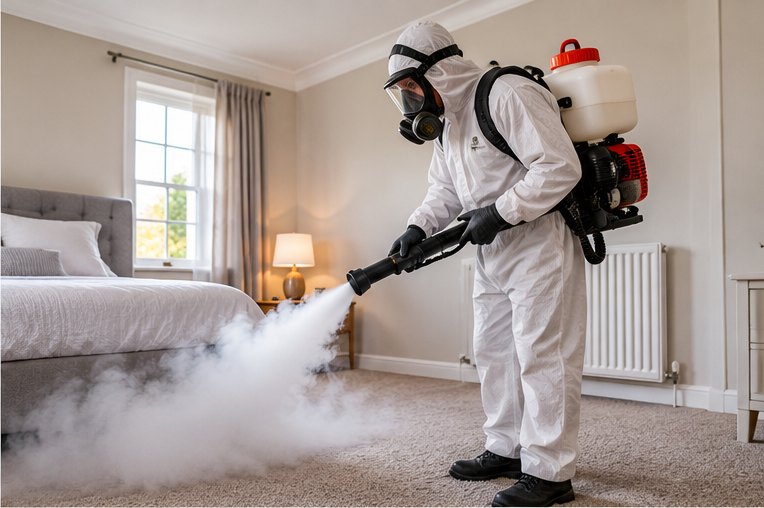
Photographs on this page are for illustration purposes only.
What the pattern should look like
The number to watch is not whether you see a flea. It is whether you see fewer this week than last.
A normal course looks like a noticeable drop straight away, then a tail of occasional sightings that thins out over the following weeks as the cocoons empty. Bites should stop before the sightings do. In a warm house with a light infestation it can be over quickly; in a cool house with a heavy one it runs longer, because the cocoons come out on their own schedule and cold slows everything down.
If you want to speed it up, walk about and vacuum. Both are emergence triggers, and every flea you bring out early is one that meets the treatment while it is fresh.
What actually goes wrong, when something does
When something genuinely has gone wrong it is one of four things, and none of them is the treatment wearing off early.
- The pet was not treated, or its treatment lapsed. New eggs keep arriving. This is the commonest by a long way.
- A room or area was left out. A car boot, a conservatory, a garage the cat sleeps in, an outbuilding, a caravan, or simply a room nobody mentioned.
- Something untreated keeps restocking it. A neighbour's cat using a cat flap, a fox under the decking, a cat or an abandoned bird's nest in the roof space.
- The carpets were shampooed or steam-cleaned after the visit, which lifts the treatment straight back out. Vacuum, do not wash.
When to ring back
Ring if the numbers are not clearly falling after a few weeks, if bites are continuing rather than tailing off, or if the problem has moved to a room that was not affected before.
What is useful when you ring: roughly how many you are seeing and where, whether it is more or fewer than last week, what the pet is on and when it was last treated, and whether anything has been cleaned. That usually identifies which of the four it is without another visit.
Before you book
Quick Answers
How long should I expect to keep seeing them?
The live page puts full effect at a few days as the treatment works through the life cycle. In practice a heavy infestation in a cool house runs longer. What matters is the trend - fewer each week - rather than reaching zero on a particular day.
Can I use a shop-bought spray in the meantime?
Better not to. Many of them repel rather than kill, which pushes fleas away from the treated surfaces and undoes the work. Vacuum instead - it helps rather than interferes.
Tell Us About the Pets and the Rooms
Whether there are pets and what they are on, which rooms are affected, and how long it has been going on.
Get in touch
Book a Flea Treatment
Tell us whether there are pets in the property and what they are on, which rooms are affected, and how long it has been going on. If the property is empty between tenants, say so — that is a different treatment.
- Phone
- 01908 465226
- Message us on WhatsApp
- sales@miltonkeynespestcontroller.co.uk
- Milton Keynes Pest Controller Service
- Address
- South Row
Milton Keynes
MK9 3DQ - Covering
- Milton Keynes, Buckinghamshire, Bedfordshire and parts of Hertfordshire