
Home › Flea Control › The Flea Life Cycle, and Why It Decides Everything
Flea control
The Flea Life Cycle, and Why It Decides Everything
Four stages, and only one of them is the insect anybody ever sees. The other three are why flea jobs go wrong.
Egg
An adult flea feeds on the animal and lays its eggs in its coat. The eggs are pearly, smooth and about half a millimetre, and crucially they do not stick to anything. Within hours they roll off wherever the animal happens to be.
So the eggs end up as a map of the animal's day: its bed, the sofa it is allowed on, the warm spot by the radiator, the stair carpet, the bedroom if it sleeps up there, the boot of the car if it travels. A well-fed female keeps this up steadily, day after day, which is how a small problem becomes a large one in a few weeks.
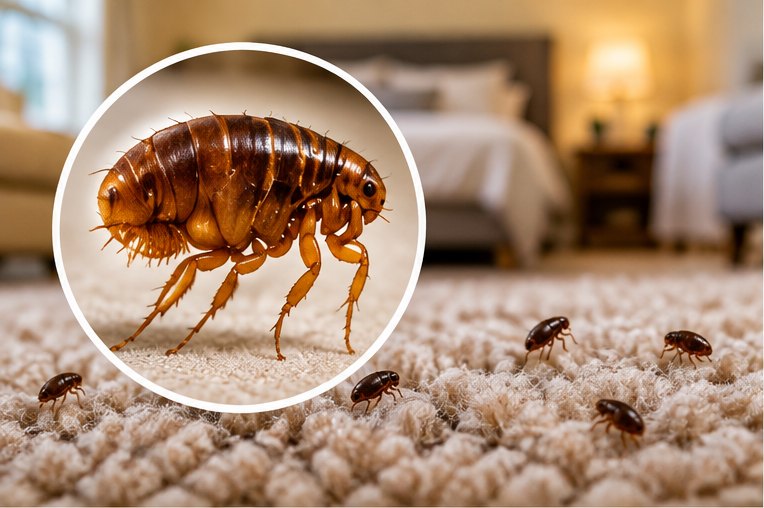
Photographs on this page are for illustration purposes only.
Larva
The eggs hatch into small pale larvae, and the larvae want nothing to do with the pet at all.
They avoid light. They wriggle down to the base of the carpet pile, in under the gripper rail at the skirting, into the gap between floorboards, under a heavy sofa that has not been moved in years, and into the dust beneath a fitted wardrobe. What they eat there is flea dirt — the dried blood that adult fleas pass and that falls off the animal alongside the eggs.
That is the part people find hard to believe and it is the most useful thing to know. The larvae are not on your pet and they are not sitting on the surface of the carpet. They are down in the dark at the edges, which is exactly where a treatment has to go, and deeper than a vacuum reliably reaches.
Pupa — the cocoon, and the whole problem
When the larva is ready it spins a silk cocoon. The silk is sticky, so it immediately picks up carpet fibres, dust and grit until it is camouflaged and effectively part of the floor.
Two things about that cocoon govern how every flea job goes.
First, it is far more resistant to insecticide than any other stage. No treatment available reliably kills a flea inside its cocoon. That is not a shortcoming of one product; it is the stage.
Second, the adult inside does not come out on a timer. It waits for evidence that something worth biting has arrived: vibration through the floor, warmth, and the carbon dioxide of something breathing nearby. With none of those, it can sit there for weeks, and in a cool empty room for considerably longer.
That is why the first person into a house that has stood empty gets swarmed at the ankles, and why fleas appear a few days after a treatment that seemed to have worked.
Adult, and what it means for the treatment
The adult emerges, finds a host, feeds, and starts laying. In a warm house the whole circuit can turn over in a few weeks; in a cold one it stretches out considerably.
Put the four stages together and the arithmetic is uncomfortable: the overwhelming majority of the fleas in a house at any moment are eggs, larvae and cocoons in the floor, not adults on the animal. Treat the animal alone and you are dealing with the visible minority while the supply continues.
Which gives the three rules the rest of these pages keep coming back to. Treat the property as well as the pet. Expect to see fleas for a while afterwards as the cocoons empty. And keep vacuuming, because the vibration brings them out early, into a treatment that is waiting for them.
Before you book
Quick Answers
How long does the whole cycle take?
In a warm house it can turn over in a few weeks. In a cool one it takes considerably longer, mainly because the cocoon stage stretches out. That variability is why nobody can give you an exact date for the last flea.
Do flea eggs stay on the pet?
No, and that is the point. They are smooth and do not stick, so they fall off within hours wherever the animal goes. That is why the carpet, not the animal, is where most of the population ends up.
Tell Us About the Pets and the Rooms
Whether there are pets and what they are on, which rooms are affected, and how long it has been going on.
Get in touch
Book a Flea Treatment
Tell us whether there are pets in the property and what they are on, which rooms are affected, and how long it has been going on. If the property is empty between tenants, say so — that is a different treatment.
- Phone
- 01908 465226
- Message us on WhatsApp
- sales@miltonkeynespestcontroller.co.uk
- Milton Keynes Pest Controller Service
- Address
- South Row
Milton Keynes
MK9 3DQ - Covering
- Milton Keynes, Buckinghamshire, Bedfordshire and parts of Hertfordshire