
Reason one
Resistance Is Real and It Is Specific
Most insecticides sold to the public are pyrethroids. They have been the dominant class for decades, which is exactly why resistance to them is now widespread in the insects people most want to kill — bed bugs in particular, and German cockroaches.
Resistance is not a vague loss of potency. It is specific mechanisms: enzymes that break the compound down faster, and changes at the nerve-channel site the compound acts on. A resistant bed bug is not slightly harder to kill with a pyrethroid; it may be substantially unaffected.
This is why professional treatment is not simply a stronger version of the same tin. It is a different approach — different actives, applied where the insects actually harbour, or heat, which nothing can develop resistance to because it is physics.
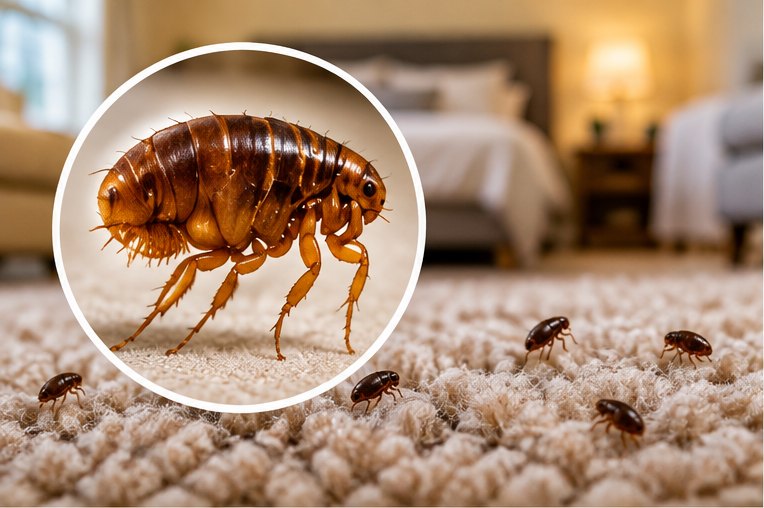
Photographs on this page are for illustration purposes only.
Reason two
Repellent Is the Opposite of What You Want
This one causes more damage than any other, and it is invisible to the person doing it.
A lot of consumer products repel. For a wandering insect in an open room, repelling is fine. For a social insect with a nest, it is actively harmful, because it breaks the one mechanism that would have solved the problem.
Ant bait works because foragers carry it home and share it with the colony and the queen. Spray a repellent on the trail and the foragers stop using that route, the bait never gets carried anywhere, and the trail reappears somewhere you have not found. With pharaoh ants it is worse: the colony responds by splitting, and one problem becomes several in different parts of the building.
Cockroaches do the same — disturbed by a repellent they disperse deeper into voids and through a building. Bed bugs disturbed by a spray move to the next room, which is how a one-bedroom problem becomes a three-room one.
Reason three
Dose and Placement Do the Work
A foggers-and-bombs product fills a room with a mist that settles on horizontal surfaces. Almost nothing lives on horizontal surfaces in the open. Fleas are down in the carpet pile; bed bugs are in seams and behind the headboard; cockroaches are behind and under the appliances. The product goes where they are not.
Placement is most of professional work. A flea treatment has to reach into the pile and stay there long enough to catch the next generation emerging from pupae, because pupae are the resistant stage and nothing kills them reliably. Rodent bait has to be in the run the animal already uses, in a box a child or a dog cannot open. Ant bait has to be on the trail and nowhere else.
Doing too little is the common failure. Doing far too much is the one that ends up as a safety problem — repeated heavy application by someone working from the back of a packet, in a house with children and pets in it, is genuinely higher risk than a technician doing it once.
The other side
Four Jobs Where DIY Is the Right Call
Not everything needs a visit, and pretending otherwise is not honest.
- Proofing. Closing gaps with wire wool, mesh or mortar is straightforward, and doing it yourself in October is the single most useful thing on this page.
- Cleaning an ant trail off a worktop. Hot soapy water or a detergent spray removes the pheromone. It clears the surface and tells you where they re-form, which is useful information. It is not a treatment.
- Vacuuming, for fleas and carpet moths. Thorough, frequent vacuuming genuinely removes eggs and larvae and helps a treatment work. Empty it outside.
- A spring wasp nest, small and reachable from the ground. In April it is one queen and no workers.
The pattern: physical jobs are fine to do yourself. It is chemical ones, and anything involving a nest with defenders in it, where doing it yourself tends to cost more than it saves.
Short answers
Questions, Briefly
Are professional products just stronger?
Not really - the difference is which product, where it goes, and how much. A lot of professional work is placement rather than potency.
Why did my flea bomb not work?
Foggers settle on open horizontal surfaces. Fleas are down in the carpet pile, and the pupal stage is highly resistant to insecticide regardless.
Is it bad to spray an ant trail?
If the product repels, yes. It stops the foragers carrying bait back to the nest and moves the trail somewhere you have not found. Cleaning the trail off with hot soapy water is fine.
What can I safely do myself?
Proofing gaps, vacuuming thoroughly, cleaning trails off surfaces, and knocking down a small spring wasp nest you can reach safely from the ground.
I have already used something. Does that matter?
Tell us what and where. It changes what the technician expects to find - particularly if it was a repellent.
Ring and Describe It
No call-out fee, same-day appointments where we can, and evenings and weekends.
Get in touch
Ask Us About It
Tell us what you have seen and where in the property. If you have a photograph, it is worth more than a description.
- Phone
- 01908 465226
- Message us on WhatsApp
- sales@miltonkeynespestcontroller.co.uk
- Milton Keynes Pest Controller Service
- Address
- South Row
Milton Keynes
MK9 3DQ - Covering
- Milton Keynes, Buckinghamshire, Bedfordshire and parts of Hertfordshire